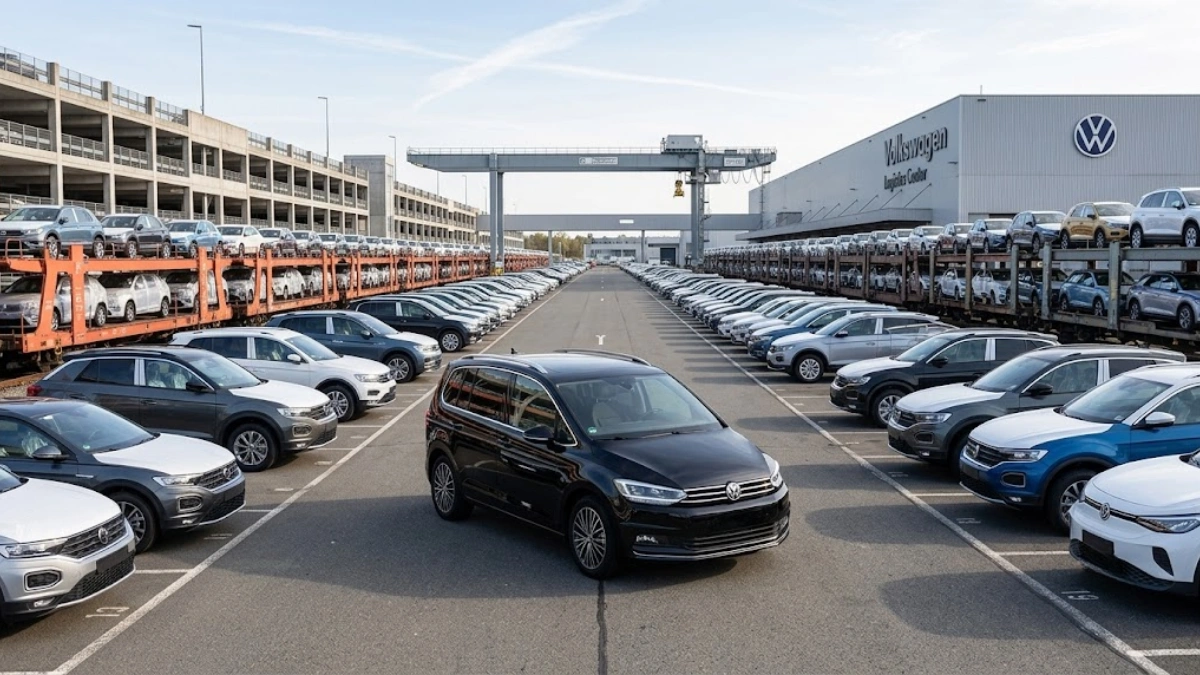
Volkswagen Announces 50% Reduction In Global Car Line-up
- Cars
- Published: 14 Jul, 2026
- Updated: 13 Aug, 2026
Book a Test Drive
Free doorstep test drive at your convenience
Volkswagen Group has confirmed one of the biggest restructuring moves in its history. On July 9, 2026, the German automotive giant's Executive Board announced a sweeping plan to cut its global model portfolio by up to 50 percent by 2030, alongside a 75 percent reduction in equipment, trim, and powertrain complexity. The move marks one of the most aggressive consolidation efforts ever undertaken by a major carmaker and signals a fundamental shift in how Volkswagen plans to compete in an increasingly volatile global auto market.
Quick Summary
- Volkswagen Group will eliminate up to 50% of its current vehicle nameplates across all 10 of its brands by 2030.
- The number of available trims, equipment packages, and powertrain options will shrink by up to 75%.
- Annual production capacity will be resized from roughly 12 million vehicles to about 9 million, closer to what the Group actually delivered in 2024 and 2025.
- The company has not officially named specific models for discontinuation, though several outlets have reported on internal lists.
- The plan is driven largely by steep sales declines in China, falling global deliveries, and shrinking profit margins.
- Reports suggest the restructuring could involve up to 100,000 job cuts and the closure of up to four German manufacturing plants.
Why Is Volkswagen Cutting Half Its Lineup?
Volkswagen's decision comes against the backdrop of serious financial pressure. According to the company, the Group's Chinese deliveries fell 14.8 percent in the first quarter of 2026 and a steep 36.6 percent in the second quarter, while worldwide deliveries dropped 8.6 percent in Q2 alone. First-quarter net profit was also down 28 percent year-on-year. Chinese electric vehicle makers have been outpacing Volkswagen with faster innovation cycles and more competitively priced EVs, eroding the brand's traditional strongholds.
CFO Arno Antlitz explained that the company can no longer rely on incremental cost-saving measures and must instead pursue a fundamental realignment of its business model to achieve lasting structural improvements. CEO Oliver Blume framed the plan around a clear long-term goal: making Volkswagen Group the world's most attractive automotive company by 2030, built on iconic brands, strong products, leading technology, and reliable financial performance.
What Exactly Is Changing?
1. Fewer Models Across All Brands
Volkswagen Group owns 10 brands, including Volkswagen, Audi, Porsche, Bentley, Lamborghini, Skoda, Cupra, SEAT, and the upcoming American brand Scout. Over the years, this multi-brand structure has led to significant overlap, with different brands often engineering similar vehicles for the same customer segments. The company now wants to eliminate these "parallel structures" and concentrate resources on the most attractive, highest-margin market segments.
2. Drastically Simplified Options
Perhaps the more immediately impactful change for buyers is the planned 75 percent cut in powertrain, trim, and equipment-package complexity. Rather than offering dozens of configuration choices per model, Volkswagen wants to streamline its lineup into fewer, more clearly defined trims. This should lower engineering and manufacturing costs, but it may also mean fewer ways for customers to customize a vehicle exactly the way they want it.
3. Reduced Manufacturing Capacity
Volkswagen plans to bring annual production capacity down from around 12 million vehicles to approximately 9 million — a figure that roughly matches what the Group actually delivered in both 2024 and 2025. This right-sizing is meant to better align factory output with real-world demand rather than idle, underused capacity.
4. Workforce and Plant Restructuring
While the official statement stopped short of confirming plant closures or layoffs, multiple reports indicate Volkswagen is considering as many as 100,000 job cuts and the closure of up to four plants in Germany, potentially including facilities such as Zwickau, Emden, Hanover, and Neckarsulm. If confirmed, this would represent the largest restructuring in the history of the auto industry.
Which Volkswagen Models Could Be Discontinued?
Volkswagen has not released an official list of models being axed. The company has said only that its future lineup will be "concentrated on the most attractive market segments," with spending redirected toward products and technologies that deliver the greatest value to customers and to the Group itself.
That said, several media reports have speculated on likely candidates based on sales performance, brand overlap, and prior discontinuation signals:
· Volkswagen brand: Slow-selling models in Europe, such as the Touran, alongside nameplates like the Jetta, have been flagged in preliminary reports (notably by German newspaper Bild) as vulnerable, though this is not confirmed by VW itself.
· Skoda: Expected to emerge relatively unscathed, though low-volume models like the Scala hatchback face uncertain futures.
· SEAT: Likely to remain a small, budget-focused brand with a limited range.
· Cupra: Could see a larger cut, ironically because of its more premium, performance-oriented positioning, which may increasingly overlap with SEAT and other Group offerings.
· Audi: Has already discontinued the A1 subcompact and Q2 small SUV, shifting entry-level duties to the upcoming A2 e-tron. Its Sportback coupe-SUV variants and the ageing A8 flagship are considered at risk of further pruning.
· Porsche: The gas-powered 718 Boxster and Cayman reportedly ended production, and the combustion-engine Macan is being phased out. Wagon-bodied Taycan variants, including the Cross Turismo and Sport Turismo, are also considered vulnerable, while core models like the 911, Cayenne, and Macan (in its newer form) are expected to remain safe.
· Bentley and Lamborghini: Seen as the least exposed to cuts, since their business model already depends on the kind of low-volume, high-margin variant complexity that the plan targets elsewhere in the Group.
It's worth noting that much of this remains speculative reporting rather than confirmed company policy, and Volkswagen has explicitly stated that the 50 percent figure is a ceiling and a long-term trajectory rather than a fixed, finalized list of cuts.
How Will This Affect Buyers in Different Markets?
Europe
Europe is likely to see the most visible impact, since many of the models considered highest-risk — such as the Polo, T-Cross, Touran, and various Skoda and Cupra models — are sold predominantly or exclusively in that region.
United States
For American buyers, the direct effect is expected to be more limited. Volkswagen's US lineup is already fairly focused, built around high-volume models like the Atlas, Atlas Cross Sport, Tiguan, Taos, and the Jetta sedan. These core, high-demand models are considered more likely to survive than low-volume global nameplates that overlap with other options within the Group. The more likely US impact is a thinning of Audi trim walks and Porsche body-style variants, rather than the disappearance of mainstream nameplates. Locally built vehicles, including those from Volkswagen's Chattanooga plant and the upcoming Scout factory in South Carolina, may also become strategically more valuable in a tariff-sensitive market.
India and Other Emerging Markets
While the announcement is primarily a global restructuring plan centered on Volkswagen's core European and Chinese operations, any resulting shift in platform investment, powertrain strategy, or model prioritization could eventually influence which vehicles Volkswagen chooses to develop, localize, or export to markets like India in the coming years.
What Does This Mean for Car Buyers Going Forward?
· Fewer choices, but simpler decisions: With fewer trims and powertrain combinations, choosing a Volkswagen Group vehicle could become simpler, even if it means less granular customization.
· Possible price shifts: Cutting the least expensive trims or standalone options could push buyers toward higher-priced packages to get the features they want, even as the company frames the changes as cost improvements.
· Longer gaps between niche products: Wagons, small hatchbacks, coupes, and other niche body styles, already difficult business cases in several markets — may see longer gaps between generations or be discontinued altogether.
· Stronger focus on core segments: Expect continued and possibly increased investment in high-volume, high-margin segments like SUVs and premium crossovers, which already anchor Volkswagen Group's most profitable markets.
Volkswagen's Long-Term Vision
CEO Oliver Blume has been direct about the scale of ambition behind this plan, stating that the Group's goal by 2030 is to become the most attractive automotive company in the world, built on iconic brands, compelling products, leading technology, strong financial results, dependable capital market performance, and a unified team culture across its brands.
Volkswagen maintains that these changes will be implemented gradually rather than overnight, with the first steps toward reducing product and technology complexity already underway "with immediate effect." The company has emphasized that this restructuring is meant to improve vehicle cost structures without compromising product substance, while significantly reducing overhead costs and accelerating decision-making across its sprawling brand portfolio.
Frequently Asked Questions
When did Volkswagen announce the 50% model lineup cut?
Volkswagen Group's Executive Board announced the plan on July 9, 2026, as part of a broader restructuring strategy addressing financial pressures, particularly steep sales declines in China.
Which Volkswagen models are confirmed to be discontinued?
Volkswagen has not officially named any specific models for discontinuation. Reports from outlets like Bild have speculated about vulnerable nameplates, but the company has only confirmed a percentage-based target, not a finalized product list.
Will this affect Volkswagen buyers in the US?
The impact on the US market is expected to be relatively limited, since Volkswagen's American lineup is already concentrated on high-volume models like the Atlas, Tiguan, Taos, and Jetta. The more likely changes involve reduced Audi trim options and fewer Porsche body-style variants.
Why is Volkswagen cutting its model lineup?
The primary drivers are declining sales in China, falling global deliveries, shrinking profit margins, and the high cost of maintaining overlapping models across Volkswagen's 10 brands.
Will Volkswagen close factories or cut jobs?
While not officially confirmed in the announcement, multiple reports suggest the company is considering up to 100,000 job cuts and the closure of as many as four plants in Germany as part of the broader restructuring.
By when will the 50% reduction take effect?
Volkswagen has framed 2030 as the target year for reaching up to a 50 percent reduction in its global model portfolio, with initial steps toward simplifying its product and technology complexity already underway.
Book a Test Drive
Free doorstep test drive at your convenience
Popular Brands





Latest Car News
Maruti Baleno Facelift Booking Price: Expected Booking Amount, EMI & Loan Calculation
Kia Sorento 6 Seater vs 7 Seater: Which One Should You Choose?
Kia Sorento AI Assistant Explained: Features, Commands, and Indian Language Support
What Is the Difference Between Tata Curvv and New Curvv Series X?
Tata Car Sales August 2026: Model-Wise Sales & Growth Report
Car Sales Report of August 2026: Tata Motors, Maruti, Mahindra Lead Growth
Pajero 2026 vs Fortuner: Which SUV Could Be Better?
Volvo EX90 Booking Price: Expected Booking Amount, EMI & Loan Calculation
Next Generation Tata Nexon 2027: Expected Launch, Price, Design & Features
MG Hector Tomahawk EV Variant-Wise Price & Features Comparison
Maruti Baleno Facelift vs Toyota Glanza: Complete Comparision
Upcoming Cars in September 2026 in India: New Cars, Launch Dates & Expected Prices
MG Hector Hawk SUV vs Tata Harrier: Expected Price, Features & Key Differences
Skoda Superb Diesel in India: Will the Diesel Engine Make a Comeback?
Tata Punch Becomes India's Best-Selling SUV in July 2026 with 21,313 Units Sold
Car Sales Report July 2026: Maruti Remains No.1, Tata, Mahindra & Hyundai Record Strong Growth
Tata Curvv EV Discount August 2026: Save Big with Limited-Time Offers
Kia Sorento Booking in India: Launch Date, Price & Booking Process
Skoda Slavia Facelift Launch Date in India
Hyundai Creta Next Gen Upgrades: Biggest Changes Expected