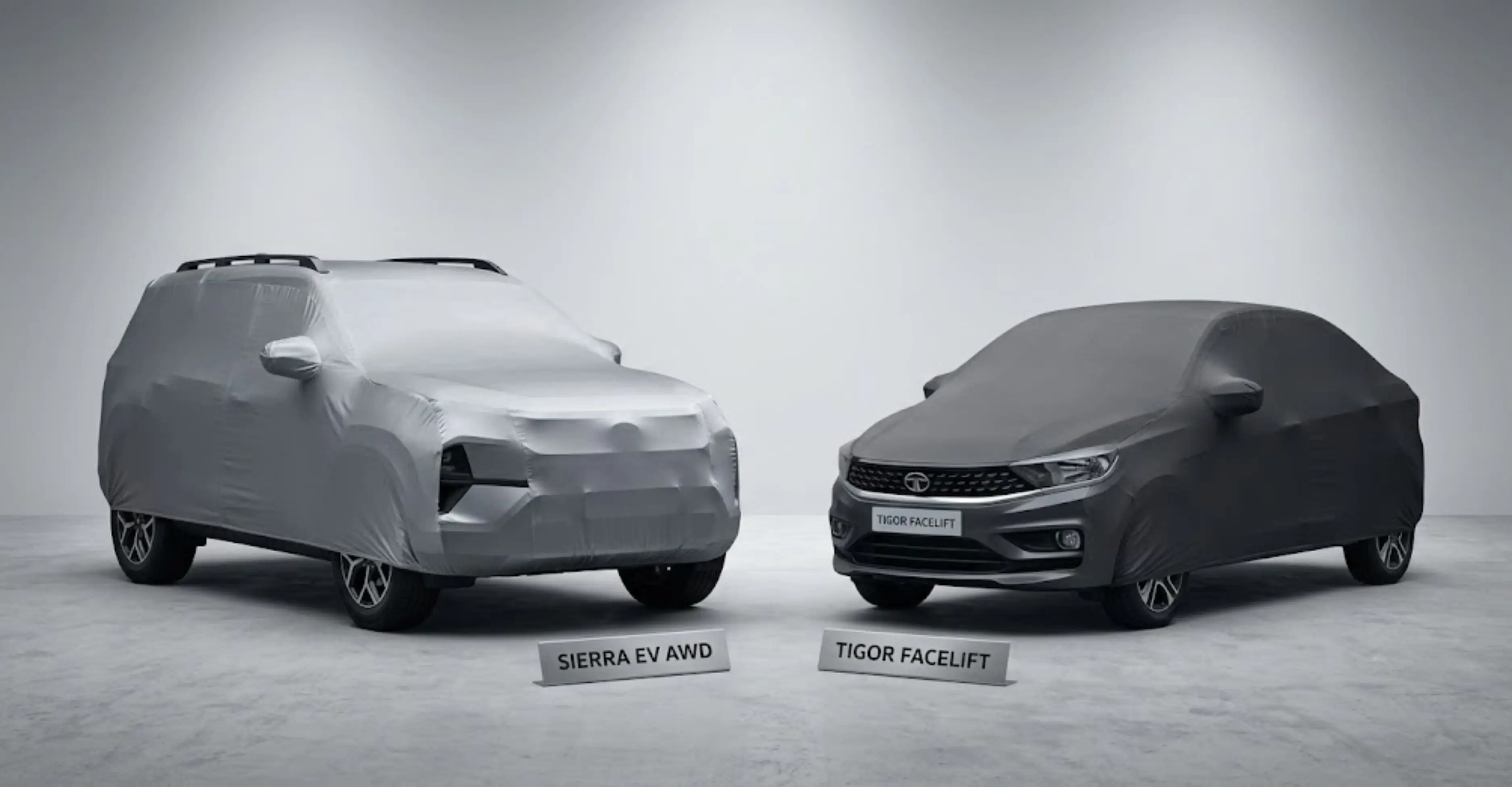
2 New Tata Cars Coming Soon — Sierra EV AWD & Tigor Facelift Leaked
- Cars
- Published: 25 Jun, 2026
Book a Test Drive
Free doorstep test drive at your convenience
Tata Motors is on one of the most remarkable product offensives in its history. Having transformed its brand image over the past five years — from a manufacturer associated with unreliable, outdated products to one of India's most aspirational homegrown automotive brands — the company shows no signs of slowing down. Two upcoming models are generating significant buzz in the Indian automotive community right now: the Sierra EV AWD, the performance-oriented all-wheel-drive variant of the already-anticipated Sierra electric SUV, and the Tigor Facelift, a leaked refresh of Tata's long-running compact sedan.
These two cars couldn't be more different in positioning, price, or purpose — one is a bold statement about where Indian electric vehicles are headed, and the other is a pragmatic refresh of a proven urban workhorse. But together they illustrate the breadth of Tata's ambition in the current market cycle.
Here is everything that has leaked, been confirmed, or can be reasonably inferred about both.
Tata Sierra EV AWD — India's First Premium Electric SUV With All-Wheel Drive
For anyone who grew up in India in the 1990s, the name Sierra carries genuine emotional weight. The original Tata Sierra, produced from 1991 to 2000, was India's first indigenous SUV — a three-door, rear-engined oddity that was unlike anything else on Indian roads at the time. It was flawed in many ways, but it was bold, distinctly Indian, and ahead of its time in attempting to create an SUV for the Indian market before the segment even existed here.
Reviving the Sierra name for a flagship electric SUV is a deliberate, emotionally intelligent decision by Tata. It signals continuity with the company's heritage while simultaneously positioning the new Sierra as a forward-looking, premium product. It is Tata saying, in effect, that the brand has come full circle — from India's first SUV attempt to India's most sophisticated electric SUV.
What Has Been Confirmed
Tata officially showcased the Sierra EV concept at the 2023 Bharat Mobility Global Expo, and the production version has been confirmed for India. The Sierra EV is built on Tata's Gen 2 Electric architecture — the same advanced platform underpinning the Avinya concept and representing a significant step up from the Ziptron technology used in the Nexon EV and Tiago EV. This is a purpose-built EV platform rather than an adaptation of a combustion vehicle architecture, which has profound implications for packaging, range, and performance.
The production Sierra EV is expected to be a five-door SUV in the ₹25–35 lakh price bracket, positioning it above the Nexon EV and directly competing with the MG ZS EV, Hyundai Ioniq 5 (at the lower end of that car's range), and the upcoming Maruti e-Vitara.
The AWD Variant — What Has Leaked
The standard Sierra EV was expected as a single-motor, rear-wheel-drive or front-wheel-drive configuration. What has recently emerged, through leaked regulatory filings, spy shots, and supply chain information, is that Tata is also developing an AWD (All-Wheel Drive) variant that uses a dual-motor setup.
In an AWD electric vehicle, each axle is powered by an independent motor. This delivers several advantages simultaneously, instantaneous torque vectoring between front and rear wheels for superior traction, dramatically improved performance with combined power outputs typically 40–60% higher than the single-motor variant, genuine all-weather and mild off-road capability, and the kind of acceleration that repositions the Sierra EV from a practical family SUV to a performance machine.
Based on leaked specifications and regulatory documents, the Sierra EV AWD is expected to produce in the range of 300-350 bhp combined from its dual motor setup, figures that would make it by far the most powerful Tata vehicle ever sold in the Indian market, and competitive with global performance EVs at significantly higher price points.
Expected Range and Battery
The Gen 2 platform is designed around a larger battery architecture than the current Ziptron-based vehicles. Industry sources and component supply chain reports suggest the Sierra EV will offer a battery pack in the 60-75 kWh range, with the AWD variant likely using the larger end of this range to compensate for the additional power drain of the second motor.
Expected real-world range for the standard Sierra EV is in the 450-500 km bracket on a single charge under Indian driving conditions, a significant step up from the Nexon EV's approximately 300–350 km real-world range. The AWD variant, with its higher power output and additional motor weight, will likely see a modest range reduction to approximately 400-440 km, which is still class-competitive for the price segment.
Fast charging capability on the Gen 2 platform is expected to support DC fast charging at 100 kW or higher, meaning an 80% charge from near-empty in approximately 40-45 minutes, which begins to make long-distance EV travel genuinely practical in India as the charging network continues expanding.
Design - What the Leaks and Concept Suggest
The Sierra EV concept shown at the Bharat Mobility Expo was striking — one of the most cohesive and purposeful design statements Tata has ever made. The production version is expected to retain the concept's key proportions: a boxy, upright SUV silhouette that pays homage to the original Sierra's distinctive shape, with modern surfacing and an EV-specific front fascia featuring a sealed grille and distinctive LED light signatures.
Leaked production spy shots show a vehicle that is close in proportion to the concept — encouraging news, as the distance between Indian concept cars and their production versions has historically been large. The profile features a strong shoulder line, a nearly vertical tailgate reminiscent of the original Sierra, and a roof profile that prioritises rear headroom — important for a five-seater family SUV.
The AWD variant is expected to be visually distinguished from the standard Sierra EV through unique badging, a slightly more aggressive front bumper treatment, larger wheel arch cladding, and dedicated AWD-spec alloy wheel designs.
Interior and Technology
Tata's recent interiors — in the Harrier facelift, Safari facelift, and Punch EV — have demonstrated a significant leap in quality and perceived premium feel compared to earlier Tata products. The Sierra EV is expected to take this further, targeting a genuinely premium cabin experience appropriate for the ₹30 lakh-plus price bracket.
Expected interior highlights based on leaks and Tata's stated product direction include a large panoramic sunroof, a floating dual-screen setup combining a digital instrument cluster and a central touchscreen infotainment unit, ventilated front seats, a flat floor enabled by the skateboard-style EV platform, and a full suite of ADAS (Advanced Driver Assistance Systems) features including adaptive cruise control, lane keep assist, and autonomous emergency braking.
The AWD variant will likely add performance-specific interior elements — a sportier steering wheel, paddle shifters for regenerative braking adjustment, and performance drive mode displays.
Expected Launch Timeline and Price
Tata has not officially confirmed a launch date for the Sierra EV, but industry tracking and dealer network briefings point to a 2025 launch for the standard variant, with the AWD variant following 6 to 12 months later — likely in late 2025 or early 2026. This is consistent with Tata's typical pattern of launching a single-motor variant first and following with a performance variant after establishing the model.
Expected pricing:
- Sierra EV Standard (Single Motor): ₹24–28 lakh (ex-showroom)
- Sierra EV AWD (Dual Motor): ₹32–38 lakh (ex-showroom)
At these prices, the Sierra EV AWD would represent genuinely unprecedented value in the Indian performance EV segment — a dual-motor, 300+ bhp electric SUV for under ₹40 lakh is a product that does not currently exist in India.
Why the Sierra EV AWD Matters
The significance of the Sierra EV AWD extends beyond its specifications. It represents a psychological threshold being crossed in the Indian EV market — the point where Indian-manufactured electric vehicles move from being practical, economy-focused alternatives to combustion cars into genuine performance and aspiration territory.
Every previous Indian-made EV has been positioned primarily on the axis of economy and environmental responsibility. The Sierra EV AWD is positioned on performance, and it is being positioned there by a homegrown Indian brand. That is a genuinely new thing in the Indian automotive landscape, and its implications for the market's evolution are significant.
Tata Tigor Facelift — The Quiet Refresh of a Silent Workhorse
The Tata Tigor launched in 2017 as a compact sedan — Tata's answer to the Maruti Dzire and Honda Amaze in the sub-₹10 lakh three-box segment. It was the first product of Tata's design renaissance under Pratap Bose, featuring the Impact Design 2.0 language that looked sharper and more contemporary than anything Tata had produced before.
The Tigor has had a complicated commercial life. It has never challenged the Dzire's dominance in the compact sedan segment, but it has maintained a consistent, loyal buyer base — particularly in the fleet and government segments, and among buyers who specifically want a Tata product with a proper sedan body. The Tigor EV, introduced in 2021, gave the nameplate new relevance as India's most affordable electric sedan, and fleet operators — particularly state government taxi schemes and corporate fleets — have adopted it in significant numbers.
The standard petrol Tigor has been due for a significant refresh. Leaked images and regulatory filings suggest that refresh is now imminent.
What Has Leaked
Multiple sets of undisguised spy shots of the Tigor Facelift have emerged, shot both in outdoor test conditions and in what appears to be final pre-production configuration. These images reveal a significantly updated exterior, particularly at the front and rear, along with visible changes to the alloy wheel design and trim level badging.
Front End Changes: The leaked images show a completely redesigned front fascia that brings the Tigor's appearance in line with Tata's current design language — the same family face seen on the Punch facelift, the new Nexon, and the Safari/Harrier facelifts. The headlamp clusters appear to be new units with a more angular, sharper LED design. The front bumper is significantly restyled, with more defined air intakes and a more aggressive lower treatment. The grille is wider and features the current-generation Tata tri-arrow pattern in a more prominent application.
Rear End Changes: The tail lamp cluster appears to have been updated with a new LED light guide design — a connected light bar treatment similar to what Tata has implemented on the Nexon and Punch facelifts. This gives the rear a more premium, contemporary look and better night-time visual differentiation from competing compact sedans.
Alloy Wheels: Higher variants in the leaked images feature new alloy wheel designs — a multi-spoke pattern that looks more upmarket than the current Tigor's offerings. This is a relatively low-cost change that significantly affects the car's perceived value.
Colour Options: New exterior colour options appear in the leaked shots, including what appears to be a new dual-tone roof option — a feature increasingly expected in the compact sedan segment following its introduction on the Dzire and Amaze.
Expected Mechanical Updates
The Tigor Facelift is not expected to receive powertrain changes. The existing 1.2-litre Revotron turbocharged petrol engine producing 86 bhp will likely carry over — it is a BS6 Phase 2 compliant unit that does not require modification for the foreseeable regulatory future.
What is expected is a CNG variant in the facelift lineup — this would be a significant addition. The Maruti Dzire's CNG option is one of the most popular configurations in the compact sedan segment, and the absence of a CNG Tigor has cost Tata meaningful sales volume in the fleet and high-mileage owner segments. Adding CNG to the facelift Tigor would directly address the Dzire's strongest suit and make the Tigor competitive with it in the segment's highest-volume buying scenario.
The Tigor EV powertrain — 74 bhp, 26 kWh battery, approximately 250 km real-world range — is expected to carry over to the facelifted body shell without mechanical changes, though software updates to the energy management system and charging capability may be included.
Expected Interior Updates
The interior is where the Tigor currently feels most dated relative to its competition — the cabin design is from 2017 and shows its age against the current Dzire's significantly refreshed 2024 interior. The facelift is expected to address this substantially.
Leaked information from dealer briefings and component supply chain sources points to a new steering wheel design — the flat-bottom unit from the Punch and Nexon — replacing the current round wheel. A larger touchscreen infotainment unit of 10.25 inches is expected, replacing the current 7-inch unit. The instrument cluster may receive a semi-digital treatment with an analogue-digital hybrid design. Higher variants are expected to gain automatic climate control in place of the current manual AC controls on some trims. Rear AC vents — currently absent — may be added in top variants to address a frequent owner complaint.
The overall cabin material quality is also expected to improve, with softer touch surfaces on the dashboard and door panels and a more premium colour theme in top-spec variants.
Expected Variants and Pricing
The current Tigor is offered in XE, XM, XZ, and XZ+ variants. The facelift is expected to maintain a similar variant structure, possibly consolidating or renaming some trims to align with Tata's updated naming convention (Pure, Smart, Creative, Fearless — as used on the Nexon and Punch).
Current Tigor pricing ranges from approximately ₹6.30 lakh to ₹9.00 lakh (ex-showroom). The facelift, with its enhanced features, is expected to carry a modest price increase of ₹20,000 to ₹40,000 across variants — keeping it competitive with the Dzire while offering Tata's characteristic feature-loading at each price point.
Expected Launch Timeline
Regulatory filings in India require homologation of facelifted vehicles before sale, and the Tigor Facelift's homologation submissions have been spotted in ARAI records — suggesting the car is close to production-ready. Industry sources point to a launch in mid to late 2025, possibly at a major auto show or through a dedicated unveil event consistent with Tata's recent product launch style.
Why the Tigor Facelift Matters
The Tigor Facelift matters for reasons that have less to do with the car itself and more to do with what it signals about Tata's intentions. Tata is currently riding a wave of momentum built on the Nexon, Punch, Harrier, and Safari — all SUVs or tall hatchbacks. The sedan segment has been quietly declining across the industry, and a rival manufacturer might have simply phased the Tigor out rather than investing in a facelift.
The fact that Tata is refreshing the Tigor rather than retiring it suggests the company sees continued relevance in the compact sedan segment — particularly through the Tigor EV, where the sedan body genuinely differentiates the product from the hatchback EVs that dominate the affordable electric segment. It is also a signal that Tata is committed to maintaining its presence across all body styles rather than narrowing to the SUV-only focus that characterises some of its current momentum.
For buyers who specifically want a compact sedan with Tata's current build quality, safety standards, and service network — and who don't want the Dzire simply because it dominates the segment — the Tigor Facelift will be a genuinely compelling option.
What These Two Cars Tell Us About Tata's Direction
The Sierra EV AWD and the Tigor Facelift are separated by approximately ₹25 lakh in price and represent entirely different visions of what a Tata car can be. But they share a common underlying theme: Tata is no longer willing to accept second place in any segment it participates in.
The Sierra EV AWD is Tata swinging for the premium performance EV segment with a product that could genuinely embarrass far more expensive competition. The Tigor Facelift is Tata refusing to abandon a segment where it has loyal buyers, investing in modernisation rather than retreat. Together they represent a manufacturer that is simultaneously ambitious at the top and disciplined at the base — a combination that has historically been the signature of the most successful automotive brands in any market.
Both cars will face stiff competition. The Sierra EV AWD goes up against Hyundai's Creta EV, Kia's EV6 at a higher price point, and the incoming wave of Chinese and domestic electric SUVs that will define the Indian EV market through 2026 and beyond. The Tigor Facelift faces the entrenched Maruti Dzire, the refreshed Honda Amaze, and the continued structural decline of the sedan body style among younger Indian buyers.
But if Tata's recent track record is any indication, both cars will arrive better-equipped, better-priced, and better-positioned than most observers currently expect. That has been the consistent Tata story for the past five years — and there is no sign of it changing.
Book a Test Drive
Free doorstep test drive at your convenience
Popular Brands





Latest Car News
Upcoming Cars in September 2026 in India: New Cars, Launch Dates & Expected Prices
MG Hector Hawk SUV vs Tata Harrier: Expected Price, Features & Key Differences
Skoda Superb Diesel in India: Will the Diesel Engine Make a Comeback?
Tata Punch Becomes India's Best-Selling SUV in July 2026 with 21,313 Units Sold
Car Sales Report July 2026: Maruti Remains No.1, Tata, Mahindra & Hyundai Record Strong Growth
Tata Curvv EV Discount August 2026: Save Big with Limited-Time Offers
Kia Sorento Booking in India: Launch Date, Price & Booking Process
Skoda Slavia Facelift Launch Date in India
Hyundai Creta Next Gen Upgrades: Biggest Changes Expected
Limited Edition Skoda Slavia Monte Carlo Adds New Colours for 200 Buyers Only
Suzuki Loses India Market Share as Buyers Demand More Features
Hybrid Car Sales Decline 8% in June 2026: Complete Analysis
How to Book Maruti Brezza Facelift: Complete Booking Guide
Alto K10 vs Tiago: Which Is Better?
Maruti Brezza Facelift 2026: What's New Compared to the Current Model?
Renault Duster Adventure Edition vs Standard Duster: What's Different?
Skoda Slavia Facelift 2026 vs Volkswagen Virtus: Which Sedan Should You Wait For?
Volkswagen Tayron Life Launched in India at ₹41.99 Lakh
Volkswagen Announces 50% Reduction In Global Car Line-up
Tata Nexon Pure Plus : Know Everything Before Buying in July