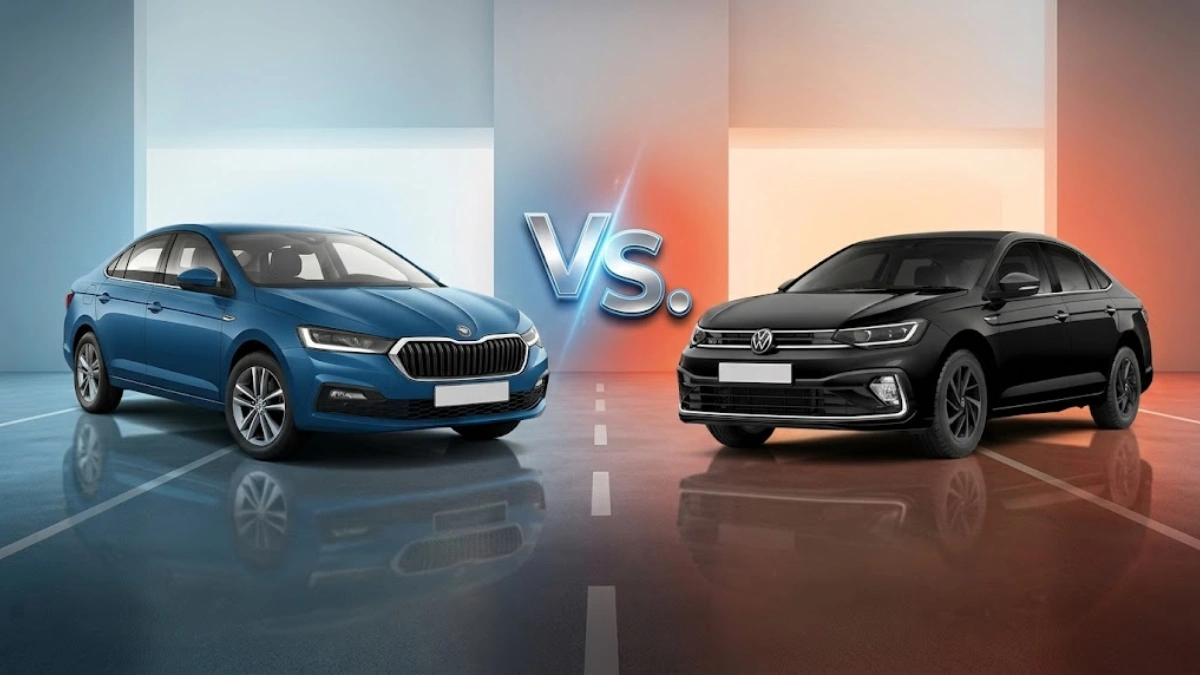
Skoda Slavia Facelift 2026 vs Volkswagen Virtus: Which Sedan Should You Wait For?
- Cars
- Published: 16 Jul, 2026
Book a Test Drive
Free doorstep test drive at your convenience
The Slavia and the Virtus have long been considered the two best-driving sedans in India's C-segment — unsurprising, since they're mechanically identical siblings built on the same MQB-A0-IN platform under Volkswagen Group's "India 2.0" program. But 2026 has thrown an interesting twist into this rivalry: both cars are due for a mid-cycle facelift within months of each other, which makes the buying decision more complicated than a simple "which one is better" comparison.
If you're in the market for a premium sedan right now, you're really weighing three questions at once: Should you buy the current Slavia or Virtus today? Should you wait for the Slavia facelift? Or should you wait for the Virtus facelift instead? This expert breakdown covers exactly what's changing, when, and what it means for your wallet.
Skoda Slavia Facelift 2026 vs Volkswagen Virtus: Quick Comparison
Here's the situation in a nutshell:
- The Skoda Slavia Facelift is expected to launch first, with reports pointing to August–September 2026, though a few sources push this out to Q4 2026.
- The Volkswagen Virtus facelift has also been spotted testing and is expected to arrive in Q4 2026, a few months behind the Slavia.
- Both facelifts are expected to bring similar upgrades: revised styling, a new digital driver's display, an updated infotainment UI, and possibly a new transmission option — because they share the same engineering underpinnings.
This means that whichever facelifted model launches later will likely benefit from segment leapfrogging (newer tech, marginally fresher design cues), while the one that launches first gets first-mover advantage and possibly a genuine ADAS upgrade the other still lacks.
Skoda Slavia Facelift 2026: What to Expect
Expected Launch Timeline and Price
The Slavia facelift has been spotted testing multiple times through early-to-mid 2026, with heavy camouflage at the front and rear — the areas expected to see the most visual change. Launch estimates vary by source:
| Source Estimate | Expected Launch | Expected Starting Price |
| CarDekho | August 2026 | ₹10.99 lakh |
| ZigWheels | September 2026 | ₹11.99–12.00 lakh |
| CarWale | Q3/Q4 2026 (FY2027) | ₹12.00 lakh |
| CARS24 | Late 2026 | ₹12.00 lakh (up to ₹18–19 lakh across variants) |
Given the spread, the safest expectation is a launch window between August and Q4 2026, with prices starting somewhere around ₹11–12 lakh (ex-showroom) for the base variant and climbing toward ₹18–19 lakh for the top-spec automatic trim — broadly in line with, or a touch above, current Slavia pricing.
Expected Design Changes
- Revised front bumper with a larger, sharper air dam for a more aggressive look
- Reworked grille with integrated lighting elements, similar to the recently launched Kushaq facelift
- Updated LED headlamp detailing and tweaked LED DRLs
- New alloy wheel design, while the overall silhouette stays the same
- Redesigned rear bumper with wraparound taillights connected by a central light bar
- Cabin retains its black-and-beige theme, with only minor revisions expected
Expected Feature Upgrades
This is where the Slavia facelift is expected to make its biggest leap:
- New 10.25-inch digital driver's display, carried over from the Kushaq facelift
- Updated infotainment UI, likely with an integrated AI assistant, while the touchscreen hardware itself may be carried forward
- 360-degree surround camera (new)
- Electronic parking brake (new)
- Level 2 ADAS suite — a segment-relevant addition the outgoing Slavia does not offer
- Dual-zone climate control
- Continuation of the single-pane electric sunroof rather than a panoramic unit, reportedly to preserve rear headroom
Expected Powertrain
Mechanically, expect no major surprises:
- 1.0-litre TSI turbo-petrol: 115 PS, 178 Nm — likely paired with a new 8-speed automatic gearbox in place of the current 6-speed torque converter unit
- 1.5-litre TSI turbo-petrol: 150 PS, 250 Nm, retained with 6-speed manual and 7-speed DSG options
- Engine mapping may be retuned slightly for better efficiency, but no power bump is expected
Where the Current Slavia Stands Today
For context, the outgoing (pre-facelift) Slavia currently costs ₹10.00 lakh to ₹18.19 lakh (ex-showroom, as of July 2026), runs the same 1.0-litre and 1.5-litre TSI engines, carries a 5-star Global NCAP rating, and comes with 6 airbags as standard. ARAI-claimed mileage ranges from 18.73 to 20.32 kmpl.
Volkswagen Virtus: Current Model and Upcoming Facelift
Current Virtus Price and Variants
The Volkswagen Virtus, as of July 2026, is priced from ₹10.50–10.71 lakh for the base Comfortline trim up to ₹19.20–19.41 lakh for the range-topping GT Plus Sport (ex-showroom). It's sold across two sub-brands:
- Virtus Chrome — Comfortline, Highline, Highline Plus, Topline, GT Plus
- Virtus Sport — GT Line, GT Plus Sport
Current Virtus Features and Specs
- 1.0-litre TSI: 115 PS, 178 Nm, with 6-speed manual or 6-speed torque converter automatic
- 1.5-litre TSI EVO: 150 PS, 250 Nm, with Active Cylinder Technology for efficiency — now DSG automatic only, since Volkswagen has discontinued the manual gearbox option for this engine
- 521-litre boot — among the largest in the segment
- 179 mm ground clearance
- Ventilated front seats, wireless charging, 10.1-inch touchscreen with wireless Android Auto/Apple CarPlay, digital cockpit (20.32 cm), electric sunroof, ambient lighting
- 5-star Global NCAP rating with 6 airbags standard
- ARAI mileage: 18.12–20.8 kmpl
- Notably, the current Virtus still has no ADAS package — a genuine gap versus what the Slavia facelift is expected to introduce
Volkswagen Virtus Facelift: What's Coming
The Virtus facelift has also been spotted testing, with the first sightings reported in April 2026, and Volkswagen has more or less confirmed a Q4 2026 launch window. Expected updates include:
- Revised headlamps, front grille, and bumpers
- New alloy wheel designs
- A larger infotainment touchscreen and an updated digital instrument cluster
- A likely new 8-speed automatic gearbox for the 1.0 TSI engine, replacing the current 6-speed torque converter unit — mirroring what's expected on the Slavia
- Engine outputs are expected to carry over largely unchanged
Volkswagen's own advisory to prospective buyers (via Autocar India's expert query column) has been telling: buyers with no urgency to upgrade have been advised that it's worth waiting for the updated Virtus, specifically because of the new 8-speed gearbox and added features.
Skoda Slavia Facelift vs Volkswagen Virtus: Side-by-Side Comparison
| Parameter | Skoda Slavia Facelift (Expected) | Volkswagen Virtus (Current) |
| Expected/Current Launch | Aug–Q4 2026 (unlaunched) | On sale now; facelift expected Q4 2026 |
| Starting Price (Ex-showroom) | ₹11–12 lakh (estimated) | ₹10.50–10.71 lakh |
| Top Price (Ex-showroom) | ₹18–19 lakh (estimated) | ₹19.20–19.41 lakh |
| Engine Options | 1.0 TSI (115 PS/178 Nm), 1.5 TSI (150 PS/250 Nm) | 1.0 TSI (115 PS/178 Nm), 1.5 TSI EVO (150 PS/250 Nm) |
| Transmission (1.0 TSI) | 6MT / expected new 8-speed AT | 6MT / 6-speed torque converter AT |
| Transmission (1.5 TSI) | 6MT / 7-speed DSG | DSG only (manual discontinued) |
| ADAS | Expected Level 2 ADAS (new) | Not offered |
| Digital Driver's Display | New 10.25-inch unit expected | 20.32 cm (8-inch) Virtual Cockpit |
| Sunroof | Single-pane electric (expected, retained) | Electric sunroof |
| 360-Degree Camera | Expected (new) | Not standard across range |
| Boot Space | Expected to carry over (~521 litres, shared platform) | 521 litres |
| Ground Clearance | Expected ~179 mm (shared platform) | 179 mm |
| Safety Rating | 5-star Global NCAP (current model); facelift not yet tested | 5-star Global NCAP |
| Airbags | 6 standard | 6 standard |
Expert Analysis: Should You Wait?
If You Want the Latest Tech and ADAS
Wait for the Slavia facelift. Based on current spy shots and reports, it's shaping up to be the more feature-forward update of the two, particularly with the expected Level 2 ADAS suite — something neither the current Slavia nor the current Virtus offers. If driver-assist features like adaptive cruise control, forward collision warning, and lane-keep assist matter to you, this is the single biggest reason to hold off.
If You Want the Best Value Right Now
Buy the current Virtus. With prices starting under ₹10.71 lakh and heavy year-end discounts common on outgoing models, the current Virtus remains an excellent driver's sedan with a strong safety score, a class-leading boot, and VW's traditionally planted highway manners. If you're not fussed about ADAS or the new gearbox, there's little reason to wait months for marginal gains.
If You Prioritize Driving Dynamics Over Features
Both cars are mechanically identical under the skin — same MQB-A0-IN platform, same engine tunes, same suspension architecture. Expert advice consistently notes that the difference in ride and handling between the Slavia and Virtus is negligible; the choice largely comes down to styling and dealership experience, not driving feel. This holds true for the facelifted versions too, since Skoda and Volkswagen rarely diverge on core engineering within the same platform generation.
If Timing Is Your Priority
The Slavia facelift is expected to arrive first (as early as August 2026), giving Skoda a temporary edge in freshness. But the Virtus facelift follows closely in Q4 2026 with a similar feature set, including the same anticipated 8-speed automatic gearbox. Buyers who can wait the extra few months may find the choice becomes a coin toss again once both cars are updated — at which point badge preference, service network, and dealership discounts will likely be the deciding factors, just as they are today.
Key Rivals to Keep in Mind
Both the Slavia and Virtus, in current and facelifted form, continue to compete against the Honda City, Hyundai Verna, and to a lesser extent the Maruti Suzuki Ciaz (before its discontinuation) in India's shrinking but still relevant mid-size sedan segment.
Conclusion
If you need a sedan immediately and don't want to gamble on launch-timeline delays, the current Volkswagen Virtus remains a well-rounded, keenly priced choice with proven reliability data and strong discounts typical of an outgoing model. But if you can hold off for a few months, the Skoda Slavia facelift looks positioned to be the more significant update of the two — expected to bring genuine, tangible upgrades like ADAS and a new digital cluster rather than styling tweaks alone. And if you can wait even longer, the Virtus facelift arriving in Q4 2026 should close much of that gap, restoring the classic "which one do you like the look of more" dilemma that has always defined this rivalry.
FAQs
1. Which is better: Skoda Slavia Facelift 2026 or Volkswagen Virtus?
The Skoda Slavia Facelift 2026 is expected to offer refreshed styling, updated features, and enhanced technology, while the Volkswagen Virtus continues to be known for its premium build quality, driving dynamics, and feature-rich cabin. Your choice depends on whether you prefer the latest updates or an already well-established premium sedan.
2. What are the expected changes in the Skoda Slavia Facelift 2026?
The 2026 Slavia Facelift is expected to receive redesigned LED headlamps, revised bumpers, updated alloy wheels, refreshed interior upholstery, a larger infotainment system, additional connected car features, and enhanced safety equipment. Final specifications will be confirmed at launch.
3. Will the Skoda Slavia Facelift 2026 get a new engine?
No major engine changes are expected. The facelift is likely to continue with the existing 1.0-litre TSI and 1.5-litre TSI turbo-petrol engines, paired with manual and automatic transmission options.
4. Is the Volkswagen Virtus more powerful than the Skoda Slavia Facelift?
Both sedans are expected to share the same Volkswagen Group MQB-A0-IN platform and turbo-petrol engine options. As a result, their power output, transmission choices, and overall performance are likely to remain very similar.
5. Which sedan offers better features: Slavia Facelift or Virtus?
The Slavia Facelift is expected to introduce new technology and convenience features that could give it a slight advantage over the current Virtus. However, the Virtus already offers premium features such as a digital cockpit, ventilated seats, wireless smartphone connectivity, and a large touchscreen infotainment system.
6. Which sedan is safer: Skoda Slavia Facelift 2026 or Volkswagen Virtus?
Both models are expected to offer excellent safety standards, including six airbags, Electronic Stability Control (ESC), ABS with EBD, ISOFIX child seat mounts, hill-hold assist, and multiple advanced driver assistance features depending on the variant.
7. Which car has better mileage: Skoda Slavia Facelift or Volkswagen Virtus?
Since both cars are expected to use the same engine options, their fuel efficiency figures are likely to be nearly identical. Actual mileage will depend on the chosen engine, transmission, and driving conditions.
8. Should I wait for the Skoda Slavia Facelift 2026 or buy the Volkswagen Virtus now?
If you need a sedan immediately, the Volkswagen Virtus remains an excellent choice. However, if you want updated styling, newer features, and the latest technology from Skoda, waiting for the Slavia Facelift 2026 could be worthwhile.
Book a Test Drive
Free doorstep test drive at your convenience
Popular Brands





Latest Car News
Next Generation Tata Nexon 2027: Expected Launch, Price, Design & Features
MG Hector Tomahawk EV Variant-Wise Price & Features Comparison
Maruti Baleno Facelift vs Toyota Glanza: Complete Comparision
Upcoming Cars in September 2026 in India: New Cars, Launch Dates & Expected Prices
MG Hector Hawk SUV vs Tata Harrier: Expected Price, Features & Key Differences
Skoda Superb Diesel in India: Will the Diesel Engine Make a Comeback?
Tata Punch Becomes India's Best-Selling SUV in July 2026 with 21,313 Units Sold
Car Sales Report July 2026: Maruti Remains No.1, Tata, Mahindra & Hyundai Record Strong Growth
Tata Curvv EV Discount August 2026: Save Big with Limited-Time Offers
Kia Sorento Booking in India: Launch Date, Price & Booking Process
Skoda Slavia Facelift Launch Date in India
Hyundai Creta Next Gen Upgrades: Biggest Changes Expected
Limited Edition Skoda Slavia Monte Carlo Adds New Colours for 200 Buyers Only
Suzuki Loses India Market Share as Buyers Demand More Features
Hybrid Car Sales Decline 8% in June 2026: Complete Analysis
How to Book Maruti Brezza Facelift: Complete Booking Guide
Alto K10 vs Tiago: Which Is Better?
Maruti Brezza Facelift 2026: What's New Compared to the Current Model?
Renault Duster Adventure Edition vs Standard Duster: What's Different?
Skoda Slavia Facelift 2026 vs Volkswagen Virtus: Which Sedan Should You Wait For?