Which Scooter Is Better Between Simple Wave and Ather Konarc?
- Electric-bike
- Published: 03 Sep, 2026
- Updated: 03 Sep, 2026
Book a Test Drive
Free doorstep test drive at your convenience
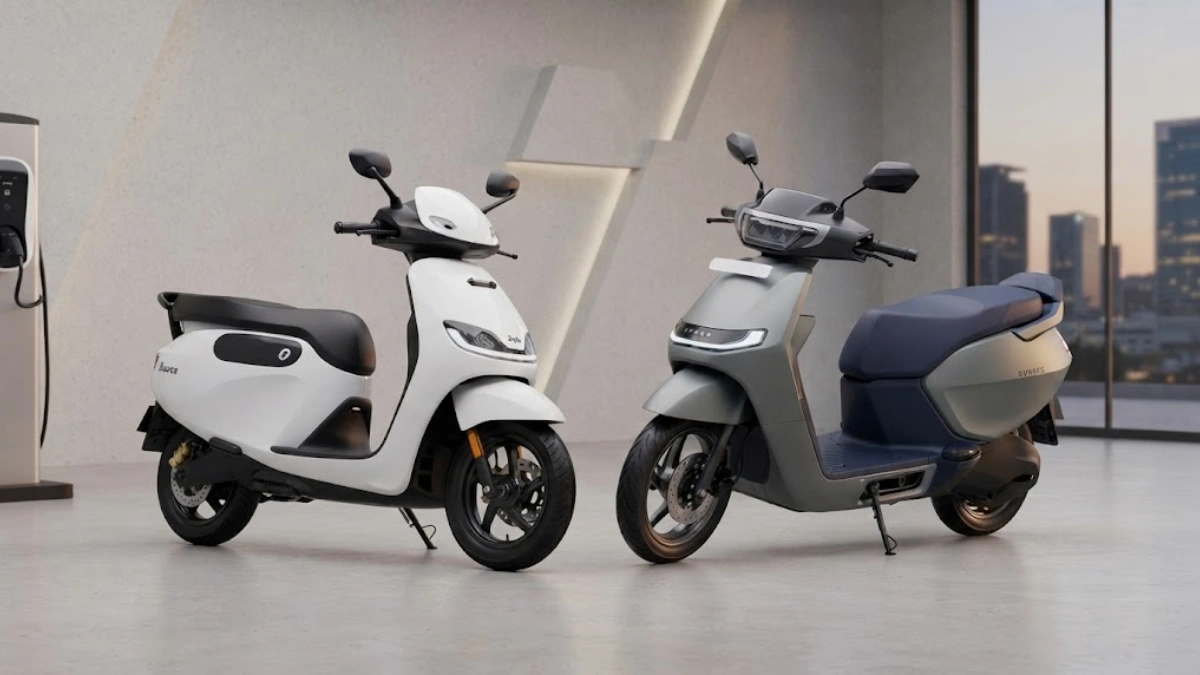
Two of India's most talked-about electric scooter launches have landed within days of each other. Ather unveiled the Konarc at its Community Day on August 29, 2026, and barely a week later, Simple Energy launched the Wave on September 2, 2026. Both are aimed squarely at the same buyer: someone who wants a practical, family-friendly electric scooter rather than a sporty performance EV. Here's a full, data-backed comparison to help you decide.
Simple Wave vs Ather Konarc: Quick Comparison
| Parameter | Simple Wave | Ather Konarc |
| Starting Price (ex-showroom) | ₹1,09,999 | ₹99,999 |
| Top Variant Price (disclosed so far) | Not yet announced | ₹1,44,999 (S 161) |
| Battery Options | 2.2 kWh, 2.7 kWh, 3.7 kWh, 5 kWh | 2.1 kWh, 2.7 kWh, 3.5 kWh (more coming) |
| Claimed IDC Range | 110 km – 243 km | 100 km – 200 km |
| Motor Power | 6.4 kW (peak) | 4 kW – 4.7 kW (S variants) |
| Top Speed | 75–90 km/h (variant dependent) | 70 km/h (S) / 80 km/h (Z) |
| Display | 7-inch TFT throughout | 4.2-inch DeepView (S 100) / 7-inch DeepView or TFT touchscreen (higher variants) |
| Underseat Storage | 70 litres (plus 4L accessory pod) | 31 litres |
| Braking | CBS standard; drum rear on base, front disc + AeBS-like traction aids on higher trims | Drum-drum (S 100); front disc + rear drum (S 125/161); AeBS on Z |
| Battery Warranty | Not fully detailed yet | 10 years |
| Deliveries Begin | September 25, 2026 | Staggered — Sept 2026 (S 125/161) to Q1–Q3 2027 for other variants |
Simple Wave Electric Scooter: Key Highlights
The Simple Wave is Simple Energy's first genuinely family-focused scooter, sitting below its existing Simple One range. A few things stand out:
- Range-topping battery options. Simple Wave is available with four battery options and up to 243 km of range, making range its biggest selling point in this segment.
- Tiered lineup. Simple Wave range starts with a 2.2 kWh battery offering a claimed IDC range of 110 km. Moving higher, the 2.7 kWh version promises 132 km, while the 3.7 kWh configuration increases range to 171 km. Sitting at the top is a substantially larger 5 kWh battery pack with a claimed IDC range of 243 km.
- Powerful, rare-earth-light motor. The scooter introduces a new 6.4 kW electric motor that Simple says is free from heavy rare-earth materials, and this motor lets the top variant hit a top speed of 90 km/h.
- Segment-leading storage. The Wave offers up to 70 litres of total storage, with a 4-litre "Pill" storage box placed on the side for quick access, and another similar unit can be added as an accessory.
- Family-first design. It has a more practical design, featuring a flat footboard, a large 920 mm seat and a 70-litre underseat storage cubby.
- Loaded feature set. According to Simple's own spec sheet, the Wave gets a 7-inch TFT screen with built-in navigation, EcoX/Eco/Ride/Sport riding modes, IP67 protection, OTA updates, reverse assist ("Super Share"), hill-hold ("Super Hold"), a quiet gear-drive transmission ("Hushdrive"), a "Guide Me Home" light, theft/tow alerts, and a fall-detection motor cutoff ("Drop Safe").
- Pricing and delivery. The base Simple Wave S variant comes with two battery options, a 2.2 kWh pack good for 110 km of IDC range and a 2.7 kWh pack rated at 132 km, priced from ₹1,09,999. Simple hasn't revealed pricing for the higher variants yet, but it has stated that the delivery date applies across the range, with deliveries starting September 25, 2026.
One trade-off to flag: the Simple Wave swaps the One's rear disc for a rear drum brake, though a Combined Braking System is standard across all four variants, and GripSense traction control, standard on the One range, is limited to the higher Wave variants only.
Simple Wave vs Ather Konarc: Price Comparison
This is where things get interesting, and also where you need to read the fine print carefully.
Ather Konarc has a fully transparent entry-level price ladder already published:
- The Konarc S 100 is priced at Rs 99,999, the S 125 at Rs 1,21,999 and the S 161 at Rs 1,44,999, all ex-showroom, Bengaluru. Pricing for the 200km S, along with both Konarc Z variants (125 km and 161 km), has not been announced yet.
Simple Wave currently has only its entry price confirmed:
- The Simple Wave's prices start at Rs 1.10 lakh (ex-showroom, Bengaluru), and prices for the higher variants haven't been revealed yet.
What this means for buyers: If your budget is close to ₹1 lakh and you want the cheapest possible EV scooter from a known brand, the Konarc S 100 undercuts the Wave by roughly ₹10,000 at entry level. But that entry Konarc only does 100 km of range on a much smaller 2.1 kWh battery. If you compare like-for-like ranges say, 130 km, the Simple Wave S (2.7 kWh, 132 km) at ₹1.10 lakh is priced close to the Konarc S 125 at ₹1.22 lakh, which would make the Wave the better value at that range bracket, though Simple hasn't officially confirmed the S variant's exact price beyond the base figure. For the true flagship range figures (243 km Wave+ vs 200 km Konarc S 200), neither company has announced final pricing yet, so a full apples-to-apples price verdict will only be possible once both companies release complete variant-wise pricing.
Range & Battery
Range is the single biggest differentiator between these two scooters, and Simple has clearly built the Wave to win this fight.
- Simple Wave: Four battery tiers, 2.2 kWh (110 km), 2.7 kWh (132 km), 3.7 kWh (171 km), and 5 kWh (243 km). The range-topping Wave+ uses a 5 kWh Nickel Cobalt Aluminium battery, while the lower configurations employ Lithium Iron Phosphate battery packs.
- Ather Konarc: Three confirmed battery sizes, 2.1 kWh (100 km), 2.7 kWh (125 km), and 3.5 kWh (161 km), with an IDC range from 100 km to 200 km, and a real-world TrueRange of up to 130 km on the currently available variants. A 200 km variant is confirmed for the future but is part of Ather's product roadmap for Q3 2027, so it isn't available at launch.
Verdict on range: On paper, the Simple Wave wins comfortably, its 243 km top-end figure beats Konarc's 200 km claim, and crucially, the Wave's long-range variant is available now, whereas Ather's 200 km Konarc is over a year away from delivery. If range anxiety is your top concern, the Wave has a real, near-term advantage.
Performance
- Simple Wave: Uses a single 6.4 kW electric motor across the range, delivering a top speed of up to 90 km/h on the flagship Wave+, while the entry-level Wave S gets a top speed of 75 kmph.
- Ather Konarc: More modest outputs on the S line — Peak Power of 4 kW on the S 100 and 4.7 kW on the S 125/S 161, with 16 Nm peak torque across all three, a claimed top speed of 70 kmph, and a 0-40 kmph time of 5 seconds (S 100) or 4.7 seconds (S 125/S 161). The upcoming Konarc Z variants step this up to an 80 km/h top speed.
Verdict on performance: The Simple Wave is meaningfully quicker and more powerful across the board — its 6.4 kW motor and 90 km/h top speed put it in a different performance bracket than the currently-available Konarc S variants, which are tuned more for gentle, efficient commuting than outright pace.
Features
Both scooters are loaded, but they take slightly different approaches — Simple leans into practicality gadgets, Ather leans into its software ecosystem.
Simple Wave features include:
- 7-inch TFT display with built-in navigation on every variant
- EcoX, Eco, Ride and Sport riding modes
- IP67 water/dust resistance
- Reverse assist, hill-hold assist, fall-detection cutoff
- Quiet belt/gear transmission (Hushdrive)
- OTA software updates, theft/tow alerts
Ather Konarc features include:
- AutoHold, Google Maps Platform navigation, Tow & Theft Alert, and Cricket Score on Dash (higher/Z variants)
- DeepView display on base variants, TFT touch screen on higher trims, with AutoPop and MagicKey™ boot access exclusive to the Z line
- MagicKey lets riders unlock the scooter's boot through the Ather app instead of a physical key, and on the Konarc Z 161 this works together with AutoPop to open the boot automatically
- Ather Connect, which includes theft and tow alerts, ride statistics, Find My Scooter, and remote charging-status monitoring
- A new AeBS (Advanced Electronic Braking System) on the Z variant, which uses electronic control to reduce stopping distances and minimise rear-wheel lock-ups during hard braking
Verdict on features: It's close. The Konarc's software polish (MagicKey, AutoPop, Google Maps, cricket scores, AeBS braking) reflects Ather's reputation for slick tech, but a lot of these are locked to the pricier Z variants that aren't even on sale yet. The Simple Wave gives its full 7-inch TFT and navigation suite to every variant, including the base model — so if you're buying the entry trim, the Wave likely feels more feature-complete out of the box.
Ride & Handling
- Simple Wave: Built around a flat footboard and a large 920 mm seat for two-up comfort, aimed squarely at families who need to carry pillion and cargo daily. The 70-litre storage also means less reliance on a top box or aftermarket luggage.
- Ather Konarc: This is the first Ather scooter to have a metal body and steel unibody chassis, along with a 14-inch front wheel, 12-inch rear wheel, and long-travel suspension. It has a 1,352 mm wheelbase — the longest of any Ather scooter — aimed at improving stability on broken surfaces, with 90 mm of front suspension travel and 100 mm at the rear. Kerb weight ranges from 126.5 kg on the S 100 to 129 kg on the S 161.
Verdict on ride quality: The Konarc's longer wheelbase, larger wheels, and steel unibody chassis suggest a genuine focus on stability over broken Indian roads, a strong argument for daily family use. The Wave counters with a bigger seat and flatter footboard for practical two-up comfort and easier cargo carrying. Neither has been ridden by independent reviewers yet, so real-world ride comfort is still to be verified once test rides begin.
Simple Wave vs Ather Konarc: Running Cost
Both scooters use LFP (Lithium Iron Phosphate) chemistry in their lower/mid variants, which is known for longer cycle life and lower degradation, keeping long-term running costs low. Neither company has published exact per-km charging cost figures yet, but as a rule of thumb:
- Electric scooters in this segment typically cost roughly ₹0.15–₹0.30 per km to charge (based on home electricity tariffs of ₹6–₹9/unit and typical scooter efficiency), versus ₹1.5–₹2.5 per km for a 110cc/125cc petrol scooter.
- Ather Konarc has a clear edge on ownership costs on paper: a 10-year battery warranty and a service interval of just once every 12 months or 10,000 km, whichever comes first — this is a longer interval than most rivals, meaning fewer service visits.
- Simple Wave's exact battery warranty and service interval terms haven't been fully detailed in the launch materials yet, so this is one area to specifically ask your dealer about before booking.
- Charging speed favours Ather in the near term: Konarc gets a 450W onboard charger as standard, which can be combined with a 900W off-board charger to provide 1.35 kW of charging capacity and reduce 0-80% home charging time to as little as two hours on the 100 km IDC variant. Simple hasn't published equivalent fast-charging figures for the Wave yet.
Verdict on running cost: Ather currently has the more transparent, buyer-friendly ownership story — a 10-year battery warranty and a 1-year/10,000 km service interval are strong, publicly confirmed numbers. Until Simple releases equivalent warranty and charging-time details for the Wave, Ather edges this category on paper.
Which One Should You Buy?
It genuinely depends on what you're optimizing for:
- Buy the Simple Wave if: You want maximum range today (up to 243 km, available at launch), more power and higher top speed, the biggest underseat storage in the segment, and a full-featured 7-inch TFT display even on the base variant.
- Buy the Ather Konarc if: You want the lowest possible entry price (₹99,999), a longer-established service network and brand track record, a 10-year battery warranty with clearly published terms, faster documented charging, and software niceties like MagicKey, AutoPop, and Google Maps integration (on higher trims).
Simple Wave vs Ather Konarc: Pros and Cons
Simple Wave
Pros:
- Highest range in the segment (up to 243 km claimed)
- More powerful 6.4 kW motor, faster (up to 90 km/h)
- Massive 70-litre storage
- Full 7-inch TFT + navigation on every variant, even the base
Cons:
- Higher starting price than Konarc
- Full variant-wise pricing not yet announced
- Battery warranty/service interval details still unclear
- Rear drum brake (not disc) on base variants; GripSense traction control limited to higher trims
Ather Konarc
Pros:
- Lowest starting price in this comparison (₹99,999)
- 10-year battery warranty, confirmed
- Longer 1-year/10,000 km service interval
- Faster documented home charging (as low as 2 hours with optional charger)
- Strong Ather software ecosystem and established service network
Cons:
- Lower range than Wave at every equivalent price point (200 km max vs 243 km)
- Best features (MagicKey, AutoPop, AeBS, TFT touch screen) locked to pricier/unreleased Z variants
- Long, staggered delivery timeline — some variants not arriving until Q1–Q3 2027
- Lower power output and top speed than the Wave
Our Opinion – Which Is Better For You?
If range and outright performance are your priority — and you're comfortable waiting for Simple to confirm full pricing — the Simple Wave currently looks like the stronger all-round package: more power, more range, more storage, and a fuller feature set at every price tier. It genuinely undercuts and outperforms the Konarc on the numbers that matter most for long-distance daily commuting.
If you want the lowest possible entry price, the comfort of a well-established brand with a strong dealer network, and clear, transparent long-term ownership costs (10-year battery warranty, fixed service intervals), the Ather Konarc is the safer bet — provided you're fine with the base variant's shorter 100 km range and are willing to wait for the fully-loaded Z variants to arrive.
Our practical recommendation: Wait 2-3 weeks for both companies to release complete variant-wise pricing and for the first independent test rides/reviews. Given how close in positioning these two scooters are, an actual test ride will tell you more about ride comfort and build quality than spec sheets alone. If you must decide today, prioritise the Wave for range-hungry buyers and daily long commutes, and the Konarc for budget-conscious first-time EV buyers who value brand trust and after-sales support.
Book a Test Drive
Free doorstep test drive at your convenience
Latest Electric Bike News

Royal Enfield Himalayan 440 Booking: How to Book, Price & Delivery Date
Royal Enfield Himalayan 440 Launch Today: 5 Things to Know Before the Reveal

Bike Taxi on White Number Plate Bikes: Nitin Gadkari Urges States to Allow Permits
Royal Enfield Himalayan 440 Spotted At Dealership Ahead Of 4 September Launch

2027 Kawasaki Ninja 500 vs KTM RC 390 vs Yamaha R3: Complete Comparison
Yamaha R2 vs R15 vs R3: Which Yamaha Sports Bike Should You Buy?
Bajaj Pulsar N160 SS Mileage: Real-World Average, City & Highway Figures
Hero June 2026 Sales Report: Splendor, HF Deluxe, Destini & Glamour

War Impact on Two-Wheeler Market: Sales Growth or Slowdown in 2026?
Electric Bikes vs Petrol Bikes During War: Which Is the Smarter Choice?
EV Bikes vs Petrol Bikes: Which One Holds the Future in 2026?

Royal Enfield Hunter 350 Launched in 2026: What’s New in India’s Popular Bike?
Triumph Tracker 400 (350cc) Launched in India: Affordable Premium Bike?

Upcoming Bikes April 2026: 5 Bikes That Can Change the Market
Hero Xtreme 160R 4V Launched in India with Cruise Control: Price, Features and Full Specs

Hero MotoCorp February 2026 Sales Report: No.1 Again?

TVS Holi Finance Scheme 2026 Brings 0% Down Payment

Bajaj Holi Discount 2026: ₹10,000 Off Bikes
Top 5 Best Mileage Bikes in India 2026 Under ₹1 Lakh
Hero Xtreme 125R vs TVS Raider 125 – Best 125cc Bike Comparison