
Kia Sorento 6 Seater vs 7 Seater: Which One Should You Choose?
- Cars
- Published: 03 Sep, 2026
Book a Test Drive
Free doorstep test drive at your convenience
Ask any family shopping for a three-row SUV in India and you'll hear the same debate play out: do you want maximum seating capacity, or maximum comfort for the people who actually use the car every day? With the new Kia Sorento launching in India on September 4, 2026, that decision has become a real, concrete choice rather than a hypothetical one, because Kia is offering the Sorento in both 6-seater and 7-seater configurations, and the difference between the two goes well beyond just counting heads.
If you're trying to decide which layout suits your family, your budget, and the way you actually drive, here's a detailed, fact-based breakdown to help you choose.
The Core Difference between Six Seater & Seven Seater Kia Sorento
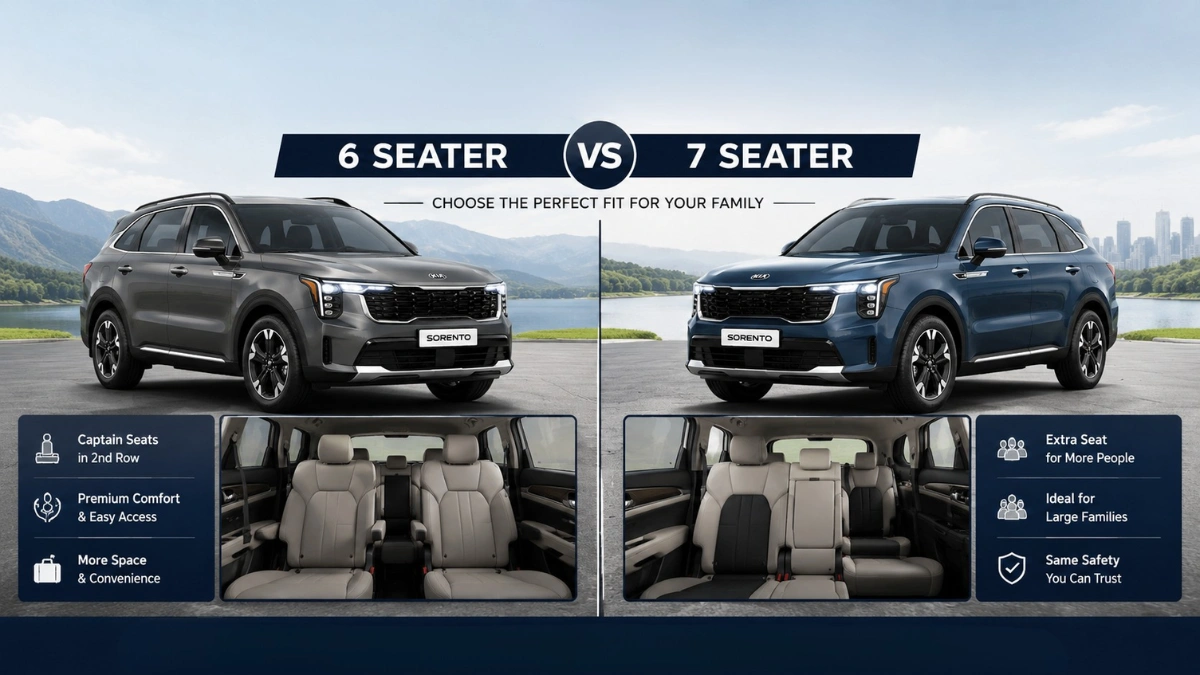
The entire 6-seater vs 7-seater debate comes down to what Kia does with the second row.
- 6-Seater Sorento: The second row gets individual captain seats, two separate, standalone chairs with their own armrests, instead of one continuous bench. This drops total seating capacity to six, but each of those two second-row occupants gets a dedicated, sofa-like seat.
- 7-Seater Sorento: The second row is a 60:40 split-folding bench seat, which can seat three people across, or fold in sections for extra cargo flexibility. This keeps total capacity at the traditional seven.
Both versions retain the same third row and the same overall body, the difference is purely in how the middle row is configured, and that one change has a ripple effect on comfort, access, flexibility, and even price.
Kia Sorento 6-Seater: What You Get
The 6-seater variant is built around one idea: making the second row feel less like "the back seat" and more like a first-class cabin.
Key advantages:
- Individual captain's chairs with their own armrests, offering a more premium, cocooned feel — ideal for passengers who value personal space over shoulder-to-shoulder seating.
- Walk-through access to the third row. Because there's a gap between the two captain seats instead of a solid bench, getting to row three is far easier, no folding or sliding a heavy bench seat every time someone needs to climb back.
- Ventilated second-row seats (as spotted on India-bound test units), adding a genuine luxury touch that's rare in this segment, especially useful in Indian summers.
- Reclining, more supportive seating designed for long-distance comfort, making the 6-seater the natural pick for highway road trips.
- Storage advantages, the space between the captain seats is often used for a centre console, cupholders, or additional storage, adding functional convenience that a bench seat can't offer.
Where it falls short:
- Lower total capacity. You lose one seat permanently, fine for a couple with one or two kids, but a real constraint if you regularly travel with extended family.
- Slightly higher price compared to the equivalent 7-seater trim, since captain seats and their added features (ventilation, individual adjustment, etc.) typically come bundled with higher-spec variants.
- Less flexible for large groups. If you occasionally need to carry six friends or a big joint family for a wedding or a trip, the fixed six-seat cap can be limiting.
Kia Sorento 7-Seater: What You Get
The 7-seater sticks to the format most Indian SUV buyers are already familiar with, a proper three-row people-mover built for maximum flexibility.
Key advantages:
- True seven-passenger capacity, making it the better choice for larger families, joint households, or anyone who regularly needs to fit more people in one vehicle.
- 60:40 split-folding second-row bench that can seat three across when needed, or fold in sections to free up cargo space without sacrificing all rear seating.
- Sliding and reclining the second row on the India-spec car, so you can shift the bench forward to free up third-row legroom, or back to prioritise second-row comfort, a flexibility captain seats don't offer.
- Practical everyday features carried over regardless of configuration, including dedicated AC vents, Type-C charging ports for rear passengers, and retractable sunshades on the rear doors.
- Better value on lower trims. The 7-seater layout tends to be offered on the more accessible variants, making it the practical entry point into Sorento ownership.
- More usable cargo flexibility. With three rows that can fold independently, you get more configurations for hauling luggage, furniture, or sports equipment when the third row isn't in use.
Where it falls short:
- Less individual comfort in row two. A bench seat, even a well-designed 60:40 split unit, doesn't match the ergonomic support and personal space of dedicated captain's chairs.
- Harder third-row access. Passengers getting into row three have to squeeze past or fold part of the bench, which is more effort than simply walking through a gap between two captain seats.
- No ventilated second-row seats on most configurations, since that feature has typically been paired with the captain-seat layout.
Space, Comfort, and Practical Numbers
Regardless of which seating layout you choose, the Sorento's overall footprint stays the same, a genuinely large three-row SUV, measuring 4,815mm in length, 1,900mm in width, 1,700mm in height, with a 2,815mm wheelbase. That's a significant footprint, and it shows up in cabin space:
- Both configurations offer generous third-row space for two adults, not just children, a rarity in this segment where third rows are often an afterthought.
- Second-row space is ample in either layout, the difference is in how that space is distributed (shared across a bench vs dedicated to two individual chairs).
- The third row is largely identical across both variants, typically with split-folding functionality for cargo flexibility either way.
- Cargo capacity with the third row folded is substantial in both configurations, since the difference lies in row two, not the boot.
In short: neither configuration compromises on outright interior room. The choice is about how that room is allocated, not how much of it you get.
Which One Should You Choose?
Here's a straightforward way to think through the decision based on how your family actually uses the car:
Choose the 6-Seater if:
- You're a couple or small family (1-2 kids) who won't regularly need all seven seats.
- Second-row comfort, for a spouse, parents, or older children, matters more to you than raw capacity.
- You frequently take long road trips and want the most comfortable, supportive seating for rear passengers.
- Ease of getting in and out of the third row matters (useful if you have young kids who need to be buckled into the back row often).
- You want the most premium-feeling cabin experience the Sorento can offer.
Choose the 7-Seater if:
- You regularly travel with extended family, in-laws, or larger friend groups and need consistent 7-passenger capacity.
- Flexibility matters more than individual luxury, you want the option to seat three across when needed.
- You're prioritising value, since the 7-seater tends to be positioned on more accessible trims.
- Your third-row usage is occasional, and you want a bench that can fold to expand cargo space without permanently losing a seat.
- You want a more traditional, familiar three-row SUV layout that's easy to explain to occasional drivers or family members.
Our Opinion
There's no universally "better" choice here, it genuinely depends on your family size and how you use the car day-to-day. Think of it this way: the 6-seater is the Sorento built for comfort-first families who'd rather give two rear passengers a first-class experience than squeeze in a seventh seat they rarely use. The 7-seater is the Sorento built for capacity-first families who need the flexibility to carry a full house when the occasion demands it, without paying a premium for captain's chairs they may not always need.
Before you book, it's worth test-sitting both layouts at your nearest Kia dealership once the Sorento launches. Seating preference is deeply personal, what feels spacious and comfortable to one family might feel restrictive to another. But now that you know exactly what changes between the two configurations, and what stays the same, you're in a much better position to make that call with confidence.
Book a Test Drive
Free doorstep test drive at your convenience
Popular Brands





Latest Car News
Kia Sorento 6 Seater vs 7 Seater: Which One Should You Choose?

Kia Sorento AI Assistant Explained: Features, Commands, and Indian Language Support
What Is the Difference Between Tata Curvv and New Curvv Series X?

Tata Car Sales August 2026: Model-Wise Sales & Growth Report

Car Sales Report of August 2026: Tata Motors, Maruti, Mahindra Lead Growth
Pajero 2026 vs Fortuner: Which SUV Could Be Better?
Volvo EX90 Booking Price: Expected Booking Amount, EMI & Loan Calculation

Next Generation Tata Nexon 2027: Expected Launch, Price, Design & Features
MG Hector Tomahawk EV Variant-Wise Price & Features Comparison
Maruti Baleno Facelift vs Toyota Glanza: Complete Comparision
Upcoming Cars in September 2026 in India: New Cars, Launch Dates & Expected Prices
MG Hector Hawk SUV vs Tata Harrier: Expected Price, Features & Key Differences
Skoda Superb Diesel in India: Will the Diesel Engine Make a Comeback?
Tata Punch Becomes India's Best-Selling SUV in July 2026 with 21,313 Units Sold

Car Sales Report July 2026: Maruti Remains No.1, Tata, Mahindra & Hyundai Record Strong Growth
Tata Curvv EV Discount August 2026: Save Big with Limited-Time Offers
Kia Sorento Booking in India: Launch Date, Price & Booking Process
Skoda Slavia Facelift Launch Date in India
Hyundai Creta Next Gen Upgrades: Biggest Changes Expected
Limited Edition Skoda Slavia Monte Carlo Adds New Colours for 200 Buyers Only