
Pajero 2026 vs Fortuner: Which SUV Could Be Better?
- Cars
- Published: 02 Sep, 2026
- Updated: 02 Sep, 2026
Book a Test Drive
Free doorstep test drive at your convenience
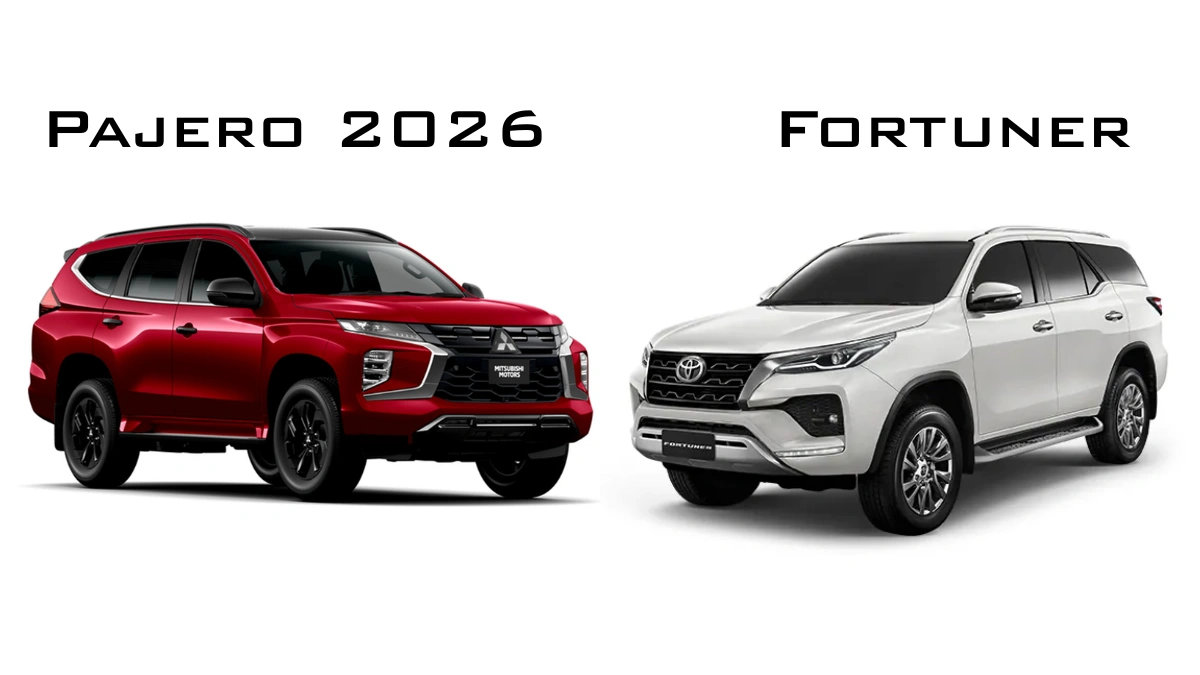
Mitsubishi finally pulled the wraps off its all-new, fifth-generation Pajero on 2 September 2026 — a genuine ladder-frame, Triton-based flagship built to take on the Toyota Land Cruiser Prado and Ford Everest globally. Naturally, Indian buyers are already asking the obvious question: how does it stack up against the segment king here, the Toyota Fortuner?
Before we dive in, here's an important, honest clarification: Mitsubishi has not confirmed an India launch for the new Pajero. Mitsubishi Motors officially announced that its all-new cross-country SUV would be named Pajero, with a world premiere in autumn 2026, and the SUV will be built in Thailand and exported to roughly 100 countries including ASEAN nations, the Middle East, and Latin America, but India is not on that initial rollout list. Mitsubishi has not confirmed any plans to bring the new-generation SUV to the Indian market, and industry analysts believe a full India comeback — if it happens at all — is more realistic in the 2028-2030 window rather than in the immediate term.
So this comparison is best read as "the Fortuner today vs. the Pajero the world just got, and what it would mean for India if and when it arrives." We've used the freshly revealed global specifications and India's real, current Fortuner pricing and data so you get an accurate, useful picture either way.
Pajero 2026 vs Fortuner – Quick Comparison
| Parameter | Mitsubishi Pajero (2027 global model) | Toyota Fortuner (2026, India) |
| India Status | Not launched; no confirmed India plans | On sale, established since 2009 |
| Engine | 2.4L twin-turbo diesel | 2.7L petrol / 2.8L diesel (mild-hybrid option) |
| Power/Torque | 204 hp and 354 lb-ft of torque (480 Nm) | 166hp/245Nm petrol; 204hp/up to 500Nm diesel |
| Transmission | 8-speed automatic | 6-speed manual/automatic |
| Ground Clearance | 230 mm | 225 mm |
| Seating | 7 (3 rows) | 7 (3 rows) |
| Price (Global reference) | Not announced yet | ₹34.76 lakh – ₹50.46 lakh ex-showroom |
| 4WD System | SuperSelect II / S-AWC | Part-time 4WD (diesel variants) |
| Availability in India | Uncertain, possibly 2028+ | Available now, pan-India network |
Pajero 2026 vs Fortuner Price
This is where the comparison gets tricky, because the Pajero simply doesn't have an India price yet — Mitsubishi hasn't released pricing for any market, and hasn't even confirmed a US launch. What we do know is how the new Pajero is being positioned globally: dealers who previewed the car described it as feeling like a proper Land Cruiser Prado rival, and Mitsubishi is understood to be benchmarking it against the Prado and even the full-size Land Cruiser 300, not budget-friendly ute-based SUVs. That alone tells you this won't be a cheap, mass-market product.
If Mitsubishi ever does bring the Pajero to India — most likely as a CBU (Completely Built Unit) import initially, given the brand has no local manufacturing presence for passenger SUVs right now — heavy import duties would push the on-road price well into premium territory, realistically anywhere from ₹65 lakh to over ₹1 crore depending on the variant and import route. This is an estimate based on how similarly positioned CBU SUVs are taxed in India, not an official figure.
The Fortuner, meanwhile, is a known quantity. In 2026, the Fortuner is priced from ₹34.76 lakh for the 2.7 Petrol 4x2 AT to ₹50.46 lakh for the range-topping GR-S 2.8 Diesel 4x4 AT, across nine variants, and on-road prices in a city like Mumbai run from around ₹41.63 lakh to ₹62.47 lakh.
Bottom line: the Fortuner is accessible today; the Pajero, if it ever lands in India, will almost certainly be a much pricier, low-volume flagship rather than a direct value alternative.
Pajero 2026 vs Fortuner Engine & Performance
The new Pajero drops the previous generation's V6 petrol/diesel options and unifies around one powertrain for now. Mitsubishi has confirmed a turbocharged 2.4-litre diesel engine borrowed from the Triton, making 204 horsepower and 354 lb-ft of torque, paired with an eight-speed automatic gearbox — an upgrade from the Triton pickup's six-speed unit. A hybrid version is expected down the line but isn't part of the initial launch lineup.
The Fortuner gives Indian buyers more choice. It's available with a 2.7-litre turbo-petrol making 166hp/245Nm, and a 2.8-litre diesel making 204hp and up to 500Nm of torque, with the diesel also offered with a 48V mild-hybrid system on higher variants for better efficiency and driveability. Toyota offers both manual and automatic transmissions across engine options.
On paper, the two diesels are closely matched on power (204hp each), but the Fortuner's diesel edges ahead on peak torque (500Nm vs the Pajero's ~480Nm), which matters for towing and highway overtaking with a full load.
Size & Ground Clearance Comparison
The new Pajero has grown noticeably compared to its predecessor and is now a proper full-size SUV. It measures 4,920mm in length, 1,925mm in width, and 1,910mm in height, riding on a 2,870mm wheelbase with a 1,630mm track, and ground clearance stands at 230mm — genuinely tall for the segment.
The Fortuner, by comparison, measures 4,795mm long, 1,855mm wide and 1,835mm tall, on a 2,745mm wheelbase, with 225mm of ground clearance. So the Pajero is longer, wider, taller, and rides marginally higher — useful for both cabin space and rough-road capability, though it also means a bigger turning radius and trickier city parking.
4x4 & Off-Road Capability
This is genuinely where the new Pajero looks special. Mitsubishi has fitted its flagship system, and the Pajero is reported to offer significantly more ground clearance than rivals like the Triton (228mm), Ford Everest (229mm) and Toyota Land Cruiser Prado (up to 221mm). Off-road geometry is strong too: 30.4 degrees of approach angle, 22.6 degrees breakover, and 25.8 degrees departure angle, backed by a 52:48 front-to-rear weight distribution and long-travel suspension. Under the skin, Mitsubishi has fitted a high-mounted double-wishbone front suspension and a new five-link rigid rear axle for a stiffer, more capable platform than the outgoing unibody Pajero.
The Fortuner isn't a pushover either. Diesel variants get both 4x2 and 4x4 drivetrain options, and it has years of proven durability across Indian terrain — from Himalayan passes to monsoon-flooded roads — with a massive network of owners who can vouch for its reliability off the beaten path.
Verdict: on paper and specs, the new Pajero looks like the more serious off-roader, with genuinely class-leading ground clearance and a purpose-built chassis. But the Fortuner has decades of real-world proof in Indian conditions, which counts for a lot when there's no tarmac in sight and no service centre within 200km.
Interior & Features
The new Pajero's cabin is a big step up in tech and material quality. Top variants get twin 14.3-inch screens with heritage-inspired graphics, including a Multi Meter display, while cheaper trims get a slightly smaller 12.3-inch setup. The digital instrument cluster shows pitch and roll angles, altitude, compass heading, and left-right torque distribution — genuinely useful for serious off-roading. Top-of-the-range models also get leather upholstery, a panoramic sunroof, and tri-zone climate control, and Mitsubishi has used acoustic glass on the windshield as well as the front and rear door windows for a quieter cabin.
The Fortuner's interior is more conservative but still well-equipped for the price. It gets an 8-inch touchscreen with Apple CarPlay and Android Auto, ventilated seats on higher variants, cruise control, a sunroof, and a 360-degree camera — solid, dependable, if not class-leading in outright glitz.
Safety Features
Mitsubishi has clearly pushed hard on safety with the new Pajero. It gets Forward Collision Mitigation, Predictive Forward Collision Warning, Emergency Lane Assist, Front Cross Traffic Alert, MI-PILOT highway driving assist, and eight airbags — including the brand's first-ever center airbag.
The Fortuner isn't far behind on paper: it carries a 5-star crash test rating, seven airbags, a seatbelt warning, child locks, ISOFIX anchor points, high beam assist, driver attention warning, and traffic sign recognition as standard.
Both are strong performers here, though the new Pajero's driver-assist suite (with predictive warnings and highway assist) reads as slightly more advanced — assuming those features carry over unchanged to whichever market it eventually reaches, including India.
Mileage & Running Cost
Real-world mileage figures for the new Pajero aren't available yet since it was only just revealed, Mitsubishi hasn't published ARAI or WLTP fuel economy numbers.
For the Fortuner, we have solid Indian data: ARAI-claimed mileage ranges from 11 to 15.54 kmpl, with the petrol returning around 10.3 kmpl and the diesel variants between 14.33 and 14.4 kmpl. Running costs for the Fortuner are also a known quantity in India — parts, service intervals, and resale value are all well-documented and generally favourable, backed by Toyota's extensive dealer network.
Until the Pajero has confirmed India-spec fuel figures and local service costs, this category has to go to the Fortuner simply on the basis of known, real-world running expenses.
Pajero 2026 vs Fortuner: Which Is Better for Families?
For Indian families, this comes down to space, comfort, and long-term ownership confidence.
The new Pajero's larger footprint and longer wheelbase should translate into a genuinely spacious third row, dealers who previewed it in the US described it as offering a "spacious third row," a common weak point on rival ute-based SUVs. Combined with the panoramic sunroof and tri-zone climate control on top trims, it could be a very comfortable family cruiser, if it ever officially arrives here with those features intact.
The Fortuner remains a tried-and-tested family SUV in India, with generous boot space (296 litres, expandable by folding the third row), a strong reputation for reliability on long road trips, and crucially a sales and service network you'll find in virtually every district. For families who value predictability, resale value, and the peace of mind of knowing spare parts and trained mechanics are never far away, the Fortuner is currently unbeatable.
Pros & Cons
Mitsubishi Pajero 2026 (global spec)
Pros:
- Larger dimensions, taller ground clearance, and stronger off-road geometry
- More advanced digital cabin with dual large screens and off-road telemetry
- Richer standard safety suite including predictive collision warnings
- Genuine Dakar Rally heritage and brand nostalgia in India
Cons:
- No confirmed India launch — remains speculative for Indian buyers
- No official pricing, mileage, or India-spec details yet
- Mitsubishi has a thin sales and service network in India currently
- Likely to be significantly pricier than the Fortuner if it does arrive
Toyota Fortuner
Pros:
- Available today, across India, with proven reliability
- Strong resale value and the widest service network in the segment
- Two well-sorted engine options, including a mild-hybrid diesel
- Established as the segment benchmark for over a decade
Cons:
- Interior tech and design feel dated next to newer rivals
- Ride quality and NVH are workmanlike rather than premium
- No confirmed next-gen redesign timeline yet in India
Pajero 2026 vs Fortuner – Which SUV Should You Buy?
If you need a body-on-frame SUV in India right now, the choice is straightforward: the Fortuner is the only real option between the two, since the Pajero isn't sold here and has no confirmed launch date. It's proven, well-supported, and available across every price bracket in the segment.
If you're simply curious about how the new global Pajero compares as a product, it looks like a genuinely stronger off-roader on paper — more ground clearance, richer tech, and a more modern safety suite. But "better on paper" and "buyable in India" are two very different things right now.
Our Opinion
The new Mitsubishi Pajero is an exciting, long-overdue return for one of the most storied SUV nameplates in the world, and the specifications revealed on its 2 September 2026 debut suggest Mitsubishi has built a genuinely serious Land Cruiser Prado rival. For enthusiasts, that's worth getting excited about.
But for Indian buyers making a real purchase decision today, patience and realism are important. Mitsubishi has given no indication that India is part of its initial ~100-country rollout, and even optimistic industry watchers don't expect a local launch before 2028 at the earliest — and even then, it would likely arrive as a low-volume, expensive flagship rather than a mainstream Fortuner rival. Until that changes, the Toyota Fortuner remains the sensible, dependable choice for anyone shopping in this segment in India.
Book a Test Drive
Free doorstep test drive at your convenience
Popular Brands





Latest Car News

Car Sales Report of August 2026: Tata Motors, Maruti, Mahindra Lead Growth
Pajero 2026 vs Fortuner: Which SUV Could Be Better?
Volvo EX90 Booking Price: Expected Booking Amount, EMI & Loan Calculation
Next Generation Tata Nexon 2027: Expected Launch, Price, Design & Features
MG Hector Tomahawk EV Variant-Wise Price & Features Comparison
Maruti Baleno Facelift vs Toyota Glanza: Complete Comparision
Upcoming Cars in September 2026 in India: New Cars, Launch Dates & Expected Prices
MG Hector Hawk SUV vs Tata Harrier: Expected Price, Features & Key Differences
Skoda Superb Diesel in India: Will the Diesel Engine Make a Comeback?
Tata Punch Becomes India's Best-Selling SUV in July 2026 with 21,313 Units Sold
Car Sales Report July 2026: Maruti Remains No.1, Tata, Mahindra & Hyundai Record Strong Growth
Tata Curvv EV Discount August 2026: Save Big with Limited-Time Offers
Kia Sorento Booking in India: Launch Date, Price & Booking Process
Skoda Slavia Facelift Launch Date in India
Hyundai Creta Next Gen Upgrades: Biggest Changes Expected
Limited Edition Skoda Slavia Monte Carlo Adds New Colours for 200 Buyers Only
Suzuki Loses India Market Share as Buyers Demand More Features
Hybrid Car Sales Decline 8% in June 2026: Complete Analysis
How to Book Maruti Brezza Facelift: Complete Booking Guide
Alto K10 vs Tiago: Which Is Better?