2027 Kawasaki Ninja 500 vs KTM RC 390 vs Yamaha R3: Complete Comparison
- Bikes
- Published: 01 Sep, 2026
- Updated: 01 Sep, 2026
Book a Test Drive
Free doorstep test drive at your convenience
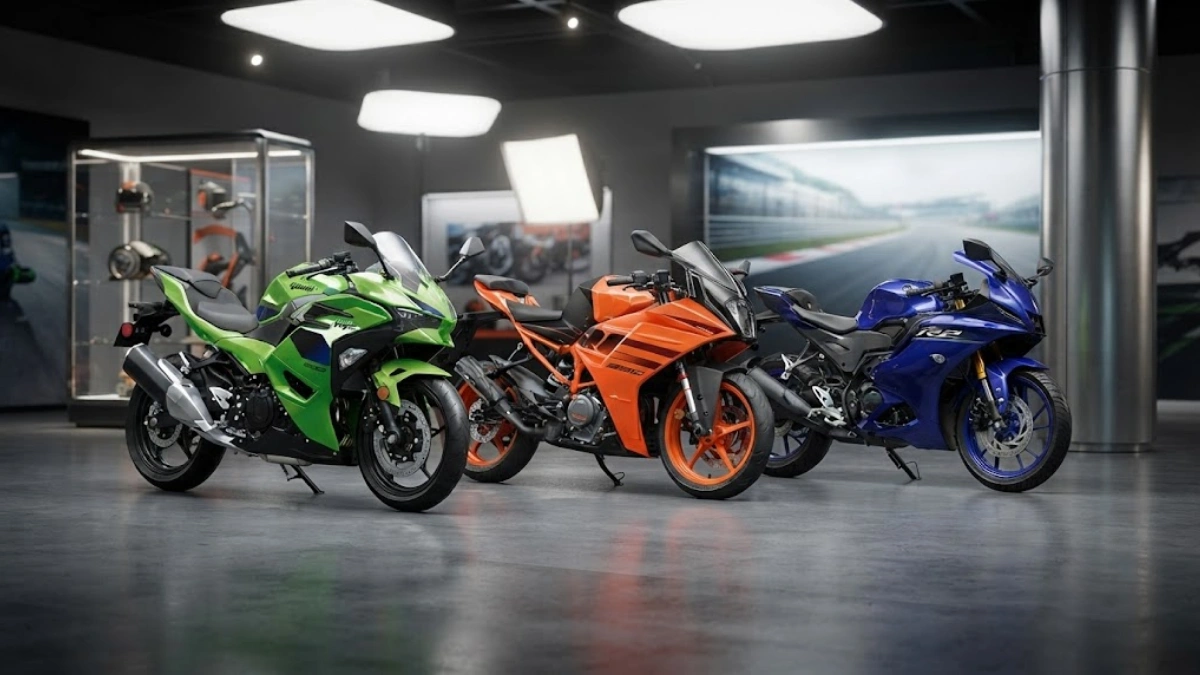
A twin-cylinder cruiser at heart, a single-cylinder track weapon, and a balanced all-rounder, three engines, three philosophies, one shortlist. Every entry-level supersport bike buyer in India eventually lands on the same three names: the Kawasaki Ninja 500, the KTM RC 390, and the Yamaha R3. On paper they compete in the same bracket; in practice, they're built for almost entirely different riders. The Ninja 500 trades outright sharpness for effortless, torque-rich cruising. The RC 390 strips things down to raw handling and value, with a chassis that genuinely wants to be on a track. The R3 sits between the two, chasing balance over extremes.
None of that nuance shows up in a spec sheet comparison and that's exactly why getting this decision wrong is so easy, and so costly. This guide breaks down price, performance, mileage, handling, features, and safety across all three, so you know which one actually fits the way you ride, not just the way it looks in a showroom.
2027 Kawasaki Ninja 500 vs KTM RC 390 vs Yamaha R3 – Overview
- Kawasaki Ninja 500: A parallel-twin supersport that replaced the long-running Ninja 400 globally. It's the segment's twin-cylinder value pick, bigger displacement, smoother power delivery, and genuine highway-cruising comfort, but comparatively light on electronics.
- KTM RC 390: The segment's benchmark for outright sharpness. A single-cylinder engine, a trellis frame borrowed from the 390 Duke, and the most track-focused riding position of the three. It also had the most consistent generational updates of any bike here.
- Yamaha R3: The most "everyday usable" of the trio. A 321cc parallel-twin with a near-perfect 50:50 weight distribution and Yamaha's R-series design DNA. It had a bumpier road in India, briefly discontinued in late 2025 due to steep CBU pricing, with a refreshed version brought back into the market.
All three sit in the ₹3–6 lakh bracket and are aimed at riders stepping up from 150–250cc machines who want genuine highway performance without jumping straight to a 600cc supersport.
2027 Kawasaki Ninja 500 vs KTM RC 390 vs Yamaha R3 – Price Comparison
| Motorcycle | Ex-Showroom Price (Approx.) |
| KTM RC 390 | ₹3.30 – 3.35 lakh |
| Yamaha R3 | ₹3.70 – 4.65 lakh (CBU import; pricing has fluctuated) |
| Kawasaki Ninja 500 | ₹5.76 lakh |
The KTM RC 390 is comfortably the most affordable of the three, and that gap only widens once you factor in on-road costs. The Yamaha R3 sits in the middle but has seen real price volatility in India, it launched at ₹4.65 lakh, was discounted to around ₹3.39 lakh to boost sales, was briefly pulled from the market entirely due to weak demand, and has since returned with revised pricing. Always check current dealership pricing before budgeting, as CBU-import bikes like the R3 are the most exposed to duty and currency-driven price changes.
The Kawasaki Ninja 500 is the most expensive by a wide margin, largely because it's also imported and carries the largest engine of the three. Buyers frequently point out that rivals like the Aprilia RS 457 undercut it while offering more electronics, worth cross-shopping if outright value is your priority.
Practical takeaway: if budget is your primary constraint, the RC 390 wins outright. If you want the biggest engine and are willing to pay for it, the Ninja 500 is the ceiling of this comparison.
Engine & Performance Comparison
| Spec | Kawasaki Ninja 500 | KTM RC 390 | Yamaha R3 |
| Engine | 451cc, liquid-cooled, parallel-twin, DOHC | 373.27cc, liquid-cooled, single-cylinder, DOHC | 321cc, liquid-cooled, parallel-twin, DOHC |
| Power | 44–45.4 PS @ 9,000–10,000 rpm | 43.5 PS @ 9,000 rpm | 40.4–42 PS @ 10,750 rpm |
| Torque | 42.6 Nm @ 6,000–7,500 rpm | 37 Nm @ 7,000 rpm | 29.5 Nm @ 9,000 rpm |
| Gearbox | 6-speed, slip/assist clutch | 6-speed, slipper clutch, bi-directional quickshifter (standard) | 6-speed, slipper/assist clutch |
| Claimed top speed | 190 kmph | 160 kmph | 180–190 kmph |
This is where the three bikes reveal completely different characters. The Ninja 500 has the largest engine and the most torque, delivered with the smoothness that only a parallel-twin can offer, it pulls cleanly from low revs and doesn't need to be thrashed to feel quick.
The RC 390 makes almost as much peak power from a much smaller single-cylinder engine, which means it has to work harder and rev higher to get there, but it comes with a standard bi-directional quickshifter, something neither rival offers as standard, making fast, clutch-less gear changes a genuine everyday feature rather than a track-day luxury.
The R3 has the smallest engine and the lowest torque figure, and it needs the highest revs (10,750 rpm) to hit peak power, meaning it rewards being ridden hard but can feel comparatively softer in real-world, low-rpm riding like city commutes.
Practical takeaway: want effortless torque and top-end pull for highway riding, Ninja 500. Want the sharpest throttle response and a quickshifter as standard, RC 390. Want a balanced, rev-happy engine with the smoothest character among the two smaller twins, R3.
Mileage & Fuel Efficiency Comparison
| Motorcycle | Claimed/Expert Mileage | User-Reported Mileage | Fuel Tank Capacity |
| Kawasaki Ninja 500 | 26.3–28.7 kmpl | 21 kmpl | 14 litres |
| KTM RC 390 | 29 kmpl | 26.6–29 kmpl | 13.7 litres |
| Yamaha R3 | 29 kmpl | 29 kmpl | 14 litres |
On paper, the RC 390 and R3 are the more fuel-efficient options, largely a function of their smaller engine capacities. The Ninja 500's bigger twin extracts a mileage penalty, especially in real-world, stop-start city riding where user-reported figures dip closer to the low-20s. All three bikes offer broadly similar tank ranges (roughly 350–400 km on a full tank under mixed riding), so highway touring range isn't dramatically different despite the mileage gap.
Practical takeaway: if daily commuting economy matters more than outright performance, the RC 390 or R3 will cost less to run than the Ninja 500.
Design & Styling
- Kawasaki Ninja 500: Carries over the sharp, SuperSport-inspired fairing design from its Ninja lineage, with a full fairing, aerodynamic bodywork, and Kawasaki's signature Lime Green paint scheme drawing a direct line to its racing heritage. It looks the most "grown-up" and premium of the three in person.
- KTM RC 390: The most track-focused silhouette here, a compact, aggressive fairing, clip-on handlebars, and a stance that visually announces its trellis-frame, race-bred origins. Recent generational updates have brought a projector headlamp and tighter panel fit, sharpening an already aggressive look.
- Yamaha R3: Wears the unmistakable R-series face, clearly inspired by the flagship R1, with aerodynamic bodywork and integrated winglets on the newer design. It reads as the most "sport-touring adjacent" of the three, slightly less extreme than the RC 390.
Practical takeaway: all three are genuinely good-looking motorcycles; the choice here is largely down to brand preference and colour availability, since each is currently offered in a very limited palette (often a single signature colour per model).
Features Comparison
| Feature | Kawasaki Ninja 500 | KTM RC 390 | Yamaha R3 |
| Instrument cluster | Full LCD with lap timer, Bluetooth via Rideology app | Digital cluster with adjustable clip-ons | LCD cluster (Bluetooth availability varies by market spec) |
| Quickshifter | Not standard | Standard, bi-directional | Not standard |
| Rider modes / Traction control | Not offered | Not offered on base spec | Not offered |
| Ergonomics adjustability | Kawasaki ERGO-FIT (adjustable footpegs, seat, handlebar) | Fixed clip-ons | Fixed, semi-relaxed clip-ons |
| ABS | Dual-channel, non-switchable | Dual-channel | Dual-channel |
None of these three motorcycles offer the rider-mode or traction-control sophistication you'd find on rivals like the Aprilia RS 457, and that's a genuine gap worth knowing about before you buy. Where each bike differentiates itself: the Ninja 500's ERGO-FIT system is a rare and genuinely useful feature that lets you physically adjust the bike to your body rather than the other way around; the RC 390's standard quickshifter is a tangible everyday convenience its rivals don't match; and the R3 keeps things simple and reliable rather than piling on tech.
Practical takeaway: if you want the most "feature-rich" ownership experience, the Ninja 500's connectivity and ergonomic adjustability edge it ahead, but the RC 390's standard quickshifter is arguably the single most useful feature across all three bikes for spirited riding.
Suspension, Brakes & Handling
| Spec | Kawasaki Ninja 500 | KTM RC 390 | Yamaha R3 |
| Front suspension | 41mm telescopic fork | WP Apex USD fork, 43mm | 37mm KYB USD fork |
| Rear suspension | Bottom-link Uni-Trak monoshock, preload adjustable | WP Apex monoshock, 10-step adjustable | Monoshock |
| Front brake | 310mm disc | Larger front disc (updated generation) | 298mm disc |
| Rear brake | 220mm disc | Disc | 220mm disc |
| Frame | Steel trellis | Trellis frame (shared lineage with 390 Duke) | Steel diamond frame |
The RC 390 is the clear handling benchmark here, its USD forks, adjustable monoshock, and trellis frame (tuned specifically for sharper turn-in than the 390 Duke it shares components with) are the most track-capable setup of the three, and it's the only one offering meaningful suspension adjustability out of the box.
The Ninja 500 uses a conventional telescopic fork rather than USD units, which is a step down on paper, but its steel trellis frame and revised chassis geometry are tuned more for stability and comfort, it's the more forgiving bike to ride hard without feeling nervous.
The R3's KYB USD fork and diamond frame strike a middle ground, offering sportier handling than the Ninja 500 without quite matching the RC 390's outright agility, especially through fast direction changes.
Practical takeaway: for outright cornering ability and track days, the RC 390 leads. For stable, confidence-inspiring handling on real-world roads, the Ninja 500 is easier to live with.
Dimensions & Weight Comparison
| Spec | Kawasaki Ninja 500 | KTM RC 390 | Yamaha R3 |
| Kerb weight | 171 kg | 158–172 kg (varies by source/spec) | 169 kg |
| Seat height | 785 mm | 835 mm | 780 mm |
| Wheelbase | Not officially specified (comparable to segment) | Not officially specified | 1,380 mm |
| Fuel tank capacity | 14 litres | 13.7 litres | 14 litres |
Seat height is a genuinely important, often-overlooked factor here. The RC 390's 835mm seat height is significantly taller than both rivals, which can be a real consideration for shorter riders, Kawasaki and Yamaha's sub-790mm seat heights are far friendlier for riders under 5'6", letting them get a flat foot down at stops.
Weight figures are close across the board, with the R3 and Ninja 500 both under 175 kg, keeping all three genuinely manageable in city traffic and easy to flick around despite their sportbike intent.
Practical takeaway: shorter riders should sit on the RC 390 before buying — its tall seat height is the biggest ergonomic outlier in this comparison.
Safety Features Comparison
All three motorcycles come with the segment-standard safety package:
- Dual-channel ABS as standard across all three
- Disc brakes front and rear on every model
- Slipper clutches on all three, reducing rear-wheel hop under aggressive downshifts
Beyond this baseline, none of the three currently offers switchable traction control, cornering ABS, or rider modes — features increasingly common on rivals like the Aprilia RS 457. The KTM RC 390 pulls slightly ahead in real-world control thanks to its standard quickshifter, which reduces the chance of missed shifts and clutch-related errors during hard acceleration, indirectly aiding rideability and control.
Practical takeaway: none of these three should be seen as "electronics-first" motorcycles — if advanced rider aids like traction control are a dealbreaker for you, this comparison isn't the right shortlist.
Kawasaki Ninja 500 vs KTM RC 390 vs Yamaha R3 – Specifications
| Specification | Kawasaki Ninja 500 | KTM RC 390 | Yamaha R3 |
| Engine displacement | 451cc | 373.27cc | 321cc |
| Configuration | Parallel-twin | Single-cylinder | Parallel-twin |
| Max power | 44–45.4 PS | 43.5 PS | 40.4–42 PS |
| Max torque | 42.6 Nm | 37 Nm | 29.5 Nm |
| Gearbox | 6-speed | 6-speed with quickshifter | 6-speed |
| Kerb weight | 171 kg | ~158–172 kg | 169 kg |
| Seat height | 785 mm | 835 mm | 780 mm |
| Fuel tank | 14 litres | 13.7 litres | 14 litres |
| Mileage (approx.) | 21–28 kmpl | 26.6–29 kmpl | ~29 kmpl |
| Price (ex-showroom) | ₹5.76 lakh | ₹3.30–3.35 lakh | ₹3.70–4.65 lakh |
Pros & Cons
Kawasaki Ninja 500
- Pros: Biggest engine and most torque in this comparison; smooth twin-cylinder power delivery; adjustable ERGO-FIT ergonomics; premium build and badge appeal
- Cons: Most expensive by a clear margin; conventional (non-USD) front fork; lower real-world mileage; no quickshifter
KTM RC 390
- Pros: Most affordable; sharpest handling and most track-capable chassis; standard bi-directional quickshifter; best power-to-price ratio
- Cons: Tallest seat height, less friendly for shorter riders; single-cylinder engine feels busier at highway speeds; most aggressive, least comfortable riding position for daily commuting
Yamaha R3
- Pros: Balanced, confidence-inspiring handling; comfortable, lowest seat height of the three; strong highway top-end; R-series design appeal
- Cons: Least torque and lowest peak-power figure; India availability has been inconsistent (briefly discontinued); CBU import pricing has fluctuated significantly
Which Bike Is Best for You?
- Choose the Kawasaki Ninja 500 if: you want the biggest engine, the smoothest power delivery, and don't mind paying a premium for it — ideal for riders who do long highway stints and value comfort alongside performance.
- Choose the KTM RC 390 if: budget matters, you want the sharpest handling and a genuine track-day-capable chassis, and you're comfortable with an aggressive, committed riding position.
- Choose the Yamaha R3 if: you want the most balanced, easy-to-live-with package with a comfortable seat height and confidence-inspiring dynamics — but confirm current India availability and pricing before committing, given its recent on-and-off status in the market.
2027 Kawasaki Ninja 500 vs KTM RC 390 vs Yamaha R3 – Our Opinion
There's no single "best" bike here, only the best bike for a specific kind of rider. If you're buying primarily on value and want the most track-honed machine your money can buy, the KTM RC 390 is the standout, backed by its standard quickshifter and the lowest price tag of the three. If you want the most premium, comfortable, and effortlessly powerful motorcycle and don't mind the extra cost, the Kawasaki Ninja 500 justifies its price with genuine twin-cylinder character and thoughtful ergonomic touches like ERGO-FIT. The Yamaha R3 remains a genuinely well-balanced motorcycle on merit, but its inconsistent availability in India is a real practical concern, verify current stock and pricing at your nearest dealership before shortlisting it seriously.
Our honest recommendation: test ride all three before deciding. Seat height, ergonomics, and engine character are deeply personal preferences that no spec sheet can fully capture, and a five-minute ride will tell you more than any comparison table.
Book a Test Drive
Free doorstep test drive at your convenience
Popular Brands



Latest Bike News
2027 Kawasaki Ninja 500 vs KTM RC 390 vs Yamaha R3: Complete Comparison
Yamaha R2 vs R15 vs R3: Which Yamaha Sports Bike Should You Buy?
Bajaj Pulsar N160 SS Mileage: Real-World Average, City & Highway Figures
Hero June 2026 Sales Report: Splendor, HF Deluxe, Destini & Glamour
War Impact on Two-Wheeler Market: Sales Growth or Slowdown in 2026?
Electric Bikes vs Petrol Bikes During War: Which Is the Smarter Choice?
EV Bikes vs Petrol Bikes: Which One Holds the Future in 2026?
Royal Enfield Hunter 350 Launched in 2026: What’s New in India’s Popular Bike?
Triumph Tracker 400 (350cc) Launched in India: Affordable Premium Bike?
Upcoming Bikes April 2026: 5 Bikes That Can Change the Market
Hero Xtreme 160R 4V Launched in India with Cruise Control: Price, Features and Full Specs
Hero MotoCorp February 2026 Sales Report: No.1 Again?
TVS Holi Finance Scheme 2026 Brings 0% Down Payment
Bajaj Holi Discount 2026: ₹10,000 Off Bikes
Top 5 Best Mileage Bikes in India 2026 Under ₹1 Lakh
Hero Xtreme 125R vs TVS Raider 125 – Best 125cc Bike Comparison
Yamaha R2 200cc Sports Bike – India Launch Update and Expected Features
Bajaj Auto to Launch 8 New Bikes in 2026 – Major Focus on Pulsar Series
Top 10 Lightweight Bikes in India in 2026
Top 10 Budget Bikes Under ₹1 Lakh 2026