Top 4 Premium SUVs Expected to Launch in India Next Month
- Cars
- Published: 22 Jun, 2026
Book a Test Drive
Free doorstep test drive at your convenience
If you have been waiting to buy a new SUV, the next few weeks might be the best time to pay close attention. India's automotive calendar for July 2026 is stacked with some genuinely exciting launches — from a performance-focused European flagship to a long-awaited Japanese hybrid, a cult-classic electric SUV, and Nissan's big return to form. Here is a detailed look at all four, explained simply and clearly.
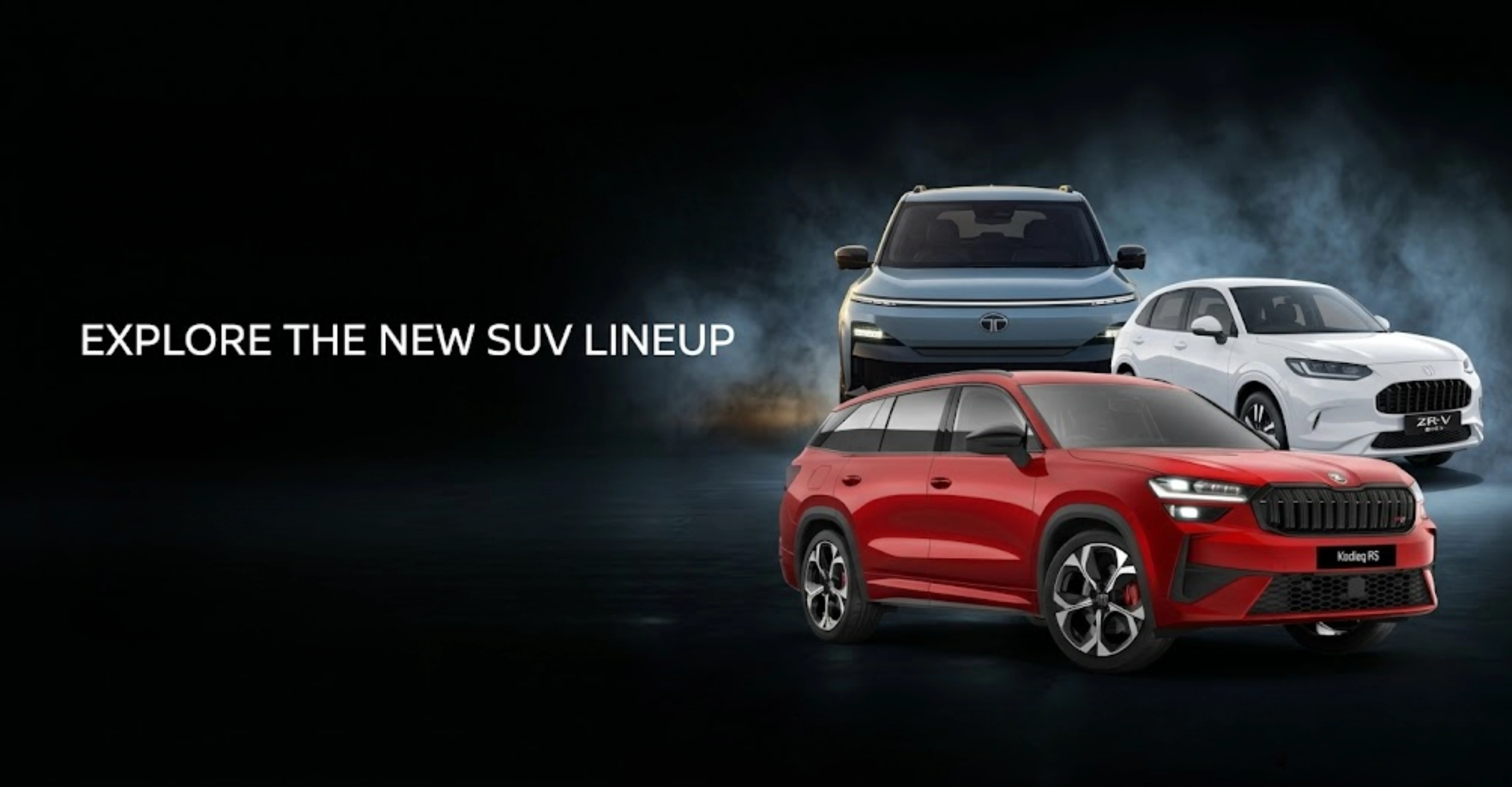
1. Skoda Kodiaq RS — India's First RS-Badged SUV (June 22 Onwards)
Let us start with the one that has already lit up the internet.
Skoda Kodiaq RS pre-bookings in India opened on June 22, 2026, marking the arrival of the brand's first RS-badged SUV in the country. Ashish Gupta, Brand Director at Skoda Auto India, confirmed this while calling it the quickest Skoda ever to come to India.
The RS badge has a loyal fanbase in India. The Octavia RS, which arrived in India over two decades ago, sold out its bookings in under 20 minutes. Now Skoda is bringing that same performance DNA to an SUV — and making it practical enough for families too.
What Makes It Special: The Skoda Kodiaq RS is powered by a 2.0L turbocharged petrol engine producing 263 hp and 400 Nm — roughly 60 hp and 80 Nm more than the standard Kodiaq. It can do the 0–100 kph sprint in just 6.3 seconds and has a top speed of 231 kph, making it Skoda's fastest SUV in India.
The RS version is also equipped with All Wheel Drive (AWD) technology, ventilated and slotted disc brakes, and larger two-piston calipers.
Design: The Kodiaq RS stands apart from the standard model with several RS-specific design elements — a sportier front bumper, gloss black accents on the grille, ORVMs, window surrounds, tailgate lettering, and rear badging. It also comes equipped with 20-inch alloy wheels and dual stainless steel exhaust outlets as standard.
Interior: The front seats carry RS branding and offer contrasting red stitching, also visible across various upholstery and interior trim elements. A large 13-inch touchscreen infotainment system dominates the dashboard, while the practical three-row seating layout remains unchanged.
Availability: Unlike the standard Kodiaq which is locally assembled, the RS variant will arrive in India as a completely built unit (CBU) import. Initial allocation for the first batch is limited to just 50 units.
Expected Price: The Skoda Kodiaq RS is expected to be priced at around Rs 59 lakh (ex-showroom) in India.
In short, the Kodiaq RS is for the buyer who wants a fast, premium, seven-seat SUV that drives like a sports car on weekends and hauls the family with ease on weekdays.
2. Tata Sierra EV — India's Most Awaited Electric SUV (June 30)
Few cars in India carry as much emotional weight as the Tata Sierra. First introduced in the early 1990s, the Tata Sierra remains a cult classic among Indian SUV enthusiasts. After years of teasers and concepts, it is finally coming back — fully electric.
Tata Motors is expected to launch the electric Sierra in India on June 30, 2026. The Sierra EV has been in development for years, first shown as a concept at Auto Expo 2020 and again in 2023.
Design: The Sierra EV features unique design elements that set it apart from its ICE counterpart, including a blanked-off grille and a revised front bumper. The car also carries ".ev" badging, as with other Tata EVs. The iconic blacked-out rear quarter glass — one of the original Sierra's most recognisable features — returns in the new model.
Battery and Range: Like the Harrier EV, the Sierra EV is expected to offer 65 kWh and 75 kWh battery options, with AWD likely limited to the 75 kWh version. Since the Harrier EV already delivers a claimed range of 622 km, the Sierra EV is widely expected to match or exceed that figure — making it one of the longest-range electric SUVs in its price segment.
Inside the Cabin: Top trims may get a triple-screen setup comprising a 10.25-inch digital instrument cluster, a 12.3-inch central touchscreen, and a 12.3-inch passenger display. Lower trims could offer dual screens and a head-up display. Other likely features include a panoramic sunroof, powered and ventilated front seats, multiple drive modes, and a premium audio system.
Safety: Expect Level-2 ADAS, electronic stability control, hill hold assist, tyre pressure monitoring system, and a 360-degree camera, along with up to six or seven airbags.
Expected Price: The Sierra EV is expected to be priced in the Rs 18 lakh to Rs 25 lakh ballpark, positioned between the Curvv EV (Rs 16.99–19.19 lakh) and the Harrier EV (Rs 21.49–28.99 lakh).
The Sierra EV is not just a car — it is an emotional homecoming for millions of Indians, now with zero emissions and cutting-edge tech.
3. Honda ZR-V Hybrid — The Fuel-Sipping Flagship (Deliveries from July 2026)
Honda has been relatively quiet in India's SUV space in recent years. The ZR-V is its answer — and it comes with a genuinely clever trick up its sleeve: a strong-hybrid powertrain that delivers outstanding fuel efficiency without sacrificing performance.
The ZR-V comes to India as a full import. Customer deliveries are set to begin in July 2026. Having already surpassed 8 lakh units in cumulative global sales since 2022, the SUV is targeted at discerning buyers seeking an aspirational and distinct driving experience.
Powertrain — The Star of the Show: Powering the new ZR-V is the highly advanced e:HEV Sports Hybrid system, which combines a 2.0-litre direct injection Atkinson-cycle engine with a dual-motor hybrid system and an e-CVT. This setup generates a combined maximum power of 184 PS and a substantial maximum torque of 315 Nm, while achieving a remarkable fuel economy of 22.79 km/l.
There are four drive modes on offer: Normal, Sport, Eco, and Snow. Honda says the SUV can go from 0 to 100 kmph in just 7.8 seconds.
For context, rivals like the Kodiaq manage around 14.86 kpl and the Tiguan around 12.58 kpl. The ZR-V's 22.79 kpl figure is in a completely different league, making it especially attractive for Indian city driving conditions.
Design and Interior: The ZR-V is 4,567 mm long, 1,840 mm wide, and 1,621 mm tall with a wheelbase of 2,655 mm. It gets full LED lights, 18-inch rims, dual exhaust tips, and 4 colour options. The interior gets leatherette seats, contrast stitching, and a bridge-like centre pedestal.
Features: The ZR-V has a powered tailgate, two-zone auto AC, powered front seats, wireless charging, phone connectivity, a 9-inch touchscreen, a 10.2-inch instrument cluster, and a 12-speaker Bose audio system.
Safety: Safety is managed by the Honda SENSING suite, which includes Adaptive Cruise Control, Low-Speed Follow, Lane Keep Assist, and more. The car comes with 8 airbags as standard.
Expected Price: The Honda ZR-V hybrid is expected to be priced between Rs 40 lakh and Rs 50 lakh (ex-showroom).
The ZR-V is the intelligent choice — a premium, Japan-built hybrid SUV that sips fuel, packs technology, and competes head-on with the Skoda Kodiaq and Volkswagen Tiguan at a different kind of price point.
4. Nissan Tekton — Nissan's Bold Return to the SUV Arena (July 9)
Nissan has been relatively off the radar in India since the Kicks was discontinued in 2023. The Tekton is the brand's big comeback — and it arrives looking confident.
The Nissan Tekton's launch is a pivotal moment for the Japanese automaker, signifying its return to the fiercely contested C-SUV segment. The Tekton is expected to play a crucial role in Nissan's renewed India strategy, which includes a substantial $700 million investment in new platforms and products.
The Nissan Tekton will be a badge-engineered version of the Renault Duster, though it will have its own distinct design identity — both outside and inside. The exterior styling draws clear inspiration from the Nissan Patrol.
Design — Baby Patrol Vibes: Up front, the Tekton features a connected LED DRL on the front fascia housing multi-pod LED headlamps. The "TEKTON" badging sits proud on the bonnet, which gets a muscular profile for a tough look. The grille houses the Nissan badge with red accents and chrome trim running across the width of the car, while a chunky silver cladding on the lower bumper enhances road presence.
Engine Options: The Tekton will be powered by the same engine options as the new Renault Duster — a 1.0L turbo-petrol, 1.3L turbo-petrol, and a 1.8L strong hybrid. Both manual and automatic transmissions are likely to be offered.
Interior: Nissan has not fully revealed the cabin, but we can see a multi-layered dashboard design with a gloss black panel accentuated by copper accents running along its width, giving it a premium look. Expect a large touchscreen, panoramic sunroof, ventilated seats, and ADAS on higher variants.
Made in India: The Tekton will be locally produced in Chennai from mid-2026, built on the Renault-Nissan CMF-B platform.
Expected Price: The new Nissan Tekton is likely to be priced competitively, starting around Rs 11 lakh for the base variant and going up to Rs 19 lakh for the top-end trim.
Saurabh Vatsa, MD of Nissan Motor India, confirmed that the Tekton will hit showrooms within weeks of its unveiling, ensuring a swift launch-to-sales cycle and immediate customer deliveries.
The Tekton's biggest strength is value. It combines Renault Duster's proven platform with a bold Nissan-specific design and the promise of locally produced pricing, targeting buyers who want something fresh and rugged at a reasonable cost.
Quick Comparison at a Glance
Here is a simple summary to help you decide which SUV is right for you:
The Skoda Kodiaq RS (expected Rs 55–60 lakh) is for performance-hungry buyers who want a flagship seven-seater with genuine sports car pace and the prestige of the RS badge — but availability is limited to 50 units, so decisions need to be quick.
The Tata Sierra EV (expected Rs 18–25 lakh) is for anyone who wants an emotionally resonant, fully electric SUV with 600+ km claimed range, triple screens, and AWD — all at a price that undercuts many petrol rivals.
The Honda ZR-V (expected Rs 40–50 lakh) is for the fuel-conscious premium buyer who wants Japanese reliability, a brilliant 22+ kpl hybrid engine, 8 airbags, and Bose audio — without the badge premium of European rivals.
The Nissan Tekton (expected Rs 11–19 lakh) is for first-time SUV buyers and those upgrading from hatchbacks, offering a bold Patrol-inspired design, proven underpinnings, and locally manufactured pricing.
Final Thoughts
July 2026 is shaping up to be one of the most exciting months for Indian car buyers in recent memory. Whether your budget is Rs 12 lakh or Rs 60 lakh, there is something meaningful arriving in showrooms. The variety also tells a bigger story about where India's auto market is heading — electric, hybrid, performance, and value are all growing simultaneously, and manufacturers are responding.
If any of these four catches your eye, now is the time to register your interest. Some, like the Kodiaq RS with its 50-unit first-batch limit, will not wait for late arrivals.
Book a Test Drive
Free doorstep test drive at your convenience
Popular Brands





Latest Car News
Upcoming Cars in September 2026 in India: New Cars, Launch Dates & Expected Prices
MG Hector Hawk SUV vs Tata Harrier: Expected Price, Features & Key Differences
Skoda Superb Diesel in India: Will the Diesel Engine Make a Comeback?
Tata Punch Becomes India's Best-Selling SUV in July 2026 with 21,313 Units Sold
Car Sales Report July 2026: Maruti Remains No.1, Tata, Mahindra & Hyundai Record Strong Growth
Tata Curvv EV Discount August 2026: Save Big with Limited-Time Offers
Kia Sorento Booking in India: Launch Date, Price & Booking Process
Skoda Slavia Facelift Launch Date in India
Hyundai Creta Next Gen Upgrades: Biggest Changes Expected
Limited Edition Skoda Slavia Monte Carlo Adds New Colours for 200 Buyers Only
Suzuki Loses India Market Share as Buyers Demand More Features
Hybrid Car Sales Decline 8% in June 2026: Complete Analysis
How to Book Maruti Brezza Facelift: Complete Booking Guide
Alto K10 vs Tiago: Which Is Better?
Maruti Brezza Facelift 2026: What's New Compared to the Current Model?
Renault Duster Adventure Edition vs Standard Duster: What's Different?
Skoda Slavia Facelift 2026 vs Volkswagen Virtus: Which Sedan Should You Wait For?
Volkswagen Tayron Life Launched in India at ₹41.99 Lakh
Volkswagen Announces 50% Reduction In Global Car Line-up
Tata Nexon Pure Plus : Know Everything Before Buying in July