
Kia Announces Price Hike from July 1: Sonet, Seltos, Syros Among Affected Models
- Cars
- Published: 19 Jun, 2026
Book a Test Drive
Free doorstep test drive at your convenience
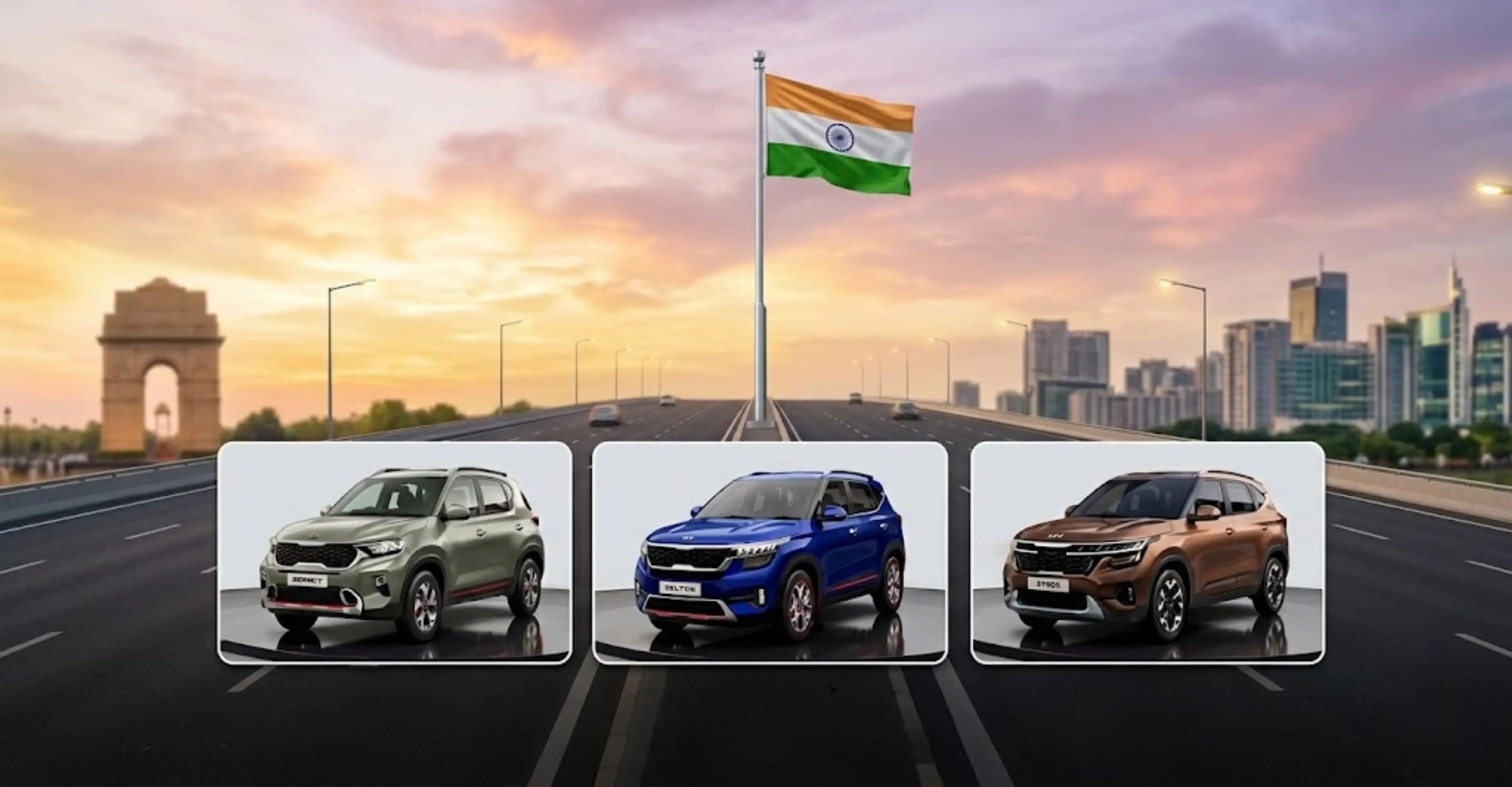
If you have been sitting on the fence about buying a Kia, now is the moment to make a decision. Kia India has announced it will increase prices across its model range by up to 2 percent from July 1, 2026. The carmaker has cited "rising input costs and an overall increase in operational expenditure" as the reason for the move.
The announcement, made officially by Kia India on June 18, 2026, marks the brand's first formal price revision of the year and will affect every model in its current lineup — from the entry-level Sonet compact SUV to the premium EV9 electric flagship. This is not routine news. For a brand that has just posted record-breaking monthly sales and crossed the 15 lakh cumulative units milestone in India, a price hike carries significant weight for thousands of prospective buyers who are actively in the market right now.
Here is everything you need to know — which models are affected, how much the prices could realistically increase in rupee terms, why this is happening, and whether you should rush to the showroom before July 1.
What Exactly Has Kia Announced?
Kia India has announced a price increase of up to 2% across its vehicle lineup, effective from 1st July 2026. The company stated that the revision has become necessary due to rising input costs and an overall increase in operational expenses. The exact quantum of the hike will vary depending on the model and variant. Kia has not yet revealed the revised price list for individual products.
Kia stated that it remains "committed to offering its customers the best-in-class products and ownership experience" and has "endeavoured to keep the price increase to a minimum" by absorbing a significant portion of the cost escalation internally. "The extent of the price increase will vary across models and variants, ensuring that the overall value proposition of each offering is maintained," said the brand.
The key practical point: while the carmaker hasn't revealed model-specific price revisions, an increase of up to ₹2.6 lakh is likely, depending on the car and variant chosen.
Which Kia Models Are Affected?
The upcoming revision will apply across Kia India's entire portfolio, including the Sonet, Syros, Seltos, Carens, Carens Clavis, Carnival, EV6 and EV9.
That is every single Kia model currently on sale in India. No model has been exempted. Let us look at each affected model, its current pricing, and the likely impact.
Kia Sonet — India's Best-Selling Compact SUV
Current Price (June 2026): ₹7.33 lakh – ₹14.09 lakh (ex-showroom)
Kia Sonet starts at a price of ₹7,33,500 (ex-showroom, all India) after the GST cut. The Sonet is Kia's volume backbone and consistently one of the top-selling compact SUVs in the country. In April 2026, the Sonet surpassed the 10,000-unit sales mark — a performance that represents a healthy 31% year-on-year growth.
At 2% hike, the Sonet's base price could rise by approximately ₹14,700 — taking the entry variant to around ₹7.48 lakh. The top GTX Plus variant, currently priced at approximately ₹14.09 lakh, could see an increase of up to ₹28,000. For buyers who are actively comparing the Sonet with the Hyundai Venue or Tata Nexon, this revision makes the pre-July window meaningfully valuable.
Kia Seltos — The Star Performer and Sales Leader
Current Price (June 2026): ₹10.99 lakh – ₹20.21 lakh (ex-showroom)
Kia Seltos price starts from ₹10.99 lakh for the base model and goes up to ₹20.21 lakh (ex-showroom) for the top model as of June 2026. The new Seltos 2026 is 95mm longer, 30mm wider, and has an 80mm bigger wheelbase than the outgoing model.
As of February 2026, the Kia Seltos has crossed 6 lakh cumulative sales in the Indian market since its launch in 2019. The all-new second-generation Seltos, launched in January 2026, has been selling over 10,000 units every single month since delivery began. In lifetime sales terms, the Seltos accounts for over 41 percent of Kia India's total sales volume.
At 2%, the Seltos base variant could see an increase of approximately ₹22,000, while the top X-Line variant priced at ₹20.21 lakh could go up by as much as ₹40,000. For buyers finalising a Seltos purchase — particularly those evaluating the mid-level HTX or HTX Plus variants that represent the segment's sweet spot — locking in the June 2026 price is financially meaningful.
Kia Syros — The New Entrant That Needed a Reset
Current Price (June 2026): ₹8.42 lakh – ₹15.82 lakh (ex-showroom)
The Syros is Kia's newest and most recently updated product in India. The 2026 Kia Syros variant update improved accessibility of the diesel-automatic powertrain, with prices starting at ₹12.73 lakh — making the entry point for a Syros diesel-automatic ₹2.48 lakh more affordable than before. The base petrol-manual Syros now starts at ₹8.39 lakh, making it ₹27,000 more affordable than earlier.
The Syros had a difficult run through early 2026 in terms of volumes, with Syros sales declining sharply to 554 units in April 2026 — an 86% year-on-year drop from 4,000 units in April 2025. However, the brand updated the variant lineup in May 2026 and has been working to make it more accessible. The July price hike comes at an inopportune moment for the Syros, just as Kia was stabilising its pricing strategy for the model.
A 2% increase on the Syros range translates to roughly ₹16,000–₹31,000 depending on variant. Given the Syros's competitive position against the Maruti Fronx and Hyundai Exter in its price bracket, even a marginal increase has competitive implications.
Kia Carens and Carens Clavis — The Family MPV Duo
Current Price (June 2026): Carens ₹11.02 lakh – ₹12.88 lakh | Carens Clavis ₹11.23 lakh – ₹21.59 lakh (ex-showroom)
The Carens family accounts for a consistent 20% of Kia India's total sales. The Carens Clavis, launched in its ICE and electric (Clavis EV) avatars, has further strengthened Kia's position in the family MPV segment. The Carens Clavis, available in both ICE and EV formats, adds significant premium appeal through features like electric and panoramic sunroofs, GT-Line and X-Line trims, and a comfortable 6-seater configuration featuring captain seats.
At 2%, expect the Carens to increase by ₹22,000–₹26,000, while the Carens Clavis range could see increases of up to ₹43,000 on the top-spec variants.
Kia Carnival — The Premium MPV
Current Price (June 2026): ₹59.45 lakh (ex-showroom)
The Carnival is Kia's premium large MPV and the highest-volume-per-unit price product in its non-EV lineup. The Carnival sold just 67 units in March 2026 — a challenging performance reflecting the competitive environment in the premium MPV space. A 2% increase on the Carnival translates to approximately ₹1.19 lakh — making the July 1 deadline particularly significant for buyers in this segment.
Kia EV6 and EV9 — The Electric Flagship Duo
Current Price (June 2026): EV6 ₹65.97 lakh | EV9 ₹1.30 crore (ex-showroom)
Both the EV6 and EV9 are CBU (Completely Built Unit) imports, making them especially sensitive to cost pressures including import logistics and currency fluctuations. At a 2% revision, the EV6 could see an increase of up to ₹1.32 lakh, while the EV9 faces a possible increase of up to ₹2.60 lakh — the largest absolute increase in Kia's current lineup.
Why Is This Happening? The Honest Explanation
The latest move highlights the growing pressure automakers face from rising input costs, increasing localisation investments, and evolving regulatory requirements. Over the past few years, vehicle manufacturers have been absorbing a significant portion of rising commodity and logistics costs to remain competitive in an increasingly crowded market. However, continued inflation in steel, aluminium, plastics, semiconductors, and transportation expenses has made it difficult for OEMs to maintain margins without passing on some of the burden to customers.
Critically, Kia is not alone. This development is not an isolated event. Broader industry trends reflect similar adjustments — Maruti Suzuki recently announced its own price hikes of up to ₹30,000 starting in June 2026 due to mounting commodity and operational costs. Kia isn't the only carmaker to announce a price hike — brands such as Tata, Hyundai, and Maruti Suzuki have also raised prices, citing similar reasons.
The macroeconomic reality is clear: the era of absorbing cost pressures silently ended sometime in early 2026 across the Indian auto industry. Manufacturers held back as long as they could to protect market share, but the cumulative impact of steel and aluminium price increases, semiconductor costs, and operational expenditure growth has finally made partial pass-through unavoidable.
Kia India's Position in the Market — Why Buyers Still Trust the Brand
To understand why this price hike is unlikely to significantly dent Kia's momentum, look at the numbers. Kia recently crossed the milestone of 15 lakh vehicle sales in India within seven years of entering the market, underscoring its strong acceptance among Indian buyers.
Kia India achieved record-breaking May 2026 sales with 27,586 units — representing 23.6% year-on-year growth. Month after month, the brand has been posting record or near-record numbers, driven primarily by the all-new Seltos and the Sonet.
Kia India now has 891 touchpoints across 396 cities along with 128 Certified Pre-Owned outlets, with the company announcing the opening of its 500th service location in April 2026. The brand's service infrastructure — once a concern for buyers choosing between Kia and more established Japanese brands — has expanded dramatically in the last three years.
Industry experts believe that demand for Kia's key products is unlikely to be significantly impacted, especially in popular segments such as compact SUVs and family-oriented MPVs where the brand enjoys strong customer acceptance.
Kia's Upcoming Product Roadmap — Context for the Price Hike
Understanding the price hike also requires understanding what Kia is investing in for the near future. The company is in an active expansion phase, and that investment has to be funded.
Kia Syros EV — The Syros EV is expected to launch around August 2026. It will be Kia's second electric offering and their first electric SUV in the current lineup. The Syros EV is likely to be equipped with 42 kWh and 49 kWh battery packs. Kia Syros EV price in India could be in the range of ₹15–20 lakh (ex-showroom). It will be locally developed at Kia's factory in Andhra Pradesh.
Kia Seltos Hybrid — Atul Sood, Senior Vice-President of Sales and Marketing at Kia India, confirmed that a Seltos hybrid will indeed be launched in the Indian market by late 2026. The existing 1.5L naturally-aspirated petrol engine will be hybridised with heavily localised components for aggressive pricing.
Kia Sorento Hybrid — Kia is working on localising the Sorento to take on the likes of the Jeep Meridian and Toyota Fortuner. The three-row Sorento SUV is expected to go on sale in 2027 with a hybrid powertrain, positioned above the Seltos in Kia's portfolio.
Next-Gen Kia Sonet — The next-gen Kia Sonet has been spied testing. It might come with larger touchscreens, front and rear ventilated seats, and other upgraded features.
This is an aggressive and expensive product calendar. The investment being made in EV localisation, hybrid technology development, new platform engineering, and network expansion comes with real financial costs — and the July 1 price revision is partly a reflection of that investment trajectory.
Model-Wise Impact Summary (Estimated)
| Model | Current Base Price | Estimated Increase (Up to 2%) | New Estimated Base Price |
| Kia Sonet | ₹7.33 lakh | ~₹14,700 | ~₹7.48 lakh |
| Kia Syros | ₹8.42 lakh | ~₹16,800 | ~₹8.59 lakh |
| Kia Seltos | ₹10.99 lakh | ~₹22,000 | ~₹11.21 lakh |
| Kia Carens | ₹11.02 lakh | ~₹22,000 | ~₹11.24 lakh |
| Kia Carens Clavis | ₹11.23 lakh | ~₹22,500 | ~₹11.46 lakh |
| Kia Carnival | ₹59.45 lakh | ~₹1.19 lakh | ~₹60.64 lakh |
| Kia EV6 | ₹65.97 lakh | ~₹1.32 lakh | ~₹67.29 lakh |
| Kia EV9 | ₹1.30 crore | ~₹2.60 lakh | ~₹1.326 crore |
Note: These are maximum estimated increases. Actual hike per variant may be lower. Kia has not disclosed variant-specific revisions as of June 19, 2026.
Should You Buy Before July 1?
The answer is a qualified yes — but with important conditions.
If you are already at the stage of finalising a variant, comparing on-road prices, and ready to take delivery — act now. The window between now and June 30, 2026 represents a genuine savings opportunity ranging from ₹15,000 on an entry Sonet to potentially over ₹2.5 lakh on an EV9 or top-spec Seltos. These are not trivial amounts.
If you are still in the early research and comparison phase — comparing the Seltos against the Hyundai Creta, or the Sonet against the Tata Nexon — do not let deadline pressure push you into a hasty decision. The price increase, while real, is capped at 2%. The wrong variant or wrong car is a far more expensive mistake than a ₹20,000 revision.
For Carnival and EV6 buyers specifically: a potential ₹1–1.3 lakh increase is a genuinely compelling reason to accelerate your timeline if you were planning to purchase in the second half of 2026 anyway.
The Bottom Line
Kia India entering July 2026 with a price revision is the most significant piece of near-term news for anyone in the market for a Sonet, Seltos, Syros, or any other Kia model. For Kia, the price hike comes at a time when the company is expanding its product portfolio, strengthening its EV presence, and investing in future mobility technologies. Despite the planned price revision, Kia remains one of India's fastest-growing automotive brands.
The price hike is modest, it is industry-wide, and it is backed by legitimate economic justification. What it is not, however, is reversible once July 1 arrives. If a Kia was on your shortlist, the next 12 days represent your best opportunity to drive one home at 2026's most competitive prices.
Book a Test Drive
Free doorstep test drive at your convenience
Popular Brands





Latest Car News
Tata Punch Becomes India's Best-Selling SUV in July 2026 with 21,313 Units Sold
Car Sales Report July 2026: Maruti Remains No.1, Tata, Mahindra & Hyundai Record Strong Growth
Tata Curvv EV Discount August 2026: Save Big with Limited-Time Offers
Kia Sorento Booking in India: Launch Date, Price & Booking Process
Skoda Slavia Facelift Launch Date in India
Hyundai Creta Next Gen Upgrades: Biggest Changes Expected
Limited Edition Skoda Slavia Monte Carlo Adds New Colours for 200 Buyers Only
Suzuki Loses India Market Share as Buyers Demand More Features
Hybrid Car Sales Decline 8% in June 2026: Complete Analysis
How to Book Maruti Brezza Facelift: Complete Booking Guide
Alto K10 vs Tiago: Which Is Better?
Maruti Brezza Facelift 2026: What's New Compared to the Current Model?
Renault Duster Adventure Edition vs Standard Duster: What's Different?
Skoda Slavia Facelift 2026 vs Volkswagen Virtus: Which Sedan Should You Wait For?

Volkswagen Tayron Life Launched in India at ₹41.99 Lakh
Volkswagen Announces 50% Reduction In Global Car Line-up
Tata Nexon Pure Plus : Know Everything Before Buying in July
Best Selling Cars of June 2026 in India
July 2026 Car Offers: Tata, Honda, Kia, MG, Hyundai, Maruti and Other Brands' Discount Offers
Renault Kwid 2026 Launched at Rs 4.53 Lakh