
How to Check Oil Level in Car: Step-by-Step Guide
- Cars
- Published: 10 Sep, 2026
- Updated: 10 Sep, 2026
Book a Test Drive
Free doorstep test drive at your convenience
Engine oil is the single most important fluid keeping your car alive, it lubricates moving parts, carries away heat, and prevents metal-on-metal wear that can destroy an engine in minutes. Yet checking it is one of the simplest maintenance tasks you can do yourself, taking less than five minutes and costing nothing. If your dashboard warning light just came on, or you're simply being proactive, here's exactly how to do it right.
Before you start, make sure your car is parked on level ground and the engine has been off for at least 5-10 minutes. Checking oil immediately after driving gives a false low reading because oil hasn't had time to drain back into the pan, and it also risks burns from hot engine components.
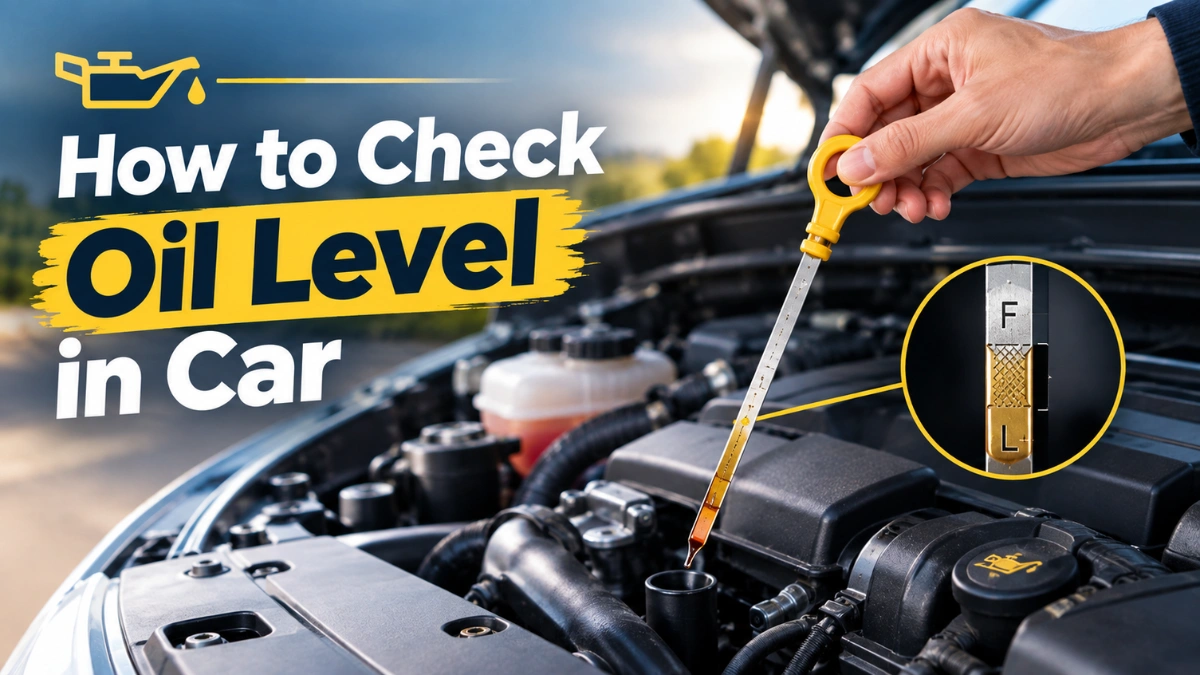
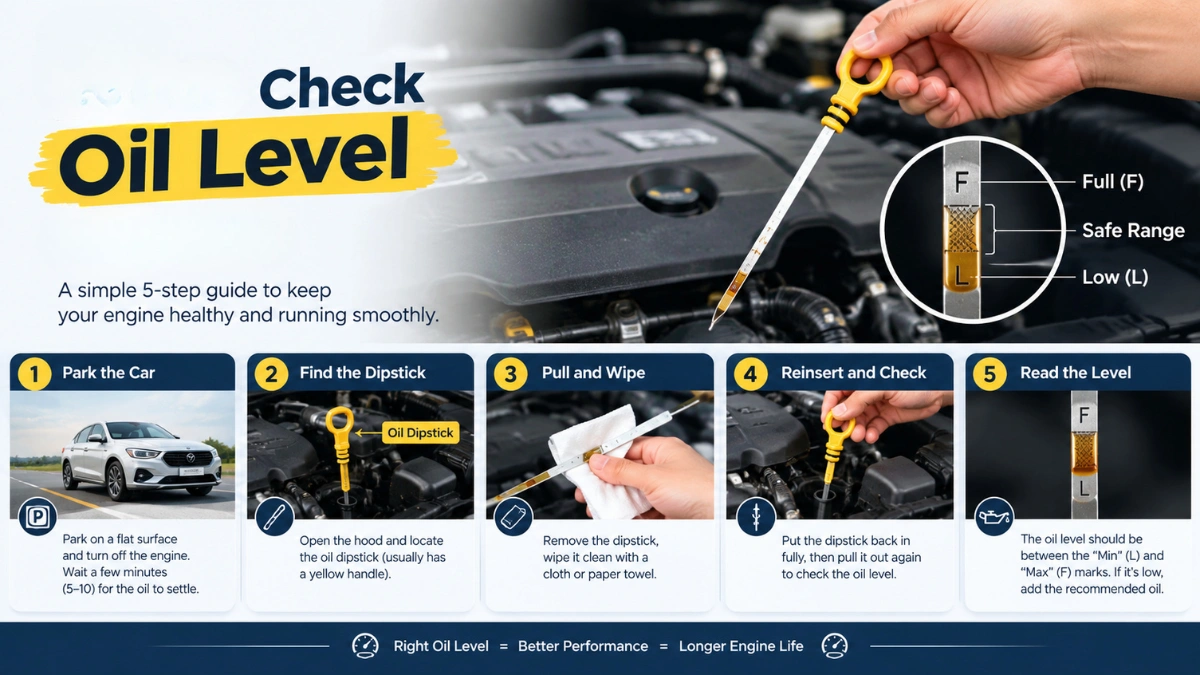
Step 1: Pop the hood and locate the dipstick.
Open your hood and look for a brightly coloured handle, usually yellow or orange, sticking out of the engine. It's typically labelled with an oil can icon or the word "OIL." If you can't find it, check your owner's manual; on some cars it's tucked near the back of the engine bay.
Step 2: Pull out the dipstick and wipe it clean.
Pull the dipstick all the way out. It will be coated in oil, so use a clean rag or paper towel to wipe it completely dry from top to bottom.
Step 3: Reinsert it fully, then pull it out again.
Push the dipstick back into its tube all the way down, then pull it straight out again without twisting.
Step 4: Read the oil level.
Look at the tip of the dipstick. You'll see markings, usually two dots, two lines, or the letters "MIN" and "MAX" (or "L" and "H"). The oil film left on the stick tells you where your level sits relative to these marks.
Step 5: Wipe and repeat if unsure.
If the reading looks ambiguous, wipe the dipstick clean and repeat the check once more for accuracy.
What Should the Oil Level Look Like? When You Check It
The oil should sit somewhere between the two markings on the dipstick, never below the minimum and never above the maximum.
- Ideal level: Right at or just below the "MAX" or upper mark. This means your engine has a full, healthy oil supply.
- Acceptable range: Anywhere between the two marks is generally fine to drive on, though closer to the top is better.
- Low/danger zone: If the oil doesn't even reach the bottom mark, that's a real problem, your engine may be running with insufficient lubrication, which accelerates wear and can cause serious damage.
Beyond the level, pay attention to two more things:
- Colour: Healthy oil is amber to light brown and somewhat translucent. Dark brown or black oil isn't necessarily an emergency (oil darkens naturally as it picks up combustion byproducts), but very dark, gritty, or sludgy oil signals it's overdue for a change.
- Texture and smell: Oil that feels gritty between your fingers, smells burnt, or has a milky, frothy appearance (a sign of coolant mixing in, a serious issue) needs immediate attention. Don't ignore a milky dipstick; get the car to a mechanic before driving further.
What If Your Car Doesn't Have an Oil Dipstick?
Many newer cars, especially post-2018 models from brands like BMW, Mercedes-Benz, Chevrolet (Corvette), and some others, have eliminated the traditional dipstick in favour of an electronic oil level sensor. Here's how to check oil on these:
- Use the digital dashboard menu. Turn the ignition to the "on" position (engine off or running, depending on the model) and navigate through your infotainment or driver display menu to find "Vehicle Status," "Oil Level," or similar under a maintenance or settings tab. The car will display a level as a percentage, a bar graph, or a simple "OK/Low" reading.
- Check your owner's manual for the exact steps, since the menu path varies significantly by manufacturer, some require the engine to be warmed up and idling for an accurate reading, others want it off.
- If there's no digital readout at all, some cars (rare, mostly older sealed systems) genuinely require a trip to the dealer or a mechanic with the right diagnostic tool to check the level accurately. Don't guess or assume, if you're unsure whether your car has a dipstick, a quick search of "[your car model] oil dipstick location" or a look in the manual will confirm it.
- Watch the oil life indicator light. Many dipstick-less cars will proactively warn you via a dashboard icon or message when oil is low or a service is due, don't ignore these alerts even if you can't manually verify the level yourself.
How Often Should You Check Your Car's Engine Oil?
There's no need to check daily, but making it a habit prevents nasty surprises:
- Once a month, minimum. This is the baseline recommendation for any car, especially those over 5 years old or with over 60,000 km on the odometer.
- Before any long road trip. Highway driving puts sustained stress on the engine, check oil (and coolant, tyre pressure) before you leave.
- Every time you fill up gas, if your car is older or has a known oil consumption issue. Some engines, particularly older ones or certain models known for burning oil (a common issue on some turbocharged or high-mileage engines), can lose noticeable oil between changes. If you've noticed your oil level dropping between service intervals, checking every second or third fuel stop is a smart habit.
- Immediately if you notice warning signs: a burning smell, the oil pressure warning light on your dash, unusual engine noise (ticking or knocking), or visible oil spots under where your car is parked.
As a rule of thumb: newer, well-maintained cars in good condition can safely go a month between checks. Older cars, high-mileage vehicles, or anything that's shown oil consumption issues in the past should be checked more frequently, every 1-2 weeks isn't excessive.
What to Do If Your Car Oil Level Is Low
If your dipstick check (or dashboard warning) shows the level is low, here's your practical action plan:
If it's just below the minimum mark:
- Add oil in small amounts, no more than 250-300 ml (about a quarter litre) at a time.
- Wait a minute or two after pouring, then recheck the dipstick before adding more. It's very easy to overfill, and overfilled oil can cause its own problems (foaming, seal damage, increased crankcase pressure).
- Use the exact oil type and viscosity grade specified in your owner's manual (e.g., 5W-30, 0W-20). Using the wrong grade can affect engine protection and fuel economy. If you don't have your manual handy, check the oil filler cap, it's often printed right there.
- Don't have the right oil on hand? In a genuine emergency, a small top-up of a similar-viscosity oil (even a different brand) is far better than driving on critically low oil, but get it corrected with the proper spec oil as soon as possible.
If the dipstick shows no oil at all, or the level is critically low:
- Stop driving immediately. Don't try to "make it home", running an engine with little to no oil for even a few kilometres can cause catastrophic, irreversible damage (seized pistons, destroyed bearings), turning a cheap top-up into a multi-lakh/thousand-dollar repair.
- Check for obvious leaks, look under the car for oil spots or check around the oil filter and drain plug for wetness.
- If you're stranded and it's a real emergency, call roadside assistance or a mechanic rather than risk starting the engine again.
If you find yourself needing to top up frequently (every week or two):
This usually means you have a leak or your engine is burning oil internally. Neither should be ignored:
- A visible leak (oil spots on the ground) needs a mechanic's inspection, common culprits are a worn gasket, oil pan seal, or valve cover gasket, all relatively inexpensive fixes if caught early.
- Oil being consumed without visible leaks (burning oil) often shows up as blue-tinted exhaust smoke and is usually related to worn piston rings or valve seals. This is a bigger job, so get a proper diagnosis rather than just topping up indefinitely.
Common Mistakes When Checking Engine Oil
- Checking on uneven ground. Even a slight incline throws off the reading. Always check on flat, level ground.
- Checking right after driving. Hot oil hasn't settled back into the pan yet, giving you an inaccurate (usually lower) reading. Wait at least 5-10 minutes after switching off.
- Not wiping the dipstick clean before the real reading. Skipping this step leaves old oil residue on the stick, making the level look higher than it actually is.
- Confusing the oil dipstick with the transmission dipstick. Some cars (mostly older automatics) have two dipsticks under the hood. Double-check the label or handle colour before you pull anything out.
- Overfilling after a top-up. Adding too much oil at once without rechecking between pours is one of the most common DIY mistakes, it can cause foaming and pressure issues just as low oil can cause wear issues.
- Ignoring the oil's condition, not just its level. A dipstick reading "full" with dark, gritty, or milky oil is not actually a pass, level is only half the story.
- Assuming a full-looking dipstick means no problem exists. If you're topping up often, "checking the box" on level each time without investigating why it keeps dropping just delays a bigger repair.
- Using the wrong oil grade in a pinch and forgetting to correct it. An emergency top-up with mismatched oil is fine once, but if you never follow up with a proper oil change using the correct grade, you're running a diluted, less effective lubricant long-term.
Our Opinion
Checking your engine oil is one of the easiest and most useful habits you can build as a car owner. It takes only a few minutes, but it can help you spot low oil levels or possible leaks before they turn into expensive engine problems. Spending a few hundred rupees on the right engine oil when needed is far better than ending up with a major engine repair bill later. If your car doesn't have a dipstick, don't treat that as an excuse to ignore oil level entirely, learn your dashboard's digital check process once, and it becomes just as quick.
The most practical advice we can give: don't wait for the warning light. By the time most dashboard oil warnings trigger, the level is often already in a genuinely concerning range. Build a simple habit, check it on the first of every month, and always before a long drive, and you'll rarely be caught off guard. And if you're ever unsure whether it's safe to keep driving, the safe answer is always to stop and check rather than hope for the best; oil-starvation damage is one of the few engine problems that's rarely cheap to fix.
Book a Test Drive
Free doorstep test drive at your convenience
Popular Brands





Latest Car News
How to Check Oil Level in Car: Step-by-Step Guide

Latest Cars Under ₹5 Lakh in India in September 2026

Maruti Alto K10 September Offers: Get Up to ₹62,500 Savings on Purchase

Tata Tigor Facelift Under ₹6 Lakh: A New Budget Sedan Is Coming

Hyundai Creta August 2026 Sales: With 16,288 Units Becomes India's Best-Selling Mid-Size SUV

Maruti Baleno Facelift Booking Price: Expected Booking Amount, EMI & Loan Calculation

Kia Sorento 6 Seater vs 7 Seater: Which One Should You Choose?

Kia Sorento AI Assistant Explained: Features, Commands, and Indian Language Support

What Is the Difference Between Tata Curvv and New Curvv Series X?

Tata Car Sales August 2026: Model-Wise Sales & Growth Report

Car Sales Report of August 2026: Tata Motors, Maruti, Mahindra Lead Growth

Pajero 2026 vs Fortuner: Which SUV Could Be Better?

Volvo EX90 Booking Price: Expected Booking Amount, EMI & Loan Calculation
Next Generation Tata Nexon 2027: Expected Launch, Price, Design & Features

MG Hector Tomahawk EV Variant-Wise Price & Features Comparison

Maruti Baleno Facelift vs Toyota Glanza: Complete Comparision

Upcoming Cars in September 2026 in India: New Cars, Launch Dates & Expected Prices

MG Hector Hawk SUV vs Tata Harrier: Expected Price, Features & Key Differences

Skoda Superb Diesel in India: Will the Diesel Engine Make a Comeback?

Tata Punch Becomes India's Best-Selling SUV in July 2026 with 21,313 Units Sold