Nissan Magnite Base vs Top Model: Which Should You Buy?
- Cars
- Published: 27 Apr, 2026
- Updated: 04 May, 2026
Book a Test Drive
Free doorstep test drive at your convenience
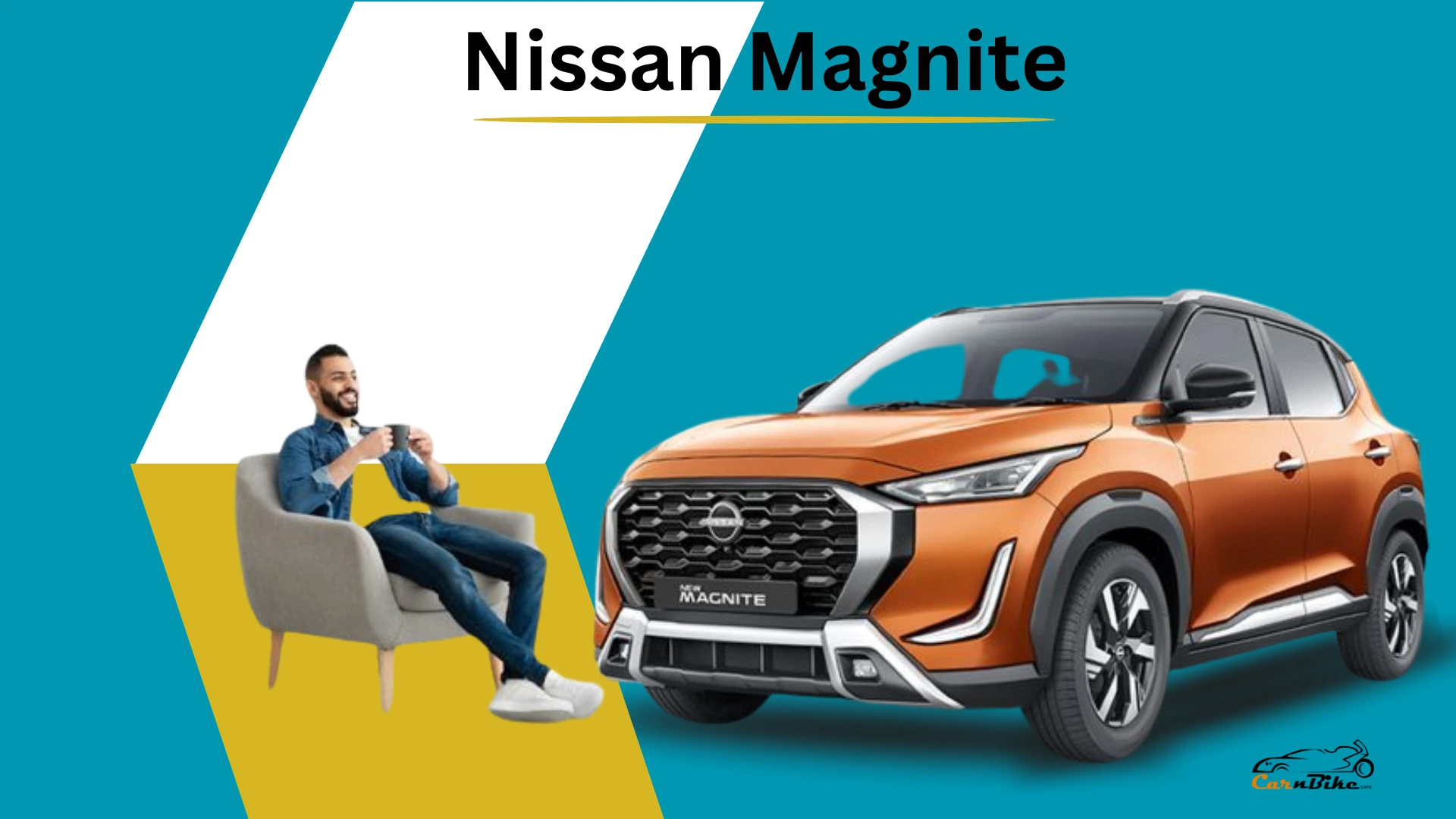
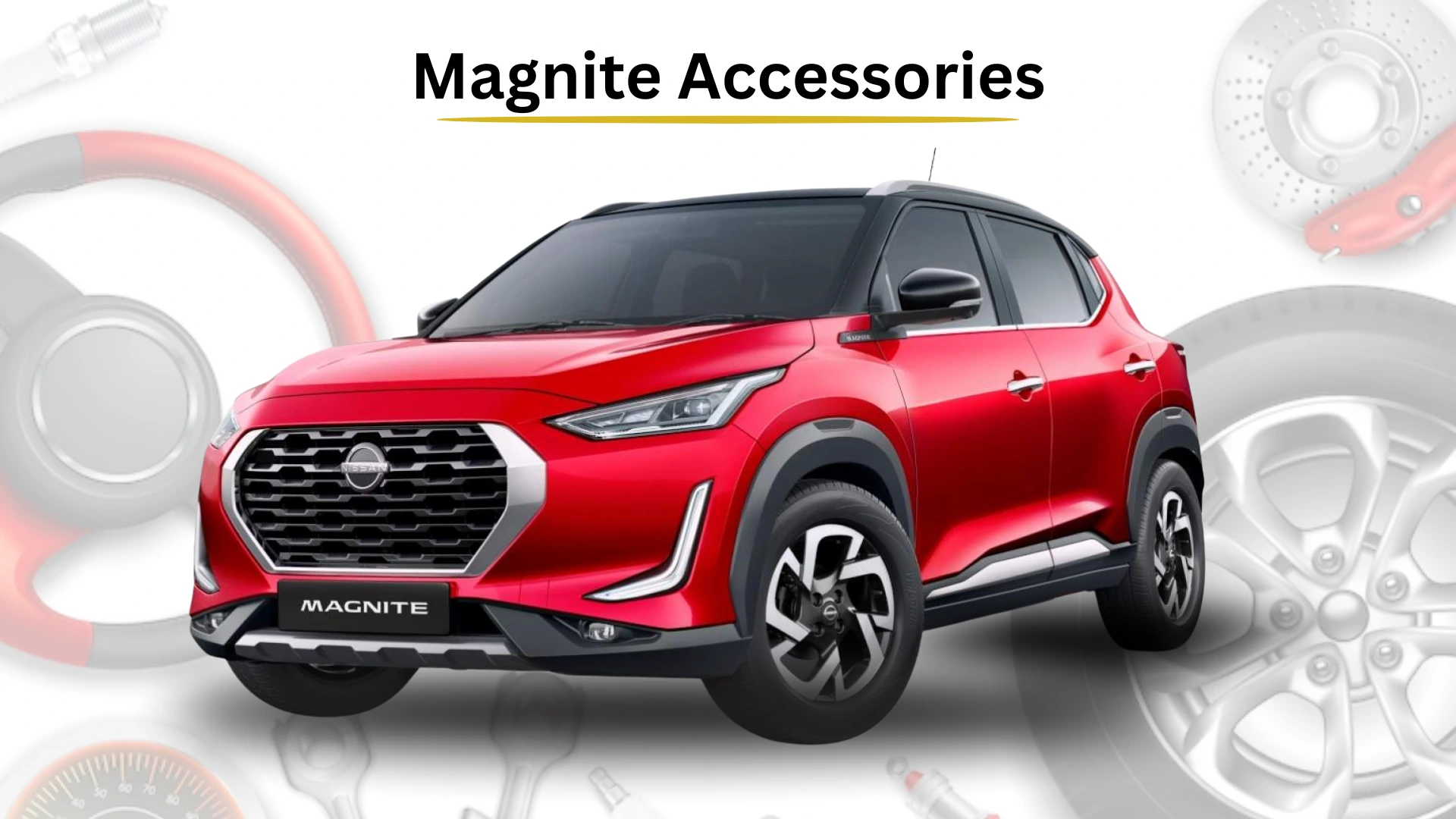
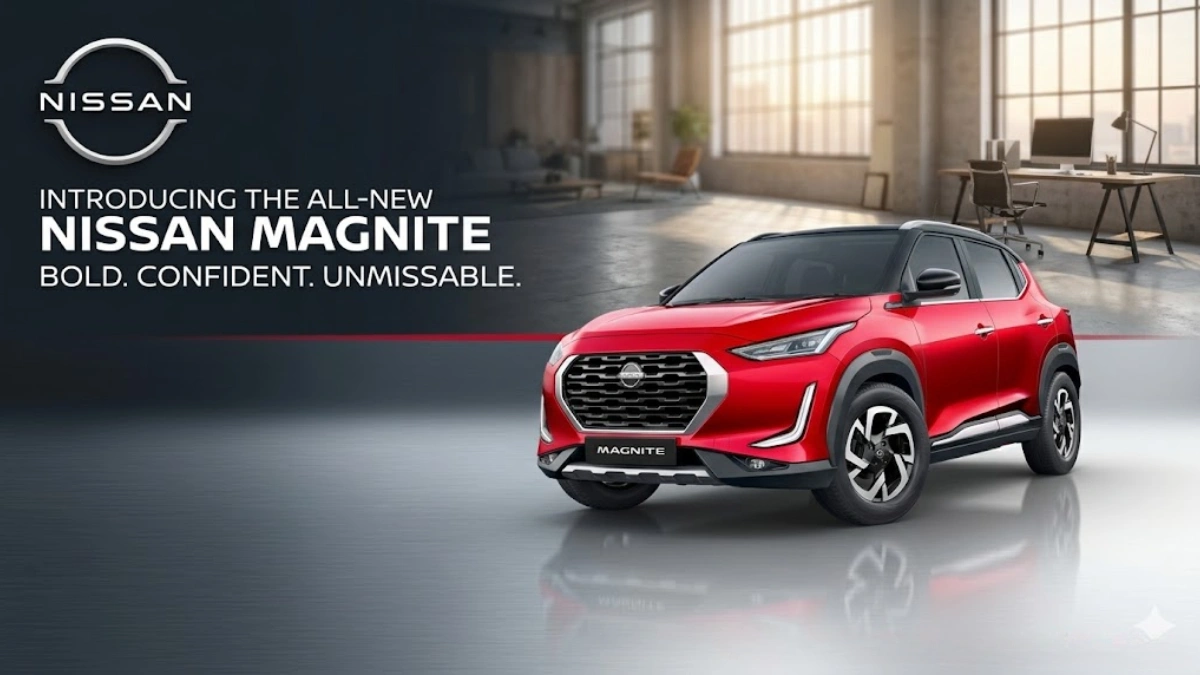
The Nissan Magnite has been one of the most talked-about sub-compact SUVs in India since its debut in late 2020. With its 2024 facelift, Nissan refreshed the Magnite with updated styling, improved interiors, and better safety credentials — all while keeping the pricing sharp and competitive. Today, the Magnite range spans from ₹5.62 lakh to ₹10.96 lakh (ex-showroom), offering 28 variants across two engine options and multiple transmission choices.
The question that stumps most buyers is this: do you save money with the base Visia, or stretch the budget for the flagship Tekna Plus Turbo CVT? The gap between the two is over ₹5 lakh , a significant sum that deserves a thorough, honest breakdown. This blog gives you exactly that facts, specs, and a clear verdict.
A Quick Look at the Variant Lineup
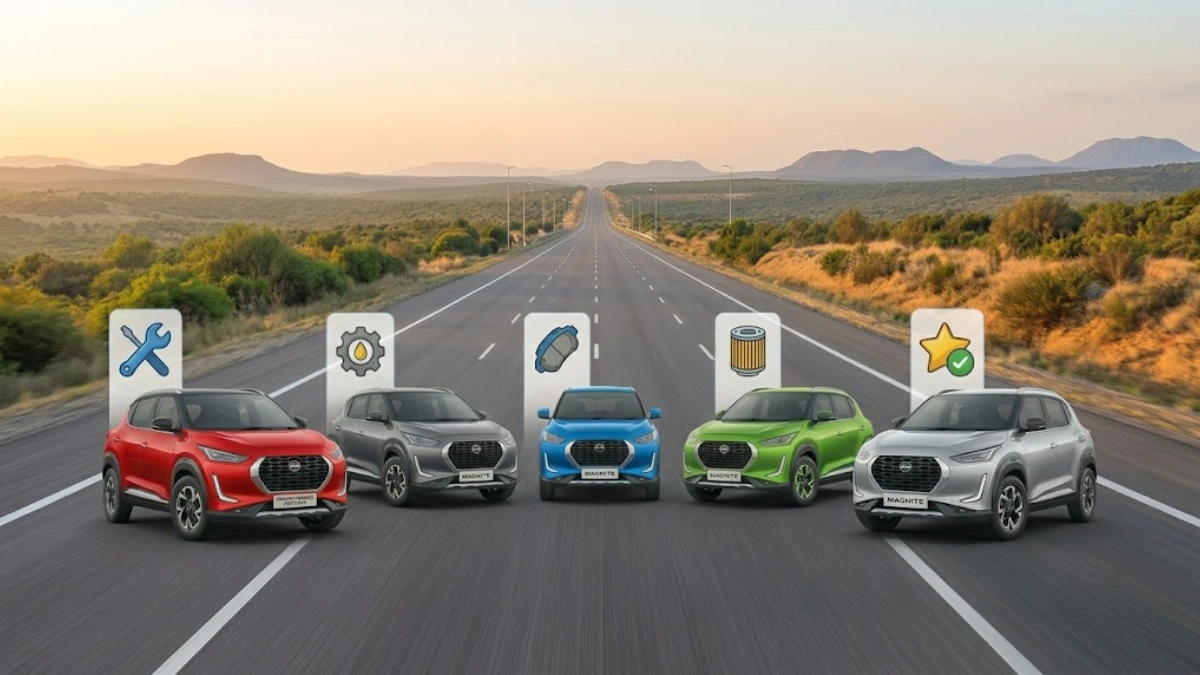
Before diving into the direct comparison, it helps to understand where the two models sit in Nissan's lineup. The 2024 Magnite is offered in six broad variant grades: Visia, Visia Plus, Acenta, N-Connecta, Tekna, and Tekna Plus. The Visia is the entry-level trim and the Tekna Plus is the fully loaded flagship.
Within each grade, Nissan further splits variants by engine and transmission, which is why you end up with 28 total configurations. For this comparison, we focus on the two polar ends of the range:
Base Model — Nissan Magnite Visia (1.0L NA Petrol, 5-speed MT) Price: ₹5.62 lakh (ex-showroom)
Top Model — Nissan Magnite Tekna Plus (1.0L Turbo Petrol, CVT) Price: ₹10.96 lakh (ex-showroom)
Engine and Performance: A Fundamental Difference
This is where the base and top models diverge most significantly — not just in output numbers, but in the very nature of the driving experience.
The base Visia is powered exclusively by the 1.0-litre, three-cylinder, naturally aspirated petrol engine producing 72 PS and 96 Nm of torque. It is mated to a 5-speed manual gearbox. This engine is smooth and refined for city driving and handles daily stop-and-go traffic with ease, but it is not the car you want for confident highway overtaking or loaded family highway trips.
The Tekna Plus, by contrast, gets the 1.0-litre turbocharged petrol engine that produces a significantly more energetic 100 PS and 152 Nm of torque. The torque figure — 58% higher than the naturally aspirated unit — is what makes a genuine, tangible difference in real-world driving. The CVT automatic transmission in the top model makes the Tekna Plus more relaxed in heavy city traffic and more spirited when you need to accelerate.
Fuel efficiency, however, is reasonably close. The naturally aspirated Visia returns a claimed 19.7 kmpl, while the Tekna Plus Turbo CVT is rated at 17.9 kmpl. In real-world conditions, both tend to return around 17–18 kmpl in mixed driving, with the NA version nudging slightly ahead in pure city use.
Exterior Design: Same Shell, Very Different Presence
Both variants wear the same Magnite body, the same 3,994 mm length, 1,758 mm width, 1,572 mm height, and 2,500 mm wheelbase. The 205 mm ground clearance that makes the Magnite so well-suited to Indian roads is also shared across the range. However, the visual execution between the base and top trims is noticeably different.
The base Visia comes with halogen headlights and no fog lamps or LED DRLs. The side profile features 16-inch steel wheels without covers, a utilitarian look that makes the car appear noticeably plainer. Colour options are restricted to just two monotone shades: Storm White and Blade Silver.
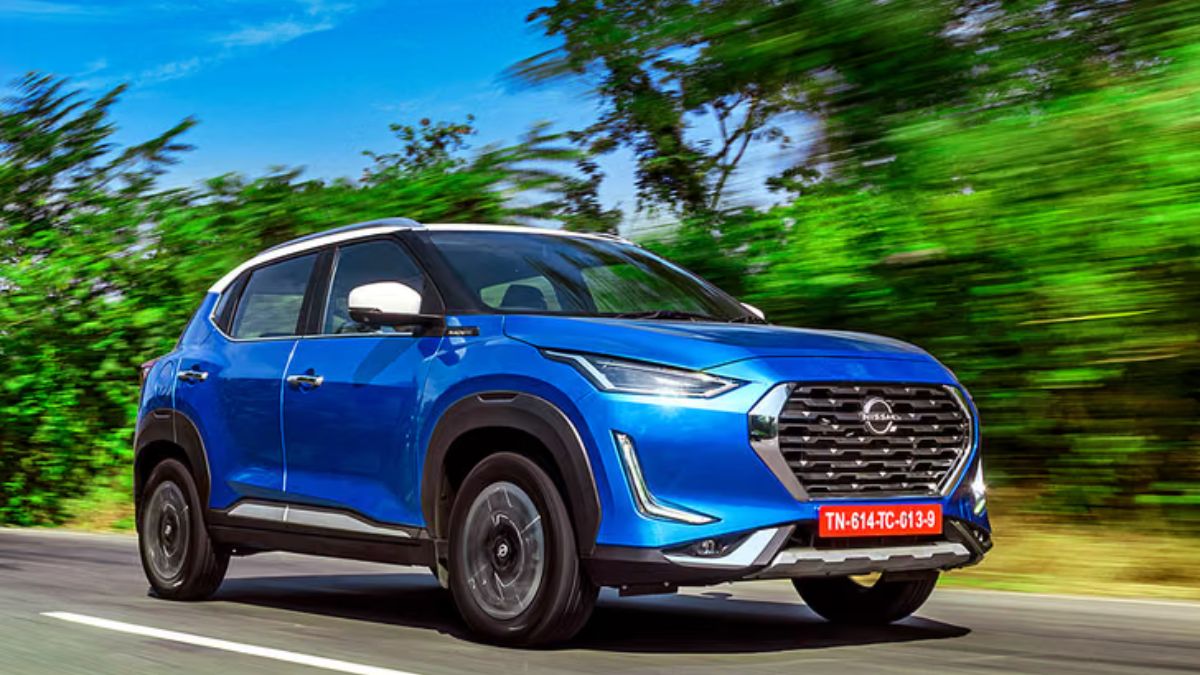
The Tekna Plus is a different visual story. It features auto-LED projector headlights, L-shaped LED DRLs, and front fog lamps integrated into a silver-treated bumper. On the side, it rides on newly designed 16-inch dual-tone alloy wheels and features silver-finished roof rails. At the rear, the tail lights are LEDs, and it adds a shark-fin antenna and rear defogger. The Tekna Plus is also available in a broader range of colours, including attractive dual-tone options.
In the real world, the difference in road presence is significant. The Tekna Plus looks like a proper modern SUV with the premium visual details buyers increasingly expect in this segment. The base Visia, while well-proportioned, reads as budget-spec at a glance.
Interior and Cabin: Night and Day
Step inside both cars and the contrast is even more apparent.
The Visia's cabin is finished in an all-black theme with fabric seat upholstery and contrasting silver elements on the steering wheel and AC vents. It gets power windows for all four doors, a tilt-adjustable steering column, manual AC, a 12V power socket, and 60:40 split rear seats. Critically, it does not come with an infotainment system, not even a basic touchscreen. There is also no reverse parking camera. For 2024, though, Nissan did improve the Visia considerably over the outgoing base model by adding rear armrests with cup holders, a smartphone pocket in the rear armrest, and ISOFIX child seat mounts, improvements that came at no extra cost over the previous generation's price.
The Tekna Plus transforms the experience entirely. The cabin adopts a dual-tone orange and black theme with leatherette seat upholstery and soft-touch materials throughout, giving it a genuinely premium feel for its price point. The highlight feature list includes an 8-inch touchscreen infotainment system with wireless Android Auto and Apple CarPlay, a 7-inch fully digital instrument cluster, a 6-speaker Arkamys-tuned sound system, a 360-degree surround-view camera system, wireless phone charging, cruise control, auto AC (climate control), keyless entry with push-button start, and 4-colour ambient lighting. The rear seats get a dedicated armrest and an air purifier.
The infotainment system on the Tekna Plus is well-regarded for its responsiveness and clean interface. The 360-degree camera system is a genuine segment highlight at this price, it makes parking in tight Indian urban spaces considerably less stressful.
Safety: A Surprisingly Good Story for Both
Safety is one area where Nissan has done something commendable, the Magnite Visia base model does not compromise on fundamental safety features despite its low price point.
Both the Visia and the Tekna Plus come equipped with 6 airbags as standard (previously the pre-facelift base model had only 2), ABS with EBD, hill start assist, and tyre pressure monitoring system (TPMS). ISOFIX child seat mounts are standard across the range.
The higher variants, including the Tekna Plus, add electronic stability control (ESC), traction control, and the aforementioned 360-degree camera, which contributes to everyday safety during parking and low-speed manoeuvring.
On the crash test front, the story has improved significantly. The 2025 Magnite, based on the same facelift platform — achieved a 5-star Global NCAP safety rating for adult occupant protection when tested for the South African market. This is an excellent result and makes the Magnite one of the safer choices in the subcompact SUV segment.
Feature-by-Feature Comparison at a Glance
| Feature | Visia (Base) | Tekna Plus (Top) |
| Engine | 1.0L NA, 72 PS, 96 Nm | 1.0L Turbo, 100 PS, 152 Nm |
| Transmission | 5-speed MT | CVT Automatic |
| Ex-showroom Price | ₹5.62 lakh | ₹10.96 lakh |
| Headlights | Halogen | Auto-LED Projector |
| LED DRLs | No | Yes |
| Fog Lamps | No | Yes |
| Wheels | 16-inch Steel | 16-inch Dual-tone Alloy |
| Infotainment | None | 8-inch Touchscreen |
| Apple CarPlay / Android Auto | No | Yes (Wireless) |
| Digital Instrument Cluster | No | 7-inch Fully Digital |
| Reverse Camera | No | Yes (360-degree) |
| Wireless Charging | No | Yes |
| AC Type | Manual AC | Auto Climate Control |
| Keyless Entry | No | Yes (with Push-Button Start) |
| Cruise Control | No | Yes |
| Seat Upholstery | Fabric | Leatherette |
| Interior Theme | All-Black | Dual-tone Orange & Black |
| Ambient Lighting | No | Yes (4-colour) |
| Roof Rails | No | Silver-finished |
| Airbags | 6 (Standard) | 6 (Standard) |
| ISOFIX Mounts | Yes | Yes |
| Hill Start Assist | Yes | Yes |
| TPMS | Yes | Yes |
| Colour Options | 2 (monotone only) | Multiple, incl. dual-tone |
The Price Gap Argument: Is ₹5+ Lakh Worth It?
The honest answer depends on who you are and how you intend to use the car.
The on-road price difference in a city like Delhi works out to roughly ₹5.5–6 lakh once registration, insurance, and taxes are factored in. That is not a small amount of money — it is enough to buy a used hatchback, invest in a child's education, or cover years of fuel and maintenance costs.
If you buy the Visia and then spend ₹15,000–20,000 to add an aftermarket infotainment system (which most base-model buyers do), you still come out significantly ahead financially. The car's fundamental proportions, spacious rear seat, 336-litre boot, excellent ground clearance — remain identical regardless of variant. What you are missing is convenience and comfort technology, not core practicality.
There is also a resale value angle to consider. Higher-spec variants of popular cars like the Magnite tend to hold their value better, particularly in metros where buyers have more purchasing power and demand more features.
Who Should Buy the Base Visia?
The Visia makes strong sense for a specific type of buyer. Consider the base model if:
You are buying your first car and primarily need it for short city commutes under 30–40 km a day. You have a tight budget and the ₹5.62 lakh price point genuinely matters — perhaps you are planning a relatively large down payment and want to keep EMIs low. You are comfortable adding an aftermarket touchscreen unit and are not swayed by the premium interior aesthetic. Your household runs on a tight fuel budget, and you want to squeeze the best mileage out of a naturally aspirated engine. You plan to use the car for a set period of 4–5 years and then sell, and want minimal depreciation exposure.
Who Should Buy the Tekna Plus?
The Tekna Plus makes the most sense if:
You do a meaningful amount of highway driving and want the confidence of the turbo engine's 100 PS and 152 Nm. You value a truly complete, ready-to-use car that does not require aftermarket add-ons. City parking stress is real for you, and the 360-degree camera is genuinely useful. You have passengers regularly and want the comfort of auto climate control and leatherette seats. You see the car as a 7–10 year ownership and want strong resale value support. The orange and black interior, ambient lighting, and premium feel matter to your everyday enjoyment of the vehicle.
What About the Middle Ground? A Word on the Sweet-Spot Variants
It would be incomplete to discuss this comparison without acknowledging that neither the base Visia nor the top Tekna Plus may be the best buy for the average buyer.
The N-Connecta variant, priced around ₹7.86 lakh (ex-showroom), is widely regarded by automotive analysts and independent reviewers as the sweet-spot of the Magnite range. It offers an 8-inch touchscreen, 7-inch digital cluster, auto AC, rear parking camera, 6-speaker Arkamys sound system, LED DRLs, 16-inch alloy wheels, keyless entry, and a turbo engine option — all without the premium pricing of the Tekna Plus. It is the variant that delivers roughly 85% of the top model's feature set at nearly 30% less cost.
If the Visia feels too stripped and the Tekna Plus feels too expensive, the N-Connecta is where most practical, informed buyers tend to land.
Final Verdict
Buy the Visia Base Model if your budget genuinely maxes out around ₹6–7 lakh on-road, you are a light urban user, and you are willing to add a few aftermarket touches. It is a remarkably safe and practical car for its money, and Nissan's decision to include 6 airbags as standard even on the base trim is genuinely commendable.
Buy the Tekna Plus Top Model if you want the complete package, drive highways regularly, and can stretch to ₹13–13.5 lakh on-road without financial strain. The turbo CVT powertrain and the comprehensive feature list make it a fully loaded, genuinely enjoyable SUV that punches above its segment in several ways.
For most buyers, though, the real answer lies in the middle — specifically the N-Connecta Turbo or Tekna Turbo Manual variants. These hit the balance of performance, features, and price that the Indian car buyer has come to expect from the Magnite's segment.
The Nissan Magnite, regardless of which variant you choose, remains one of the strongest value propositions in the Indian sub-compact SUV space. The fact that you get 6 airbags, a 5-star NCAP-rated structure, 205 mm ground clearance, and a practical 336-litre boot at any price in this range is a credit to what Nissan has built here.
Choose wisely — and drive confidently.
Book a Test Drive
Free doorstep test drive at your convenience
Popular Brands





Latest Car News
Tata Altroz vs Maruti Suzuki Brezza: Which One Should You Buy in 2026?
Wagon R vs Swift: Which Is Cheaper to Maintain?
BMW 7 Series Facelift Interior Updates: Know Everything

How to Check Oil Level in Car: Step-by-Step Guide
Latest Cars Under ₹5 Lakh in India in September 2026
Maruti Alto K10 September Offers: Get Up to ₹62,500 Savings on Purchase
Tata Tigor Facelift Under ₹6 Lakh: A New Budget Sedan Is Coming
Hyundai Creta August 2026 Sales: With 16,288 Units Becomes India's Best-Selling Mid-Size SUV
Maruti Baleno Facelift Booking Price: Expected Booking Amount, EMI & Loan Calculation
Kia Sorento 6 Seater vs 7 Seater: Which One Should You Choose?
Kia Sorento AI Assistant Explained: Features, Commands, and Indian Language Support
What Is the Difference Between Tata Curvv and New Curvv Series X?
Tata Car Sales August 2026: Model-Wise Sales & Growth Report
Car Sales Report of August 2026: Tata Motors, Maruti, Mahindra Lead Growth
Pajero 2026 vs Fortuner: Which SUV Could Be Better?
Volvo EX90 Booking Price: Expected Booking Amount, EMI & Loan Calculation
Next Generation Tata Nexon 2027: Expected Launch, Price, Design & Features
MG Hector Tomahawk EV Variant-Wise Price & Features Comparison
Maruti Baleno Facelift vs Toyota Glanza: Complete Comparision
Upcoming Cars in September 2026 in India: New Cars, Launch Dates & Expected Prices