
5 Things You'll Notice in the First 10 Minutes of Driving the Skoda Kushaq
- Cars
- Published: 24 Apr, 2026
Book a Test Drive
Free doorstep test drive at your convenience
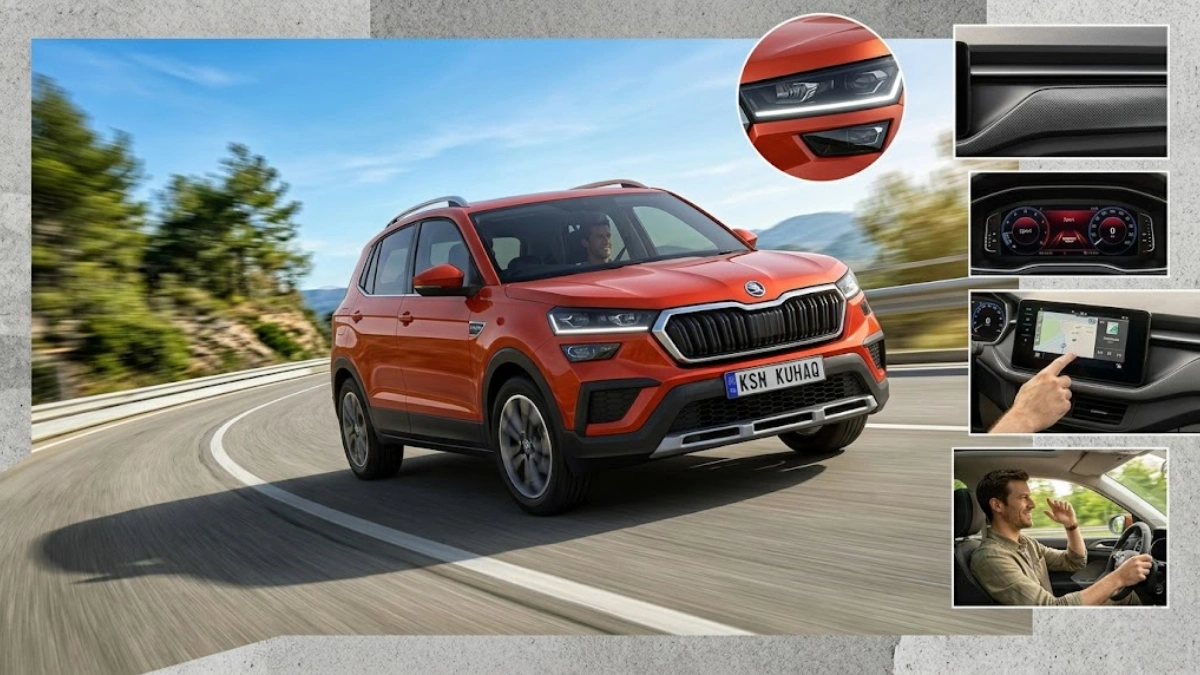
The Skoda Kushaq has been one of the most talked-about compact SUVs since it arrived in India in 2021, built on the India-specific MQB-A0-IN platform that Skoda and Volkswagen jointly developed for the subcontinent. Reviewers have praised it. Sales numbers have grown steadily. But what's the actual sensation of getting behind the wheel for the first time?
Here are five things that register within the first 10 minutes — before you've hit a highway, before you've tested the boot space, before any of that.
1. The Steering Feels Unusually Precise for This Segment
The moment you pull out of a parking spot or navigate a tight lane, the Kushaq's electrically assisted steering stands out immediately. It's not feather-light like a Hyundai Creta or vague like some of its peers. There's a deliberate, slightly weighted feel to it — especially on the 1.5 TSI variant — that makes the car feel planted and responsive.
The 1.5 TSI uses a Variable Ratio Steering (VRS) rack, which genuinely changes the steering ratio depending on how much you turn the wheel. At parking speeds, it's quick and light. At highway speeds, it firms up. You won't be able to articulate why it feels this good in the first ten minutes, but you'll feel a sense of confidence that's rare in the ₹14–20 lakh bracket.
Even the 1.0 TSI's standard EPS has a surprisingly direct feel. You steer, it responds — without the floaty disconnection that plagues a lot of SUVs targeting first-time buyers.
The data point: Skoda quotes a turning radius of 5.1 metres for the Kushaq. For reference, the Hyundai Creta comes in at around 5.3 metres. That tighter turn circle adds to the nimble first impression.
2. The Engine Pulls Cleanly, Even from Low RPM
Whether you're in the 115 PS 1.0-litre three-cylinder TSI or the 150 PS 1.5-litre four-cylinder TSI, the powertrain refinement is immediately noticeable — particularly if you're coming from a naturally aspirated engine.
The 1.0 TSI produces 178 Nm of torque from just 1,750 RPM. In city traffic, this means you're rarely hunting for gears or blipping the throttle to keep pace with traffic. Pull away from a signal, and the engine surges ahead with calm confidence. There's no lag that makes you feel like you're working against the car.
The 1.5 TSI is even more striking — 250 Nm of torque from 1,600 RPM, combined with a 7-speed DSG dual-clutch gearbox that shifts so smoothly you barely notice the changes. In Drive mode, the DSG anticipates your inputs almost eerily well in the first few minutes.
One caveat worth noting: the 1.0 TSI 6-speed manual has a clutch that some drivers find slightly heavy compared to Japanese competitors, but it's precise in its engagement point — you find the bite quickly and don't stall it.
3. Road Noise Isolation Is Better Than Expected — But Not Perfect
Within minutes of driving, you'll notice that the Kushaq has invested seriously in NVH (Noise, Vibration, Harshness) suppression. Skoda uses acoustic windshield glass on higher variants, and the cabin insulation is noticeably above average for a compact SUV in this price range.
On smooth tarmac, tyre roar is well-controlled. Wind noise at 60–80 km/h — typical city-expressway speeds — is minimal. You can hold a conversation at normal volume, which isn't something you can say about every car in this class.
However, the honesty of this blog demands acknowledgement: on broken urban roads or coarse chip-sealed surfaces, tyre noise does filter through more prominently. The Kushaq rides on 205/55 R16 or 215/60 R16 tyres depending on the variant, and the low-profile tyre choices on sportier trims can amplify road texture feedback.
The three-cylinder 1.0 TSI also has that characteristic three-pot thrum at idle that you'll notice while sitting at a long red light — it's not unpleasant, but it is present. It largely disappears once you're moving.
4. The Ride Quality Surprises You — Especially in the City
The Kushaq uses a MacPherson strut setup at the front and a torsion beam at the rear — the same fundamental architecture used across the MQB-A0-IN platform. Critics sometimes dismiss torsion beam rears as "budget compromises," but Skoda's suspension tuning on the Kushaq tells a more nuanced story.
In the first ten minutes on Indian roads — which means speed bumps, potholes, and uncertain surfaces — the Kushaq absorbs impacts with a maturity that belies its price point. Sharp-edged bumps are dealt with firmly but without crashing through to the cabin. Speed breakers are taken with a composed one-two motion rather than a wallowing bounce.
The ground clearance of 188 mm (on standard variants) means you're not holding your breath over every pothole. It's not a lifted SUV, but it has enough clearance for confident urban and semi-urban use.
Where you notice the torsion beam's limits is during rapid direction changes over mid-corner bumps — the rear can feel slightly less settled than the hydraulically-damped multilink setups used in cars like the Jeep Compass. But for everyday driving, the first impression is of a genuinely well-sorted chassis.
5. The Cabin Feels Solidly Built — Materials and Gaps Tell You Immediately
Skoda's European brand positioning is felt the moment you close the door. That satisfying thud — not a hollow clap — signals genuine door seal quality and body rigidity. In the first ten minutes, your hands are constantly touching the steering wheel, the gear lever, the dashboard surfaces — and the tactile quality holds up.
The Kushaq uses hard plastics in the lower cabin areas (this is a ₹14–20 lakh car, not a luxury sedan), but the surfaces you interact with most — the steering wheel leather, the gear knob, the door armrest padding on mid and top variants — are soft and well-finished. Panel gaps are tight and consistent, something Skoda has historically been disciplined about even on volume products.
The 10-inch infotainment screen on the Style variant is responsive to touch inputs — there's no frustrating lag when you tap a menu. The physical climate control knobs (retained wisely instead of being buried in touchscreen menus) click with a satisfying precision.
One thing first-time drivers notice: the driving position. The seat height and steering column adjustability (rake and reach on higher variants) let most drivers find a natural, commanding position quickly. You're not perched oddly high or sunk too low — it's a position that feels immediately familiar.
The Honest Summary
The Skoda Kushaq isn't trying to dazzle you with gimmicks or theatre. What it delivers in the first ten minutes is something more durable: a sense of competence. The steering talks to you. The engine cooperates. The cabin doesn't rattle or flex. The ride doesn't punish you.
For buyers in the ₹14–19.99 lakh on-road range evaluating against the Hyundai Creta, Kia Seltos, or Volkswagen Taigun (which shares the same platform), the Kushaq's first impression is one of a car that's been engineered rather than assembled — and that distinction, quiet as it is, reveals itself within minutes of driving.
Book a Test Drive
Free doorstep test drive at your convenience
Popular Brands





Latest Car News
Upcoming Cars in September 2026 in India: New Cars, Launch Dates & Expected Prices
MG Hector Hawk SUV vs Tata Harrier: Expected Price, Features & Key Differences
Skoda Superb Diesel in India: Will the Diesel Engine Make a Comeback?
Tata Punch Becomes India's Best-Selling SUV in July 2026 with 21,313 Units Sold

Car Sales Report July 2026: Maruti Remains No.1, Tata, Mahindra & Hyundai Record Strong Growth
Tata Curvv EV Discount August 2026: Save Big with Limited-Time Offers
Kia Sorento Booking in India: Launch Date, Price & Booking Process

Skoda Slavia Facelift Launch Date in India
Hyundai Creta Next Gen Upgrades: Biggest Changes Expected
Limited Edition Skoda Slavia Monte Carlo Adds New Colours for 200 Buyers Only
Suzuki Loses India Market Share as Buyers Demand More Features
Hybrid Car Sales Decline 8% in June 2026: Complete Analysis
How to Book Maruti Brezza Facelift: Complete Booking Guide
Alto K10 vs Tiago: Which Is Better?
Maruti Brezza Facelift 2026: What's New Compared to the Current Model?
Renault Duster Adventure Edition vs Standard Duster: What's Different?
Skoda Slavia Facelift 2026 vs Volkswagen Virtus: Which Sedan Should You Wait For?

Volkswagen Tayron Life Launched in India at ₹41.99 Lakh
Volkswagen Announces 50% Reduction In Global Car Line-up
Tata Nexon Pure Plus : Know Everything Before Buying in July