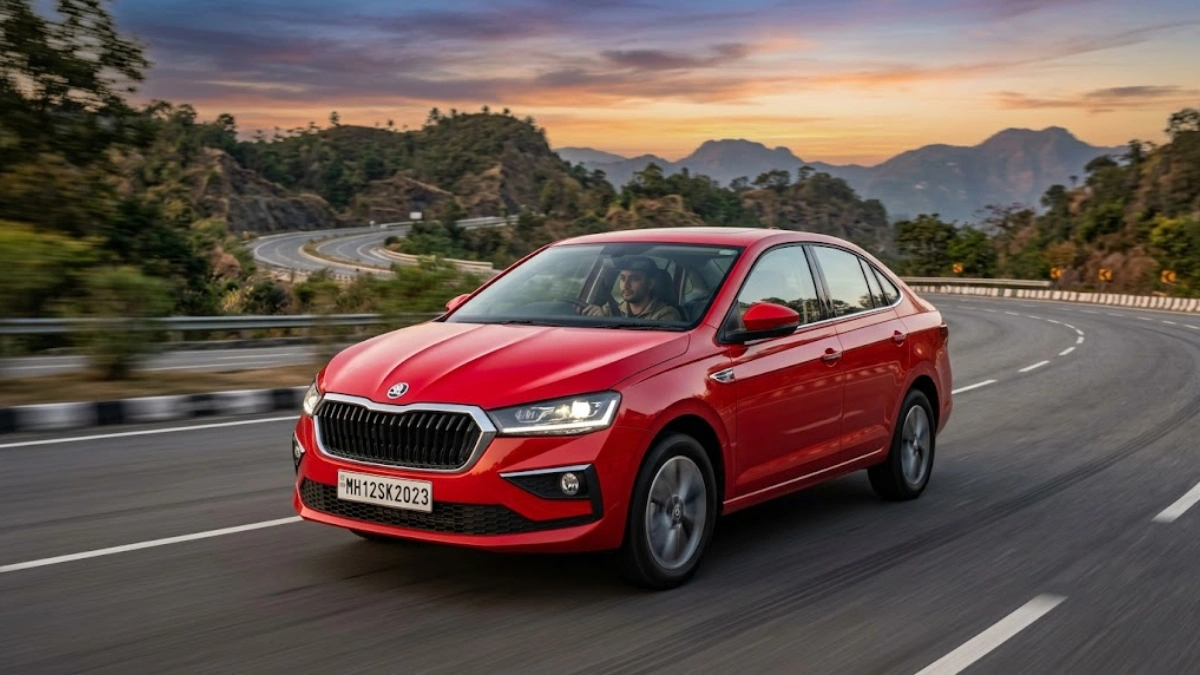
Skoda Slavia Test Drive Review: What the Showroom Won't Tell You
- Cars
- Published: 24 Apr, 2026
Book a Test Drive
Free doorstep test drive at your convenience
Walk into any Skoda dealership in India and the sales pitch for the Slavia is polished, confident, and selective. You'll hear about the 1.5 TSI's 150 PS punch, the sunroof, the six airbags, the "European DNA." What you won't hear is how the DSG behaves in a Bengaluru traffic jam, what the rear seat actually feels like on a 4-hour highway run, or whether that infotainment system will still feel premium six months in.
This review is built on those gaps — the things that matter after the showroom lights go off.
First, the Basics — Know What You're Actually Buying
The Skoda Slavia sits on the same MQB-A0-IN platform as the Kushaq SUV and the Volkswagen Virtus and Taigun. It was launched in India in March 2022 and received a mid-cycle update in 2024. It is available in two engine options:
- 1.0 TSI — 115 PS, 178 Nm, 6-speed manual or 6-speed torque converter automatic
- 1.5 TSI — 150 PS, 250 Nm, 7-speed DSG dual-clutch automatic (also available with a 6-speed manual)
The Slavia competes directly with the Honda City, Maruti Suzuki Ciaz, Hyundai Verna, and Volkswagen Virtus. It is one of the last sedans in India still being actively developed and sold to a mainstream audience, at a time when the segment is under genuine existential pressure from compact SUVs.
Price range: approximately ₹11.49 lakh to ₹19.49 lakh (ex-showroom, 2024 pricing, varies by city and variant).
Now — here's what the showroom won't tell you.
1. The 1.5 TSI DSG Is Exceptional — But It Has One Specific Weakness
The headline powertrain of the Slavia is genuinely one of the best engine-gearbox combinations available under ₹20 lakh in India, full stop. The 1.5-litre four-cylinder TSI with 250 Nm from 1,600 RPM paired to the 7-speed DSG is smooth, fast-shifting, and effortlessly quick on open roads. On a highway, overtaking manoeuvres that would require gear-hunting in other cars happen here with a simple press of the throttle — the DSG drops a ratio and surges forward without drama.
But here's what they won't tell you in the showroom:
The 7-speed DSG uses a dry dual-clutch design (DQ200), not a wet clutch system. Dry DCTs are known to be more fuel-efficient but inherently less suited to slow, stop-start traffic. In genuine bumper-to-bumper conditions — the kind experienced daily on Delhi Ring Road, Mumbai's Western Express Highway during peak hours, or any Bengaluru arterial road between 5:30 PM and 8:00 PM — the DSG can feel hesitant and occasionally jerky at very low speeds.
This is not a defect unique to Slavia. It is a characteristic of dry dual-clutch transmissions as a category. Porsche, Volkswagen Group, and Ford all use variants of this design and acknowledge the same low-speed limitation. But Skoda's showroom demo is rarely done in traffic — it's done in a clean, flowing route that never reveals this.
The practical guidance: If 60% or more of your daily driving is under 30 km/h in dense urban traffic, the 1.0 TSI torque converter automatic (available on the Ambition and Style variants) will give you a calmer, less jerky experience despite having less peak power. If you do significant highway driving, the 1.5 DSG is the unambiguous choice.
2. The Rear Seat Is Genuinely Good — But Ingress and Egress Is Not
Skoda claims a wheelbase of 2,651 mm for the Slavia. That's longer than the Honda City (2,600 mm) and the Hyundai Verna (2,600 mm). On paper and in practice, this translates to genuinely impressive rear legroom — a six-foot adult seated behind a six-foot driver has approximately 80–90 mm of knee clearance, which is exceptional for this segment.
The rear bench is wide enough to seat three adults without the middle passenger straddling an uncomfortable central tunnel. The cushion is reasonably well-bolstered and the backrest angle is reclined at a comfortable degree for highway journeys.
What the showroom skips:
The roofline. The Slavia is a three-box sedan with a relatively low, sloping roofline in the tradition of European sedans. The rear door aperture is narrower than an SUV's, and the roof is lower at the point where you duck in. For passengers over 5'10", getting in and out of the rear seat requires a conscious head-duck every single time. Over a two-week ownership period, this becomes a minor but real irritation — and for elderly passengers or anyone with back and knee issues, it is a genuine daily inconvenience.
This is not a flaw unique to Slavia — it is the structural reality of sedans as a body style. But in a market where buyers are comparing the Slavia against the Kushaq or Creta, the SUV's upright doorframe and sill height (which allows a more natural sliding-in motion) is a meaningful ergonomic advantage that no salesperson at a Skoda dealership will volunteer.
3. The Ride Quality Has a Split Personality
The Slavia uses MacPherson struts at the front and a torsion beam at the rear — identical in design philosophy to the Kushaq. Skoda's suspension calibration is more comfort-oriented on the Slavia than on the Kushaq, however, which makes sense given the sedan's audience.
On smooth tarmac — newly laid state highways, expressways, well-maintained city roads — the Slavia is genuinely composed and comfortable. It absorbs undulations with a fluency that feels more expensive than the sticker price suggests. High-speed stability is excellent; at 120 km/h on the Yamuna Expressway or Mumbai-Pune Expressway, the car feels planted and unflustered.
What changes on real Indian roads:
The Slavia sits on relatively low-profile tyres — 205/55 R16 on lower variants, 215/45 R17 on the top-spec Style variant. The 17-inch wheels with 45-profile tyres look excellent in the showroom. On an actual potholed city road, those short sidewalls transmit sharper impacts into the cabin. Not harshly — the suspension does meaningful work — but the car's behaviour changes character between smooth and rough surfaces more than a competitor like the Honda City (which runs taller 55–60 profile tyres on its standard variants) does.
The ground clearance of 179 mm is the other figure that matters. It's adequate, but it demands respect on speed breakers, steep driveway ramps, and waterlogged roads. Owners who have purchased the 17-inch variant report occasional scraping on particularly aggressive speed breakers, especially with two rear passengers. The 16-inch variant at 185 mm clearance is marginally better in this regard.
Practical guidance: If you live in a city with consistently poor road surfaces, the 16-inch tyre option on the Ambition variant offers a more forgiving daily experience. The 17-inch Style variant is the better choice if you prioritise highway dynamics and aesthetics over maximum urban compliance.
4. The Infotainment System Is Better Than It Was — But Not Without Quirks
The Slavia (post-2023 update) uses a 10-inch touchscreen running a revised version of Skoda's infotainment interface. It supports wireless Apple CarPlay and Android Auto, has a reasonably fast processor by segment standards, and the display itself is bright and readable even in direct sunlight — something that genuinely matters when the screen is angled toward the Indian sun for much of the year.
What they won't mention:
The native navigation system — Skoda's built-in maps — is not competitive with Google Maps in an Indian context. It lacks real-time traffic data and has significant gaps in mapping accuracy for newer roads, colonies, and tier-2 city layouts. In practice, most Slavia owners abandon the native navigation entirely and use wireless Android Auto or Apple CarPlay from day one.
This is fine — wireless projection works well — but the native system that featured prominently in the brochure becomes vestigial within a week of ownership. If you're paying for the top-spec variant partly on the basis of built-in connected navigation, recalibrate that expectation.
The connected car features (Skoda Connect) — remote engine start, live vehicle tracking, geofencing — work reliably in metropolitan areas with strong network coverage. In semi-urban and highway stretches with spotty 4G coverage, the app's live data can lag or disconnect. This is a network infrastructure issue as much as a product issue, but it's worth knowing before you envision yourself remotely pre-cooling the cabin from your office.
The six-speaker audio system on mid variants is decent for casual listening. Audiophiles will notice compression artefacts at high volume on the stock speakers. The system doesn't have the warmth or dynamic range of, say, the Bose system available in the higher Hyundai Verna variants. It's acceptable; it isn't a selling point.
5. Build Quality Is Genuinely Excellent — With One Area to Watch
Skoda's panel gap discipline and material quality at contact points is better than virtually every Japanese and Korean competitor in this price bracket. The doors close with authority. The dashboard doesn't creak. The steering wheel leather doesn't de-grain after six months. These are not small things — they are the daily texture of car ownership that brochures cannot communicate.
The Slavia's body rigidity — a byproduct of the MQB-A0-IN platform's structural design — means the car doesn't flex or groan over rough surfaces. This structural stiffness also contributes to the excellent crash test performance: the Slavia achieved a 5-star Global NCAP rating (tested in 2022), with strong performance in both adult and child occupant protection categories. Six airbags are standard across all variants from 2023 onward — a genuinely significant safety commitment that not all competitors have matched at this price point.
What to watch:
The touchscreen's optical bonding (the layer between the display and glass) on early 2022 production units developed delamination in a subset of cars exposed to prolonged heat — relevant in states like Rajasthan, Gujarat, and parts of Maharashtra where cabin temperatures can exceed 55°C when parked. Skoda acknowledged the issue and updated the component in later production runs. If you are buying a used 2022 Slavia, inspect the screen closely under showroom lighting for any signs of yellow or white edge discolouration.
The sunroof seal — present on the Style variant — has been reported by a subset of owners to allow minor water ingress in extremely heavy monsoon conditions when the drainage channel is not periodically cleared. This is a maintenance issue rather than a defect, but it requires awareness: clean the sunroof drainage channels at every service, especially before and after monsoon season. Your service advisor is unlikely to proactively mention this unless you ask.
The Fuel Efficiency Reality Check
Skoda's ARAI-certified fuel efficiency figures are:
- 1.0 TSI Manual: 19.47 km/l
- 1.0 TSI Automatic: 18.42 km/l
- 1.5 TSI DSG: 18.68 km/l
Real-world figures, based on owner data across Indian driving conditions:
- City driving (dense traffic): 10–13 km/l for the 1.0 TSI; 9–12 km/l for the 1.5 TSI DSG
- Mixed city-highway: 14–16 km/l across both engines
- Pure highway (80–100 km/h cruise): 17–19 km/l for the 1.0 TSI; 16–18 km/l for the 1.5 TSI
The 1.5 TSI has a cylinder deactivation system (Active Cylinder Management) that shuts off two cylinders at light throttle loads — this is what enables its highway efficiency to approach the smaller 1.0 TSI's figures. At steady highway speeds, the system works silently and effectively. You won't feel the transition between four-cylinder and two-cylinder operation.
The 47-litre fuel tank means a realistic highway range of approximately 700–750 km on a full tank with the 1.0 TSI — solid for long-distance touring.
Who Should Actually Buy the Slavia?
Be honest with yourself about these four questions:
Buy the Slavia if: You do meaningful highway driving, value a genuinely planted and engaging driving experience, seat primarily two adults in the rear rather than three, and want a car that will feel structurally tight at 80,000 km the way it did at 800 km.
Think carefully if: Your daily commute is almost entirely sub-30 km/h urban crawl and you want the 1.5 DSG specifically — the gearbox's low-speed behaviour will be a daily friction point. Consider the 1.0 torque converter automatic instead, or look at the Honda City's smoother urban manners.
Be realistic about: The roofline. If you regularly carry elderly passengers or anyone with mobility considerations, the sedan body style demands more physical effort to enter and exit than a similarly priced SUV. No amount of legroom compensates for awkward ingress over time.
The Honest Verdict
The Skoda Slavia is a car that rewards drivers who know what they want from a car. It is not the most feature-loaded option in its segment. It is not the softest ride. It is not the most spacious on a spec-sheet comparison.
What it is, is cohesive. The chassis, the engine, the steering, and the structure feel like they were developed by people who drove the car extensively on Indian roads rather than reverse-engineered from a focus group report. The 5-star NCAP score is real. The build quality is tangible. The 1.5 TSI is, in the right conditions, genuinely thrilling.
Go test-drive with Skoda Slavia in actual traffic, on your actual commute route, with your actual family in the rear seat. That test drive — not the showroom route — will tell you everything you need to know.
Book a Test Drive
Free doorstep test drive at your convenience
Popular Brands





Latest Car News
Upcoming Cars in September 2026 in India: New Cars, Launch Dates & Expected Prices
MG Hector Hawk SUV vs Tata Harrier: Expected Price, Features & Key Differences
Skoda Superb Diesel in India: Will the Diesel Engine Make a Comeback?
Tata Punch Becomes India's Best-Selling SUV in July 2026 with 21,313 Units Sold
Car Sales Report July 2026: Maruti Remains No.1, Tata, Mahindra & Hyundai Record Strong Growth
Tata Curvv EV Discount August 2026: Save Big with Limited-Time Offers
Kia Sorento Booking in India: Launch Date, Price & Booking Process
Skoda Slavia Facelift Launch Date in India
Hyundai Creta Next Gen Upgrades: Biggest Changes Expected
Limited Edition Skoda Slavia Monte Carlo Adds New Colours for 200 Buyers Only
Suzuki Loses India Market Share as Buyers Demand More Features
Hybrid Car Sales Decline 8% in June 2026: Complete Analysis
How to Book Maruti Brezza Facelift: Complete Booking Guide
Alto K10 vs Tiago: Which Is Better?
Maruti Brezza Facelift 2026: What's New Compared to the Current Model?
Renault Duster Adventure Edition vs Standard Duster: What's Different?
Skoda Slavia Facelift 2026 vs Volkswagen Virtus: Which Sedan Should You Wait For?
Volkswagen Tayron Life Launched in India at ₹41.99 Lakh
Volkswagen Announces 50% Reduction In Global Car Line-up
Tata Nexon Pure Plus : Know Everything Before Buying in July