





Limited Edition Skoda Slavia Monte Carlo Adds New Colours for 200 Buyers Only
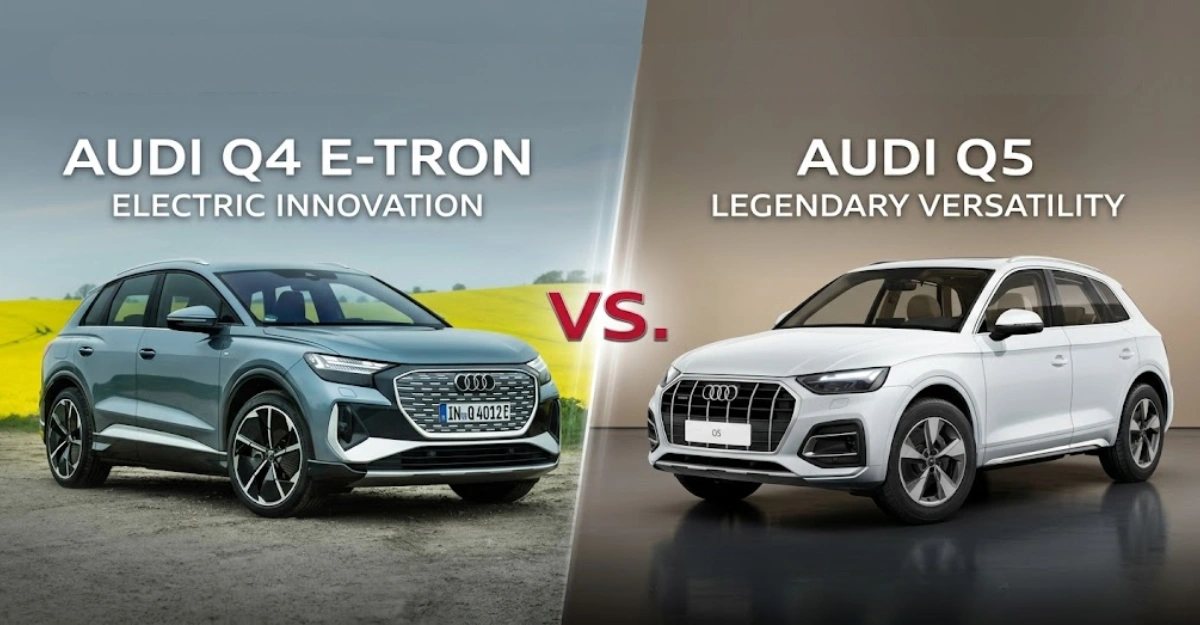
Audi Q4 e-tron Vs. Audi Q5: Which SUV Offers Better Value in India in 2026?
- Cars
- Published: 20 May, 2026
Book a Test Drive
Free doorstep test drive at your convenience
When you spend upwards of ₹65–70 lakh on an SUV, the question of value becomes deeply personal. It is not just about which car looks better or goes faster — it is about which one makes sense for your life, your city, your driving patterns, and the India you actually live in. In 2026, Audi finds itself in a fascinating position: it is selling its most prestigious combustion-engine mid-size SUV, the Q5, alongside the incoming promise of its electric future with the Q4 e-tron. Both sit at a similar price point in the Indian market, but they are fundamentally different propositions. Here is an honest, no-fluff comparison.
Where Things Stand in India Right Now
The Audi Q5 carries a starting price of ₹64.90 lakh (ex-showroom) in India, powered by a 2.0-litre turbo petrol engine paired with a 7-speed dual-clutch automatic transmission. The Q5 is powered by a 2.0-litre, four-cylinder turbocharged petrol engine producing 261 bhp and 370 Nm of torque, mated through Audi's quattro AWD system.
The Audi Q4 e-tron is a different story in India. Although Audi India has not announced an official launch timeline, the Q4 e-tron is expected to arrive in India between late 2026 and early 2027, with an expected price starting at around ₹70 lakh (ex-showroom). This is a critical fact for Indian buyers: as of mid-2026, you can walk into a showroom today and buy the Q5, while the Q4 e-tron remains an imminent but not yet available product.
That said, this comparison is entirely relevant because both models will compete head-to-head in India's premium SUV space very shortly.
The Q5: A Known, Refined Commodity
The Q5 is in its second generation in India and has earned a strong reputation here over the years. The Q5 is clearly engineered for people who value refinement over outright excitement. The suspension tuning is one of its highlights — it manages to absorb most road imperfections without making the car feel floaty. On typical Indian roads, that balance works well.
The Q5 has dimensions of 4,682 mm in length, 1,893 mm in width, and 1,655 mm in height, with a wheelbase of 2,827 mm. This generous wheelbase translates into genuine rear-seat comfort that Indian families appreciate, especially on long road trips between cities. The 520-litre boot space adds to its practicality.
The Q5 also benefits from a well-established dealer and service network across India. The new third-generation Q5 is also expected to arrive in India in late 2026, which means even the current model you buy today has the advantage of a proven ownership ecosystem behind it.
The Q4 e-tron: The Future, Almost Here
The Q4 e-tron has just received a significant global update for its 2027 model year (arriving in India around late 2026 or early 2027). The refreshed electric crossover introduces a sharper design, improved range, faster charging, and — most notably — Audi's first bidirectional charging capability.
The RWD variants produce up to 286 hp and 545 Nm, with a claimed range of up to 592 km. The AWD variants produce up to 340 hp and have a maximum claimed range of 554 km. These are WLTP figures tested in European conditions — in India's warmer climate and mixed traffic, real-world range will be lower.
The facelift features a triple-screen setup inside, including an 11.9-inch digital driver's display, a 12.8-inch touchscreen infotainment system, and an optional 12-inch passenger display — the largest for any Audi globally. For tech-forward buyers, this is a compelling proposition.
The Q4 e-tron also becomes Audi's first EV with bidirectional charging. With Vehicle-to-Load (V2L), the car can directly power electric devices via a domestic power socket in the trunk. This is genuinely useful in India, where power reliability can be inconsistent in many cities and towns.
Running Costs: Where the Real Story Is
For Indian buyers who drive 1,500–2,000 km per month, running costs matter enormously.
The Q5 petrol's real-world fuel economy is the weakest link in its ownership proposition. The Audi Q5 mileage is around 13–14 kmpl as per ARAI-certified figures, but in real-world driving, expect about 11–12 kmpl in city conditions. On the highway, fuel efficiency can go up to 14 kmpl when driven gently. In heavy traffic, mileage can drop quickly.
At ₹105 per litre for petrol (approximate 2026 Delhi pricing), driving 1,500 km per month at a city average of 11 kmpl costs around ₹14,300 per month in fuel alone. Over five years, that is approximately ₹8.5 lakh just in petrol costs.
The Q4 e-tron, charged at home on a domestic power connection, would cost a fraction of that. At ₹8 per unit of electricity and an efficiency of around 15–16 kWh per 100 km (realistic for India), 1,500 km per month works out to approximately ₹1,800–2,000 in electricity costs. The annual saving over the Q5 petrol would be approximately ₹1.5 lakh or more, year after year.
Then there is the matter of service costs. Audi Q5 annual service in India at authorized service centres runs ₹30,000–45,000, and a fully loaded 60,000 km Q5 service with brakes, DSG, spark plugs, and Haldex fluid can touch ₹1,80,000. An electric vehicle like the Q4 e-tron, with no clutch, no gearbox oil, no spark plugs, and no engine oil, has significantly fewer wear items and lower scheduled service costs over time.
The EV Ownership Reality in India
Fast-charging infrastructure outside India's top 8–10 cities remains sparse. If you live in Delhi, Mumbai, Bengaluru, Hyderabad, or Pune and own a home or apartment with a dedicated parking spot where you can install an AC charger, the Q4 e-tron makes a great deal of sense. If you live in a society with shared parking, or in a smaller city where fast chargers are few and far between, the Q4 e-tron demands careful planning before every long journey.
Range anxiety on intercity highways is a genuine concern. For realistic planning, multiply the claimed range by 0.75 for steady highway driving at 70–75 mph and 0.85 for mixed highway-city use. Applied to the Indian model's expected 450–500 km claimed range, you are looking at a practical 340–375 km on a highway run — workable for most India trips, but requiring a charging stop between, say, Delhi and Jaipur or Mumbai and Pune.
The Q5, by contrast, works everywhere in India, from Leh to Kanyakumari, from metro to tier-3 town, without a second thought about refuelling. Petrol stations remain ubiquitous, and the 60-litre fuel tank gives a highway range of approximately 800–850 km between fills.
Space, Practicality, and Road Presence
The Q5 is the larger of the two. The Audi Q5 specifications include dimensions of 4,682 mm in length and 1,893 mm in width, with seating for five passengers. Its bigger footprint gives it more commanding road presence, a higher seating position, and a sense of occasion that matters when you are spending this kind of money.
The Q4 e-tron, built on the MEB electric platform, is slightly smaller on the outside but benefits from an efficient packaging of its battery and drivetrain. It offers a flat floor in the rear, which improves the middle-seat experience. Boot space on the updated model is 515 litres, comparable to the Q5.
Resale Value: An Honest Conversation
This is a significant consideration in India, where resale value heavily influences total cost of ownership decisions. The Q5 has a proven resale record in India — a well-maintained five-year-old Q5 typically sells at 55–60% of its original ex-showroom price, supported by a mature used luxury car market.
The Q4 e-tron's resale value in India is unknown. Globally, looking at the 5-year depreciation rate, the Q4 e-tron loses 69.7% of its value compared to the Q5 losing 58% — meaning the Q5 retains 11.7 percentage points more of its value. In India, EVs from luxury brands have depreciated steeply in recent years as newer models arrive and battery anxiety persists among used-car buyers. This is a real financial risk that Q4 e-tron buyers must account for.
Features and Technology: Q4 e-tron's Strongest Card
On features for the price, the Q4 e-tron punches harder than the Q5. The 2026 Q4 e-tron included lane departure warning with emergency assist, traffic sign recognition, active front assist with evasion and turn assist, front cross traffic assist, front emergency brake assist, attention and fatigue warning with driver monitoring, trained parking, reverse assist, park assist plus, and surround-view cameras.
The triple-screen interior, bidirectional charging, augmented reality head-up display, and ChatGPT-integrated voice assistant represent a genuine generational leap in technology over the current Q5's offering. For buyers who spend a lot of time in the car and care about tech experience, the Q4 e-tron wins convincingly.
So Which One Offers Better Value?
The honest answer is that it depends entirely on your circumstances.
Choose the Audi Q5 if you live in or frequently travel to smaller cities, do not have dedicated charging at home, regularly go on long intercity road trips, value predictable resale value, and want to buy and drive today without any infrastructure-dependent anxiety. It is a complete, refined, and time-tested luxury SUV that works seamlessly across all of India.
Choose the Audi Q4 e-tron if you live in a metro with reliable home charging, your daily driving is under 80–100 km, you are excited by technology, you plan to keep the car for 6–8 years (maximising fuel savings), and you can accept the current uncertainties around resale value and long-distance charging in India. The total cost of ownership over five years, accounting for fuel savings and lower service bills, can genuinely work out in the Q4 e-tron's favour.
One more thing worth noting: the new third-generation Q5 is expected to arrive in India by late 2026 with significant upgrades. If you are considering a Q5 purchase today, it may be worth waiting a few months to see whether the new-gen version lands before you sign on the dotted line.
Book a Test Drive
Free doorstep test drive at your convenience
Popular Brands
Latest Car News
Suzuki Loses India Market Share as Buyers Demand More Features
Hybrid Car Sales Decline 8% in June 2026: Complete Analysis
How to Book Maruti Brezza Facelift: Complete Booking Guide
Alto K10 vs Tiago: Which Is Better?
Maruti Brezza Facelift 2026: What's New Compared to the Current Model?
Renault Duster Adventure Edition vs Standard Duster: What's Different?
Skoda Slavia Facelift 2026 vs Volkswagen Virtus: Which Sedan Should You Wait For?

Volkswagen Tayron Life Launched in India at ₹41.99 Lakh
Volkswagen Announces 50% Reduction In Global Car Line-up
Tata Nexon Pure Plus : Know Everything Before Buying in July
Best Selling Cars of June 2026 in India
July 2026 Car Offers: Tata, Honda, Kia, MG, Hyundai, Maruti and Other Brands' Discount Offers
Renault Kwid 2026 Launched at Rs 4.53 Lakh
Cheapest Hybrid Cars in India: You Must Know
Tata Sierra Test Drive Booking in Noida: Complete Process Guide
Most Affordable Cars with Ventilated Seats in India
Upcoming Sedan Cars in August 2026 in India
Tata Harrier Test Drive Booking in Delhi: A Complete Guide
Upcoming SUVs in August 2026 in India