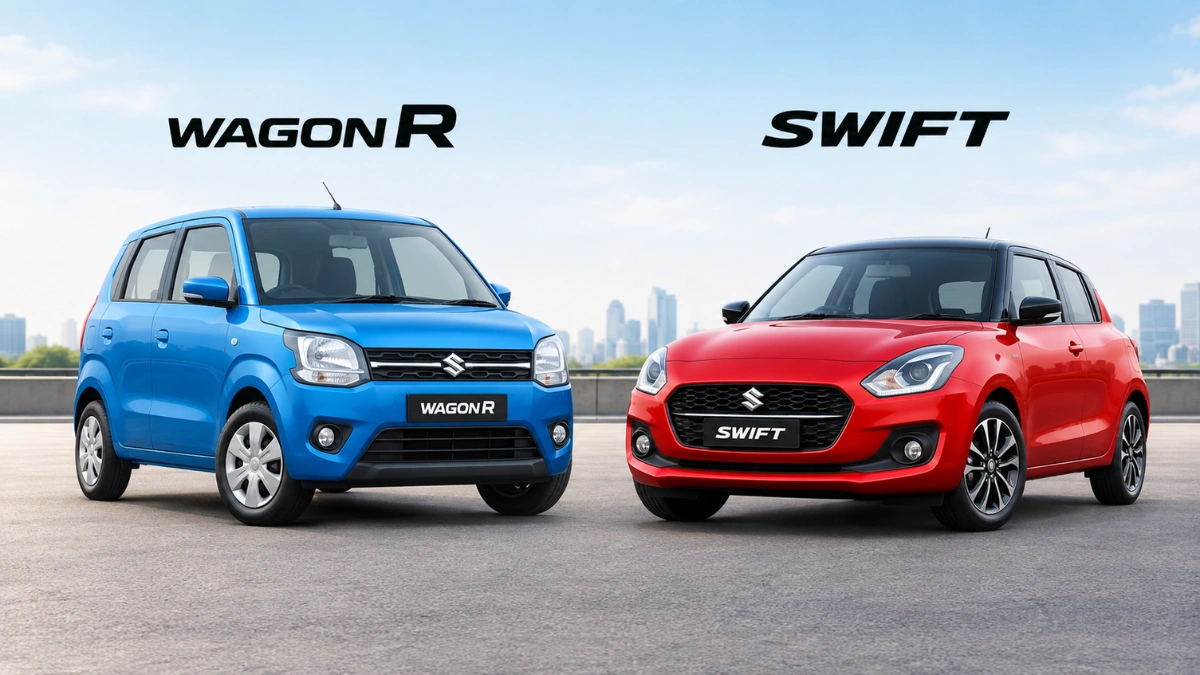
Wagon R vs Swift: Which Is Cheaper to Maintain?
- Cars
- Published: 17 Sep, 2026
Book a Test Drive
Free doorstep test drive at your convenience
When buying a hatchback, the purchase price is only one part of the ownership cost. Fuel, regular servicing, insurance, replacement parts and repairs can make a noticeable difference over several years. The Maruti Wagon R and Maruti Swift are both known for affordable ownership and Maruti Suzuki's widespread service network. However, if your priority is keeping the overall maintenance bill low, the Wagon R generally has an advantage, particularly in its 1.0-litre configuration.
Based on typical maintenance and ownership expenses, a Wagon R can save roughly ₹1,500–₹2,500 per year compared with a comparable Swift. The difference comes mainly from the engine configuration, vehicle weight, consumable requirements and the cost of certain replacement parts.
Let's break down where the difference comes from and whether the Swift's additional ownership cost is significant enough to matter.
Wagon R vs Swift Maintenance Cost at a Glance
Actual costs vary according to variant, usage, location, service centre, parts replaced and insurance policy.
1. Which Is Cheaper to Buy: Wagon R or Swift?
The cost advantage of the Wagon R starts before you even take the car home. The Maruti Wagon R starts at around ₹4.99 lakh ex-showroom, while the Maruti Swift starts at around ₹5.84 lakh ex-showroom. That means the entry-level Wagon R is roughly ₹85,000 cheaper than the entry-level Swift. A lower purchase price can also influence other ownership expenses. Depending on the variant and policy, the lower vehicle value can result in a lower insurance premium. Buyers financing the car will also generally have a smaller loan amount and, consequently, a lower EMI.
However, purchase price alone does not determine which car is cheaper over five years. The recurring costs are more important for a long-term ownership comparison.
2. Wagon R vs Swift: Annual Service Cost
This is where the Wagon R starts showing a clearer advantage. Both cars follow Maruti Suzuki's periodic service schedule, with servicing generally required around every 10,000 km or 12 months, depending on the applicable maintenance schedule.
For an average city user:
- Wagon R 998cc: Around ₹4,000–₹6,000 per year
- Swift 1197cc: Around ₹6,000–₹8,000 per year
This puts the typical annual difference at approximately ₹2,000. Over one year, that may not seem significant. But when the same difference is repeated across several years, it becomes more noticeable.
Five-Year Maintenance Cost
Over a standard 5-year/50,000 km ownership cycle, scheduled maintenance for the 1.0-litre Wagon R can work out to approximately ₹16,000–₹18,000. For the Swift, the corresponding figure is around ₹22,000–₹25,000. Therefore, the Wagon R could save approximately ₹6,000–₹9,000 in scheduled maintenance over five years, before accounting for unexpected repairs or wear-and-tear replacements.
3. Why Is the Wagon R Cheaper to Maintain?
The biggest factor is the engine configuration.
The entry-level Wagon R uses a 998cc, 3-cylinder petrol engine. Its smaller displacement means certain consumables, including engine oil and filters, can be relatively economical. The Swift, meanwhile, uses a 1.2-litre 3-cylinder Z-Series petrol engine. The difference isn't simply about the number of cylinders. The overall specification, parts used and vehicle positioning also influence maintenance costs. The Wagon R is designed primarily around practical and economical ownership. The Swift sits a little higher in the hatchback hierarchy, with a more premium positioning and a sportier design. This can result in certain replacement components costing more on the Swift.
4. What Happens If You Buy a 1.2-Litre Wagon R?
This is an important point that buyers sometimes overlook. Not every Wagon R has the smaller 998cc engine. Higher-spec Wagon R variants can also be equipped with the 1197cc, 1.2-litre engine.
That changes the maintenance comparison. If you compare a 1.2-litre Wagon R with the Swift, the maintenance difference becomes smaller because the two cars share the same basic engine displacement.
Therefore, the statement that "Wagon R is cheaper to maintain" is most applicable when comparing the 1.0-litre Wagon R with the Swift. If you're specifically considering the 1.2-litre Wagon R, compare the actual variant-specific service and parts costs rather than assuming the 1.0-litre Wagon R's maintenance advantage will remain unchanged.
5. Spare Parts and Repair Costs
Routine servicing isn't the only maintenance expense. Eventually, every car needs replacement parts such as brake pads, tyres, suspension components, filters and other wear-and-tear items. The Swift's positioning as a more premium hatchback means some components can cost more than comparable components on the basic Wagon R.
For certain parts, the difference can be in the region of 10–15%, although actual prices depend on the specific part, variant and service centre.
The Wagon R also benefits from its relatively light construction. Lower weight can reduce the stress placed on components such as tyres, brakes and suspension under normal driving conditions. This doesn't mean Swift components wear out quickly. Rather, the Wagon R's simpler and lighter configuration can make its long-term running expenses slightly easier on the pocket.
6. Wagon R vs Swift: Which Gives Better Mileage?
Fuel is usually the biggest recurring expense for a car owner, so mileage needs to be considered alongside maintenance. Interestingly, there isn't a huge difference between these two cars. The Wagon R petrol manual is rated at up to 24.35 kmpl, while the Swift's petrol version is rated at up to 24.8 kmpl.
That means the Swift actually has a slight claimed mileage advantage on petrol. For CNG buyers, the Wagon R is rated at up to 34.01 km/kg, while the Swift CNG is rated at around 32.85 km/kg.
Does the Mileage Difference Change the Ownership Calculation?
For most buyers, the difference is unlikely to completely change the maintenance equation.
Real-world mileage depends on traffic, driving style, road conditions, passenger load, tyre pressure and air-conditioner usage. So the ARAI figures should not be treated as guaranteed everyday mileage. The important takeaway is that both cars are highly fuel-efficient, and fuel consumption alone doesn't create a major ownership-cost gap between them.
7. Insurance Cost: Wagon R vs Swift
Insurance is another recurring ownership expense.
The Wagon R generally has an advantage because of its lower purchase price, particularly when comparing similar entry-level configurations. Typical comprehensive insurance for a Wagon R can be around ₹5,000–₹8,000 annually, while the Swift can cost roughly ₹1,500–₹3,000 more per year, depending on factors such as the variant, IDV, location, insurer and selected coverage. The larger engine and higher vehicle value of the Swift can contribute to the difference.
However, insurance quotes can vary considerably, so buyers should compare actual premiums for their specific variant rather than relying solely on a generic annual estimate.
8. Does Swift Have Higher Resale Value?
Maintenance cost is only one side of ownership. Depreciation also affects the total amount of money you spend on a car.
Both the Wagon R and Swift have strong demand in India's used-car market.
A well-maintained 5-year-old Wagon R with around 60,000 km can potentially command around ₹3.50 lakh–₹4.25 lakh, depending heavily on condition, variant, location and market demand. A similar-age Swift can potentially fetch around ₹4.50 lakh–₹5.50 lakh. The Swift's higher original purchase price means its used-car value can also be higher in absolute terms. Therefore, you shouldn't automatically conclude that a higher resale price means lower depreciation. What matters is the difference between what you paid for the car and what you eventually sell it for.
9. Wagon R vs Swift: Running Cost Over Five Years
When all the major expenses are considered, the ownership picture becomes clearer.
Wagon R
The Wagon R benefits from:
- Lower initial purchase price
- Lower routine maintenance
- Relatively inexpensive consumables
- Strong fuel efficiency
- Lower insurance cost in many configurations
- Wide availability of service centres and parts
Its 1.0-litre version is particularly suited to buyers who want to keep routine ownership expenses as low as possible.
Swift
The Swift brings:
- Comparable petrol fuel efficiency
- Strong service network
- Higher-positioned cabin and design
- A more premium hatchback experience
- Good resale demand
- Standard safety equipment including 6 airbags
The additional maintenance expense is therefore not simply money spent on servicing. A buyer is also paying for the Swift's different design, positioning and overall package.
10. Is the Swift ₹2,000 More Expensive to Maintain Worth It?
This ultimately depends on what you want from your hatchback of Maruti Suzuki.
If your primary objective is minimum ownership cost, the Wagon R makes more sense, particularly the 1.0-litre version. Its lower service costs, lower insurance expense and affordable consumables can make it easier to run over several years.
But if you're comfortable spending around ₹1,500–₹2,500 more per year and want a more premium-looking hatchback with a different cabin experience and the Swift's overall package, the additional maintenance expense may be relatively small compared with your total ownership cost.
Over five years, a ₹2,000 annual difference would amount to roughly ₹10,000. In the context of a car costing several lakh rupees, that isn't necessarily a deciding factor for every buyer.
11. Which One Should You Choose for Lower Running Costs?
Choose the Wagon R if:
- Your priority is low maintenance cost
- You mainly drive in the city
- You want a lower initial purchase price
- You want inexpensive routine servicing
- You are considering the 1.0-litre petrol/CNG configuration
- You want to keep insurance and running expenses under control
Consider the Swift if:
- You want a more premium hatchback experience
- You prefer its design and cabin
- You want comparable petrol fuel efficiency
- You value its standard 6-airbag setup
- You are comfortable with slightly higher service and insurance costs
- Resale demand is an important part of your ownership calculation
Final Verdict: Wagon R vs Swift Maintenance Cost
If the question is simply "Which is cheaper to maintain?", the cost structure points toward the Maruti Wagon R, especially in its 998cc configuration.
Its lower scheduled service expenses, cheaper consumables, lower insurance costs and efficient CNG option can make it a more economical choice for buyers focused on long-term running costs. The Maruti Swift, however, isn't an expensive car to maintain in absolute terms. Its annual maintenance difference compared with the Wagon R is relatively modest, while it offers a more premium hatchback experience and similarly strong fuel efficiency.
So the practical way to look at it is:
Wagon R = lower-cost ownership priority
Swift = slightly higher ownership cost for a more premium hatchback package
For buyers choosing strictly on maintenance and running expenses, the Wagon R has the cost advantage. For buyers who are willing to spend a little more on ownership for the Swift's overall package, the maintenance difference alone is unlikely to be the only factor worth considering.
Book a Test Drive
Free doorstep test drive at your convenience
Popular Brands





Latest Car News
Wagon R vs Swift: Which Is Cheaper to Maintain?
BMW 7 Series Facelift Interior Updates: Know Everything
How to Check Oil Level in Car: Step-by-Step Guide
Latest Cars Under ₹5 Lakh in India in September 2026
Maruti Alto K10 September Offers: Get Up to ₹62,500 Savings on Purchase
Tata Tigor Facelift Under ₹6 Lakh: A New Budget Sedan Is Coming
Hyundai Creta August 2026 Sales: With 16,288 Units Becomes India's Best-Selling Mid-Size SUV
Maruti Baleno Facelift Booking Price: Expected Booking Amount, EMI & Loan Calculation
Kia Sorento 6 Seater vs 7 Seater: Which One Should You Choose?

Kia Sorento AI Assistant Explained: Features, Commands, and Indian Language Support
What Is the Difference Between Tata Curvv and New Curvv Series X?
Tata Car Sales August 2026: Model-Wise Sales & Growth Report
Car Sales Report of August 2026: Tata Motors, Maruti, Mahindra Lead Growth
Pajero 2026 vs Fortuner: Which SUV Could Be Better?
Volvo EX90 Booking Price: Expected Booking Amount, EMI & Loan Calculation

Next Generation Tata Nexon 2027: Expected Launch, Price, Design & Features
MG Hector Tomahawk EV Variant-Wise Price & Features Comparison
Maruti Baleno Facelift vs Toyota Glanza: Complete Comparision
Upcoming Cars in September 2026 in India: New Cars, Launch Dates & Expected Prices
MG Hector Hawk SUV vs Tata Harrier: Expected Price, Features & Key Differences